
The World Cup 2026 teams list is bigger, broader and more unpredictable than any previous men’s World Cup. For the first time, 48 national teams will compete across Canada, Mexico and the United States, creating a tournament path with more pressure points, more qualification routes and more room for surprises.
The 2026 FIFA World Cup features 48 teams, including host nations Canada, Mexico and the United States. The other 45 places were decided through regional qualification routes across FIFA’s confederations, before the teams entered a final tournament with 12 groups of four and a 32-team knockout stage.
That matters for fans, but it also matters for anyone following World Cup betting markets. More teams means more qualification stories, more group-stage combinations, more futures markets and more chances for sportsbooks to misprice public favourites, debut nations or countries coming from less familiar qualification routes.
This guide explains which countries are in the 2026 FIFA World Cup, how they qualified, what the host nations’ automatic places mean, and how the expanded tournament path can affect group-stage expectations.
For the full format breakdown, including the Round of 32 and knockout structure, read Go Spin Casino’s World Cup 2026 Format Explained guide.
Table of contents
- Quick answer: which teams are in the World Cup 2026?
- World Cup 2026 qualified teams tracker
- How many teams will play in the World Cup 2026?
- Who are the World Cup 2026 host countries?
- Which teams have qualified for the World Cup 2026?
- How World Cup qualification works by confederation
- How the 48-team format changes the tournament path
- What qualified teams mean for group and betting markets
- Responsible gambling during the World Cup
- What This Means for Fans and Bettors
- FAQs about World Cup 2026 teams
Quick answer: which teams are in the World Cup 2026?
The World Cup 2026 includes 48 teams from six FIFA confederations. Canada, Mexico and the United States qualified automatically as host nations. The remaining 45 places were decided through regional qualification routes. FIFA confirmed 1,248 players across the final squads.
The expanded field is split into 12 groups of four. The top two teams from each group advance, along with the eight best third-placed teams. That creates a Round of 32 before the traditional knockout path continues toward the final.
For readers tracking the tournament from a betting angle, qualification route and team reputation only tell part of the story. A country’s group draw, travel schedule, squad depth and route into the Round of 32 can matter just as much as its headline ranking.
World Cup 2026 qualified teams tracker
The confirmed 2026 World Cup field includes 48 countries. The clearest way to read the tournament is by confederation, because it shows where each team came from and why this edition feels more global than the 32-team format used between 1998 and 2022.
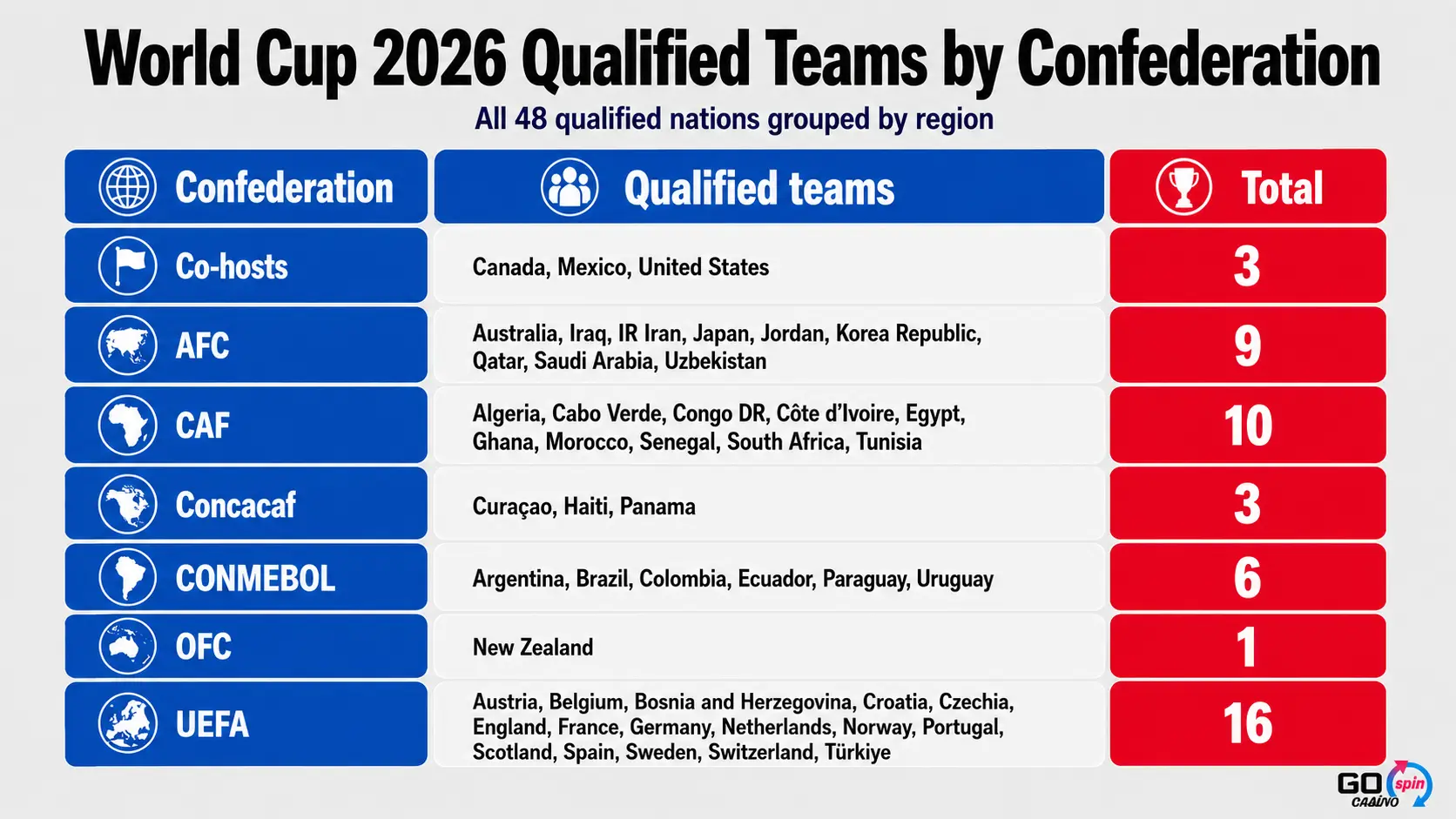
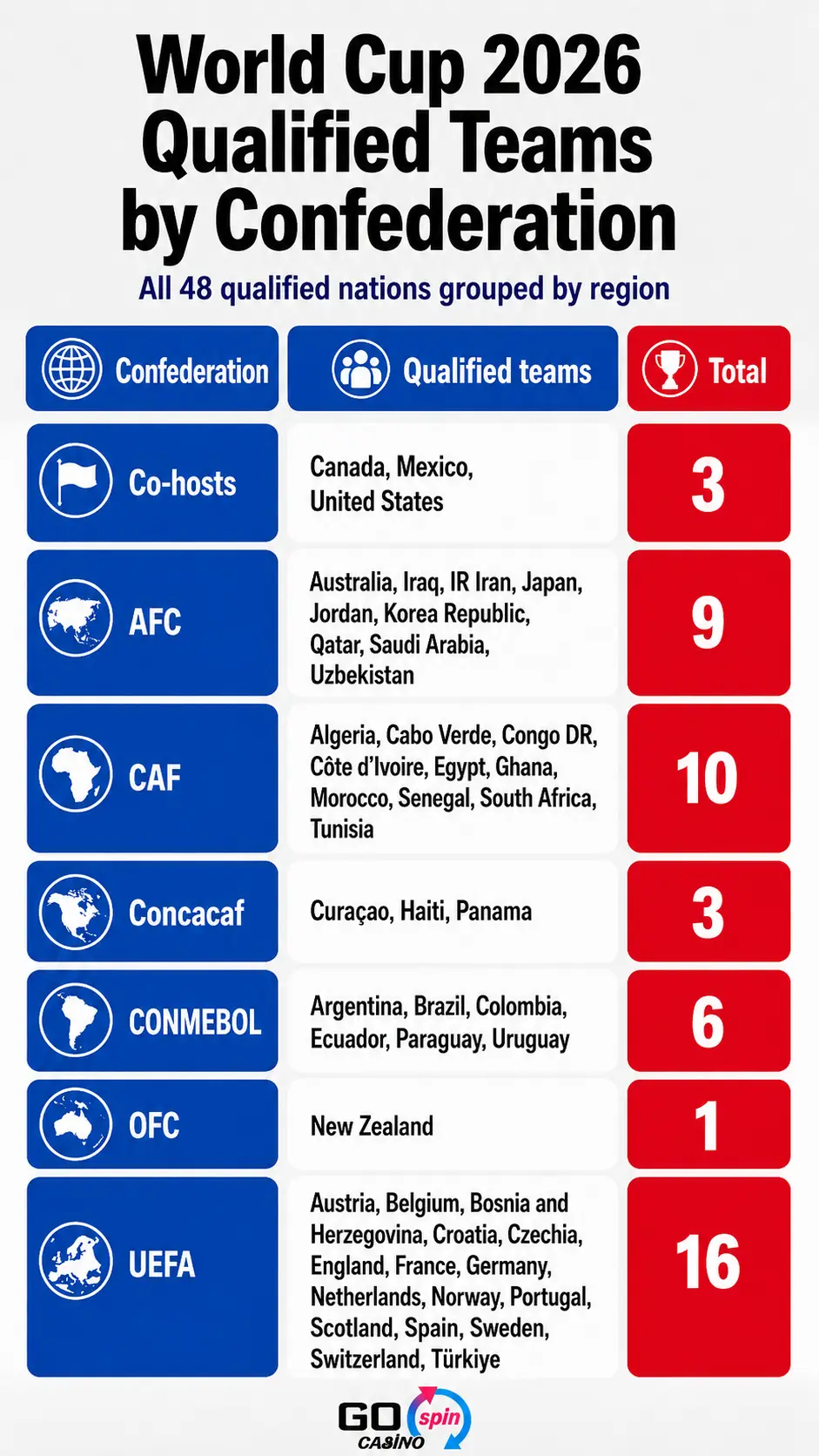
The list shows why old tournament assumptions need updating. This field includes traditional World Cup powers, host nations, debutants, returning countries and teams from regions that previously had a much narrower route into the final tournament.
A big-name country still brings talent, experience and market attention. That doesn’t automatically mean its route through the group will be smooth. A smaller or less familiar team can still be tactically disciplined, hard to price and awkward in a short tournament. In a World Cup with 12 groups and a Round of 32, survival matters almost as much as dominance.
How many teams will play in the World Cup 2026?
The 2026 tournament features 48 teams, up from 32 in the previous format. That expansion adds 16 more countries and creates the biggest men’s World Cup in history.
The structure changes the rhythm of the competition. Instead of eight groups of four, there are 12 groups of four. 64 matches rather than 104. Instead of moving from the group stage straight into a Round of 16, the competition now introduces a Round of 32.
For fans, that means more football. For bettors, it means more markets, more data points and more volatility. More teams can create obvious mismatches, but it can also create awkward fixtures where the market leans too heavily on reputation, rankings or public demand.
The expanded field also makes squad depth more relevant. Teams that can manage travel, rotation, injuries and pressure over a longer tournament may have an edge that isn’t obvious from the opening odds. The teams list should be read alongside the format, group draw and knockout path.
Who are the World Cup 2026 host countries?
The host countries are Canada, Mexico and the United States. All three qualified automatically, which removed the pressure of regional qualification but added a different kind of expectation once the tournament began.
The tournament is spread across 16 host cities in North America. Canada hosts matches in Toronto and Vancouver. Mexico hosts matches in Mexico City, Guadalajara and Monterrey. The United States hosts matches in Atlanta, Boston, Dallas, Houston, Kansas City, Los Angeles, Miami, New York/New Jersey, Philadelphia, San Francisco Bay Area and Seattle.
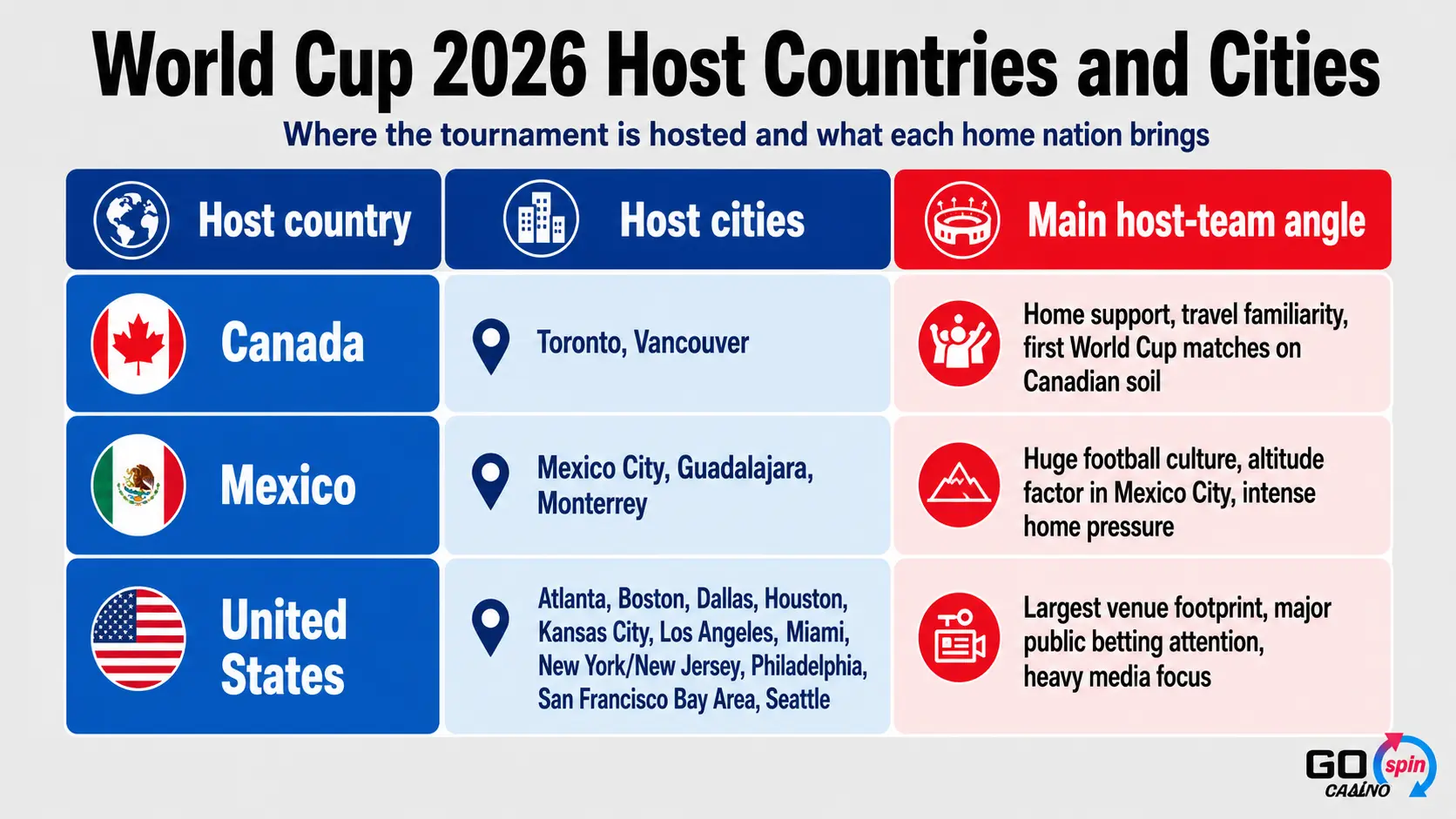
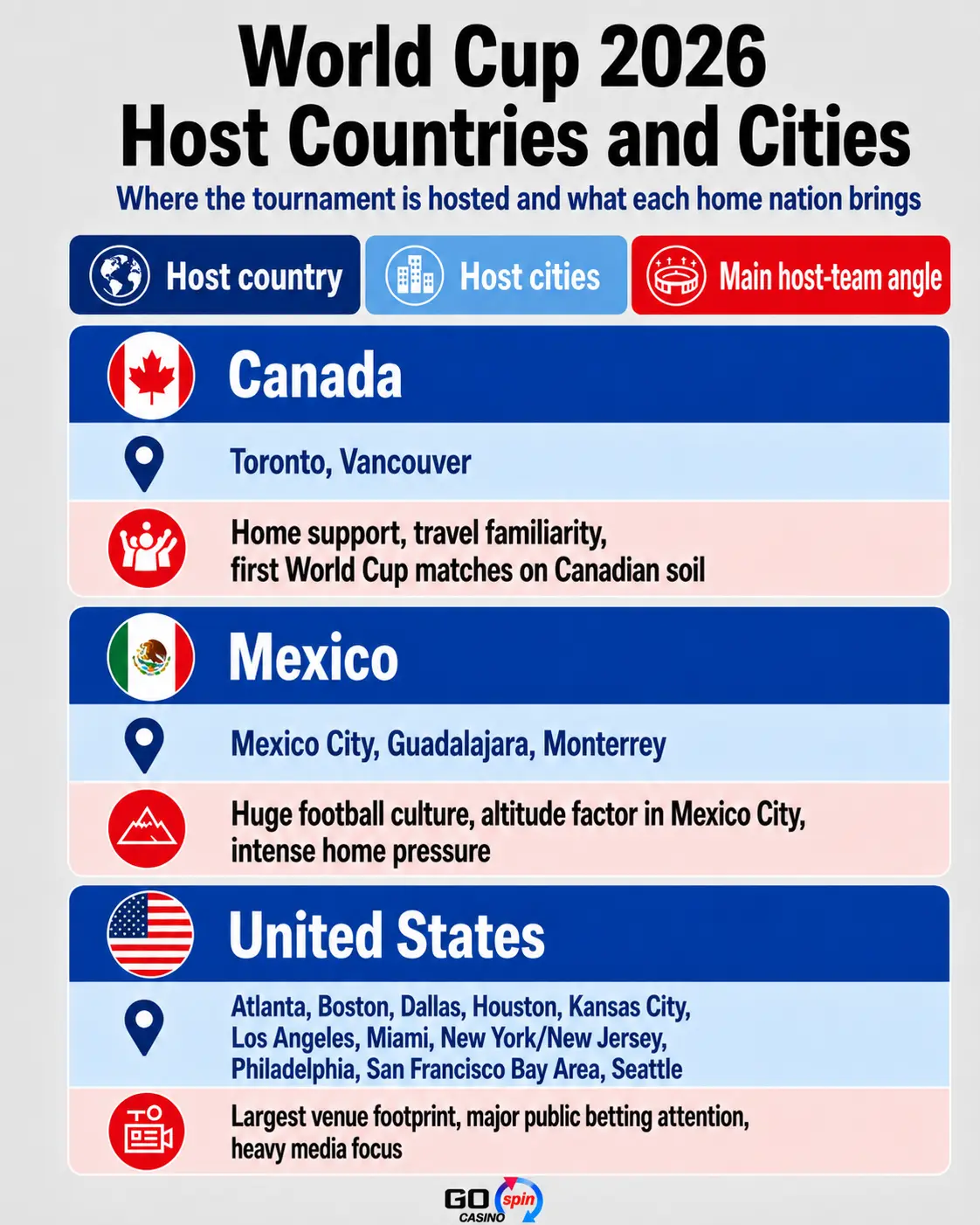
Mexico opened the tournament against South Africa at Mexico City Stadium on June 11, the first of 104 matches. Canada’s first match is against Bosnia and Herzegovina at Toronto Stadium, while the United States opens against Paraguay at Los Angeles Stadium.
Those openers matter because each host starts under a different kind of pressure: Canada chasing a statement on home soil, Mexico carrying a fierce football culture, and the United States playing under one of the brightest media spotlights of the tournament.
Host status matters because home advantage is rarely only about the pitch. It affects travel, fan support, preparation, media pressure and public betting behaviour. A host team can receive strong market attention, especially from recreational bettors, even when its group path is more difficult than the badge suggests.
That does not mean host nations should automatically be backed or faded. It means their prices need extra scrutiny. When a team attracts emotional support, sportsbooks know it. In major tournaments, popular teams can become expensive quickly.
Which teams have qualified for the World Cup 2026?
All 48 teams are confirmed. The field is best understood through three practical groups: host nations, established tournament powers, and story teams that bring debut or return narratives into the competition.
Host nations
Canada, Mexico and the United States qualified automatically as co-hosts. Their place in the competition was secured before the rest of the qualification process played out.
The hosts deserve a separate read because their tournament profile is different. They avoided qualifying pressure, but they carry home expectations, stadium attention and heavier public narratives. Canada will want a breakthrough moment, Mexico will expect to use its football culture as an edge, and the United States will attract one of the strongest media and betting spotlights of the tournament.
Established contenders
Argentina, Brazil, France, Germany, Spain, England, Portugal, Netherlands, Uruguay and Belgium are among the countries that will attract heavy attention because of their tournament history, squad depth or public profile.
That kind of reputation matters, but it can also distort the market. Argentina arrive as defending champions. Brazil, Germany and France always bring major brand weight. England and Portugal tend to attract strong betting volume because of player familiarity. Spain and the Netherlands carry tactical respect. Uruguay and Belgium bring tournament credibility but different questions around squad cycle and consistency.
For bettors, the useful question is not just whether a country is good. It is whether the price reflects the actual path. A favourite with a difficult group, heavy travel and a demanding Round of 32 route is a very different proposition from the same favourite in a softer bracket.
Debut and return story teams
Cabo Verde, Curaçao, Jordan and Uzbekistan are among the debut nations in 2026. Norway, Algeria, Haiti, Iraq and Türkiye are among the countries returning after missing recent editions or spending years outside the World Cup spotlight.
These teams create useful context for fans and bettors. Debutants can be hard to price because there is less World Cup history to rely on. Returning nations can attract emotional attention, especially when public memory is based on older squads rather than current tournament quality.
The smarter read comes from matching story with structure: group opponents, tactical profile, squad depth and schedule.
How World Cup qualification works by confederation
World Cup qualification is divided by FIFA confederation. Each region has its own allocation, competitive structure and route into the final tournament.
UEFA qualification is usually deep and unforgiving because Europe has a large number of competitive national teams. With 16 UEFA teams in the final tournament, Europe still has the largest representation, but the path remains shaped by group performance and playoff pressure.
CONMEBOL qualification is smaller but demanding. South American teams play repeated high-pressure fixtures against familiar opponents, often with difficult travel and hostile away environments. Teams that survive that route are rarely soft.
AFC qualification covers a huge geographic and tactical range. The nine Asian qualifiers include experienced World Cup regulars and less familiar teams entering the tournament with fewer global assumptions attached to them. That can create uneven public perception.
CAF qualification is intense because African football has significant depth and often produces volatile match environments. The expanded field gives Africa 10 teams at this World Cup, which makes the edition more representative and more tactically varied.
Concacaf qualification in 2026 is unusual because Canada, Mexico and the United States qualified automatically as hosts. That changed the competitive route for the remaining regional teams and opened space for Curaçao, Haiti and Panama to reach the final tournament.
OFC qualification gives New Zealand a direct place, which changes the usual conversation around Oceania representation.
The intercontinental playoff route also matters because teams that arrive through playoffs may carry recent pressure experience. They can also enter the tournament with sharper competitive rhythm than teams that qualified earlier and spent more time in friendlies.
Taken together, those routes explain why the final field should not be judged as one flat list. A country’s confederation, qualification pressure and preparation path can all shape how it enters the group stage.
For bettors, this affects match betting, totals, team goals, live betting, and qualification markets. For a deeper breakdown of group-stage scenarios, tiebreakers, and third-place qualification, read the World Cup 2026 groups explained guide.
How the 48-team format changes the tournament path
The expanded format changes how teams manage the group stage. With a Round of 32 now sitting between the groups and the deeper knockout rounds, the first target for many countries is survival rather than dominance.
That can change match behaviour. A favourite may rotate after securing qualification. A defensive underdog may protect goal difference instead of chasing an open game. A third-place contender may treat a draw like a strong result if the wider table is breaking in its favour.
For a deeper breakdown of odds, group markets, futures and live betting, read Go Spin Casino’s World Cup 2026 Betting Guide.
What qualified teams mean for group and betting markets
The confirmed field creates a much broader betting board than previous editions. More countries means more group betting, more qualification markets, more futures options and more opportunities for sportsbooks to adjust prices around public demand.
The biggest mistake is treating the qualified teams list like a power ranking. It is not. A tournament market is not only about which team is strongest on paper. It is about route, timing, squad health, travel, group balance and price.


The expanded format also makes group-stage betting more layered. A team might not win its group but could still be a strong qualification bet. Another team might be overrated in outright markets but useful in a narrow matchup. A third team might be dangerous live if it starts slowly but has strong attacking depth.
That is why the best World Cup betting approach usually starts with structure, not hype. Understand the teams, then the groups, then the prices.
Responsible gambling during the World Cup
Major tournaments can make betting feel constant. There are daily matches, emotional storylines, live odds, player props, accumulators and social pressure around big games. With 104 matches on the schedule, the 2026 tournament creates more betting opportunities than any previous World Cup.
That volume can be entertaining, but it can also make poor bankroll decisions easier. World Cup betting should be treated as entertainment, not as a way to chase losses or force action on every match. Setting a fixed budget before the tournament starts is cleaner than deciding stake sizes during a busy matchday. It also helps to avoid betting on teams only because they are popular, familiar or emotionally appealing.
Go Spin Casino recommends checking limits, cooling-off tools and responsible gambling options before using any sportsbook. For more guidance, read our Responsible Gambling Guide.
18+ | Play Responsibly.
What This Means for Fans and Bettors
The expanded World Cup changes the way the tournament should be read. A 48-team field does not just create more matches. It changes the value of survival, squad depth, travel management, third-place scenarios and the way public attention gathers around hosts, giants, debutants and returning nations.
For fans, that makes the tournament richer. There are more stories, more unfamiliar matchups and more national teams with a genuine route into the knockout stage. For bettors, it raises the standard of analysis. A famous shirt can still matter, but the path around that shirt matters more.
Compare Go Spin Casino’s reviewed sportsbook casinos and find the platform that fits your World Cup betting strategy.
FAQs about World Cup 2026 teams
Yes. Canada, Mexico and the United States qualified automatically because they are co-hosting the tournament. Automatic qualification removes the regional qualifying route, but it also brings home pressure, stronger public attention and heavier expectations once the group stage begins.
The 48 qualified teams are Canada, Mexico, United States, Australia, Iraq, IR Iran, Japan, Jordan, Korea Republic, Qatar, Saudi Arabia, Uzbekistan, Algeria, Cabo Verde, Congo DR, Côte d’Ivoire, Egypt, Ghana, Morocco, Senegal, South Africa, Tunisia, Curaçao, Haiti, Panama, Argentina, Brazil, Colombia, Ecuador, Paraguay, Uruguay, New Zealand, Austria, Belgium, Bosnia and Herzegovina, Croatia, Czechia, England, France, Germany, Netherlands, Norway, Portugal, Scotland, Spain, Sweden, Switzerland and Türkiye.
Cabo Verde, Curaçao, Jordan and Uzbekistan are among the men’s World Cup debutants in 2026. Debut nations are especially interesting because they bring new fanbases, unfamiliar matchups and less historical World Cup data for fans, analysts and betting markets.
Teams qualify through regional competitions run within FIFA’s confederations. The three host nations qualified automatically, while the remaining 45 places were decided through confederation qualification routes and playoff paths. Each region has its own allocation and qualification structure.
The 48-team format gives more countries access to the tournament and changes group-stage pressure. With the top two teams from each group and the eight best third-place teams advancing, some teams can survive without finishing first or second. Goal difference, discipline and match management become more important.