
The World Cup 2026 groups feature 48 teams split into 12 groups of four. The top two teams from each group qualify for the Round of 32, along with the eight best third-place teams. That means 32 teams move into the knockout stage, making the group stage longer, more open and more important for fans and bettors.
The useful part isn’t just knowing who plays who. It’s knowing which groups could stay live until Matchday 3, where favourites may be overvalued, and why a country sitting third might still be in a better qualification position than the table first suggests.
For the full tournament structure beyond the group stage, read Go Spin Casino’s World Cup 2026 Format Explained guide.
Table of contents
- All World Cup 2026 groups
- World Cup 2026 Group Betting Context
- Groups to Watch in the World Cup 2026
- How the World Cup 2026 Group Stage Format Works
- Who Qualifies for the Round of 32?
- How Third-Place Teams Can Reach the Round of 32
- What Happens if Teams Finish Level on Points?
- Where Are World Cup 2026 Group Games Played?
- How World Cup 2026 Places Were Distributed by Confederation
- Why the Group Stage Matters for Bettors
- Final Thoughts
- FAQs About World Cup 2026 Groups
All World Cup 2026 groups
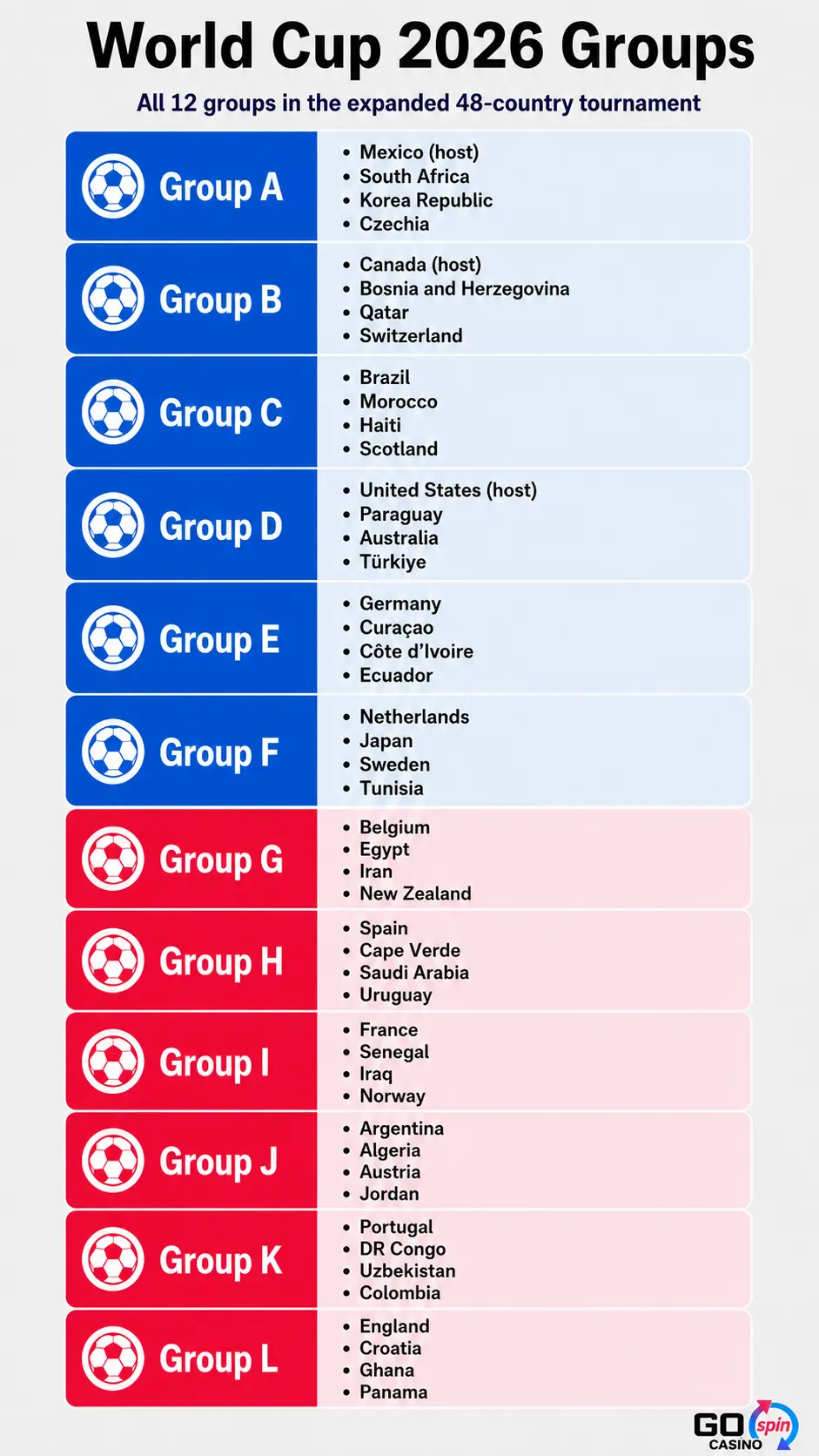
The World Cup 2026 groups are listed below. This is the first thing most fans want to see, and it’s the right place to start before looking at qualification scenarios, third-place routes or betting markets.
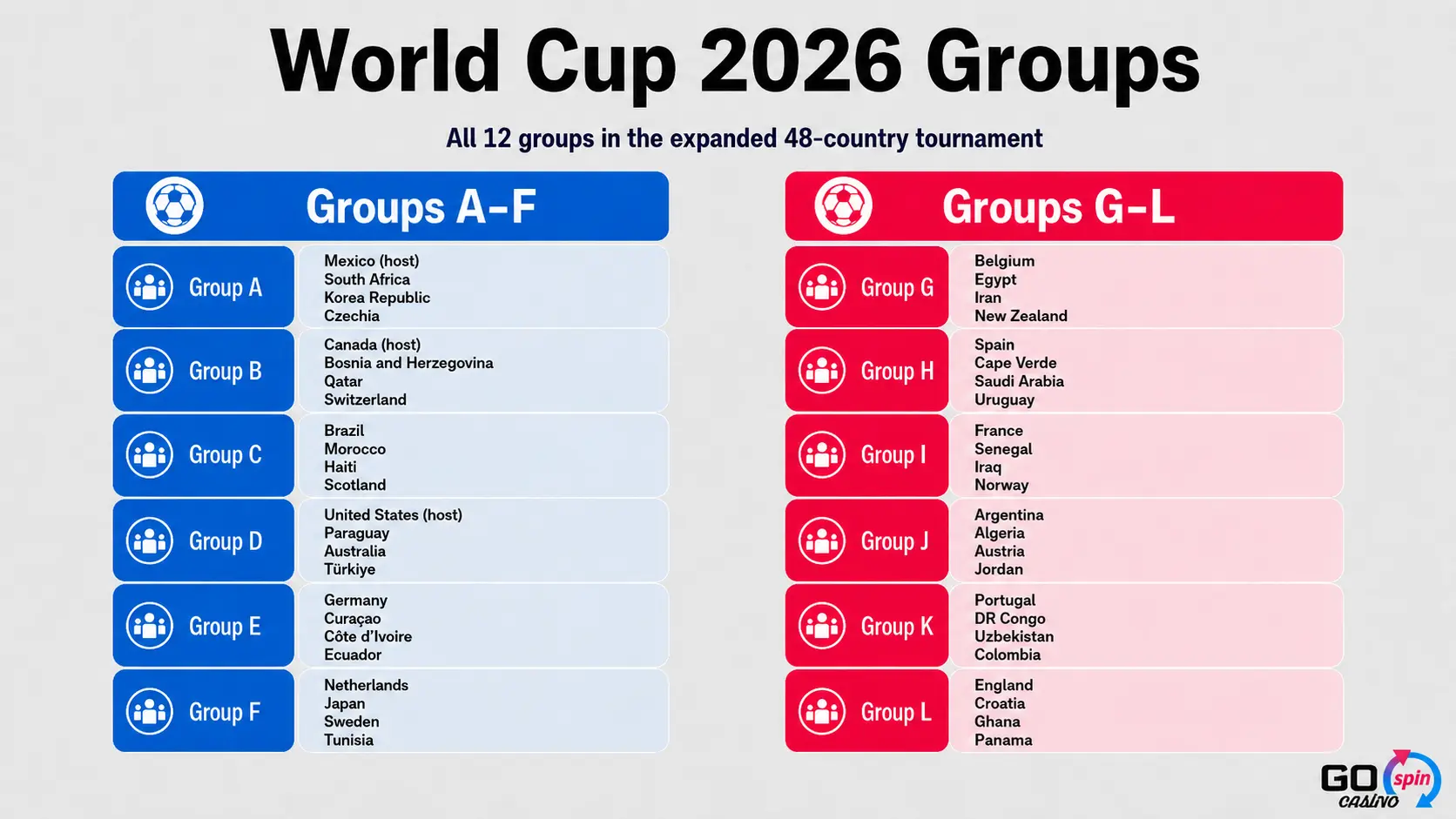
For live tables, points, goal difference and knockout bracket updates once the tournament begins, check FIFA’s official World Cup standings.The 2026 World Cup groups also show how much broader the expanded tournament has become, with more regional variety, more playing styles and more paths into the knockouts.
World Cup 2026 Group Betting Context
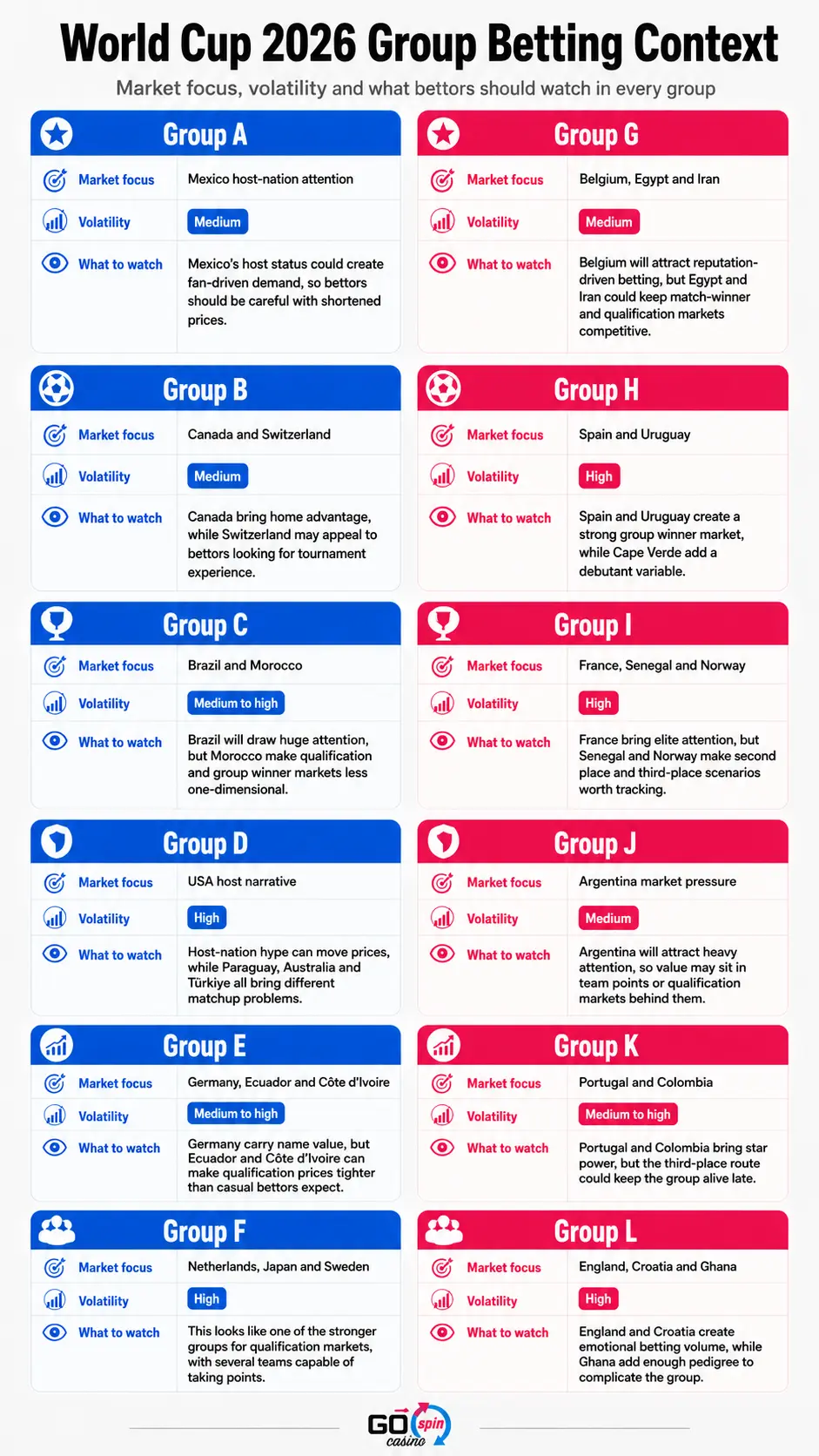
The table below adds Go Spin Casino’s betting context to each group. It is not live odds and should not be treated as sportsbook pricing. The volatility rating is based on competitive balance, fan-driven demand and likely qualification uncertainty.
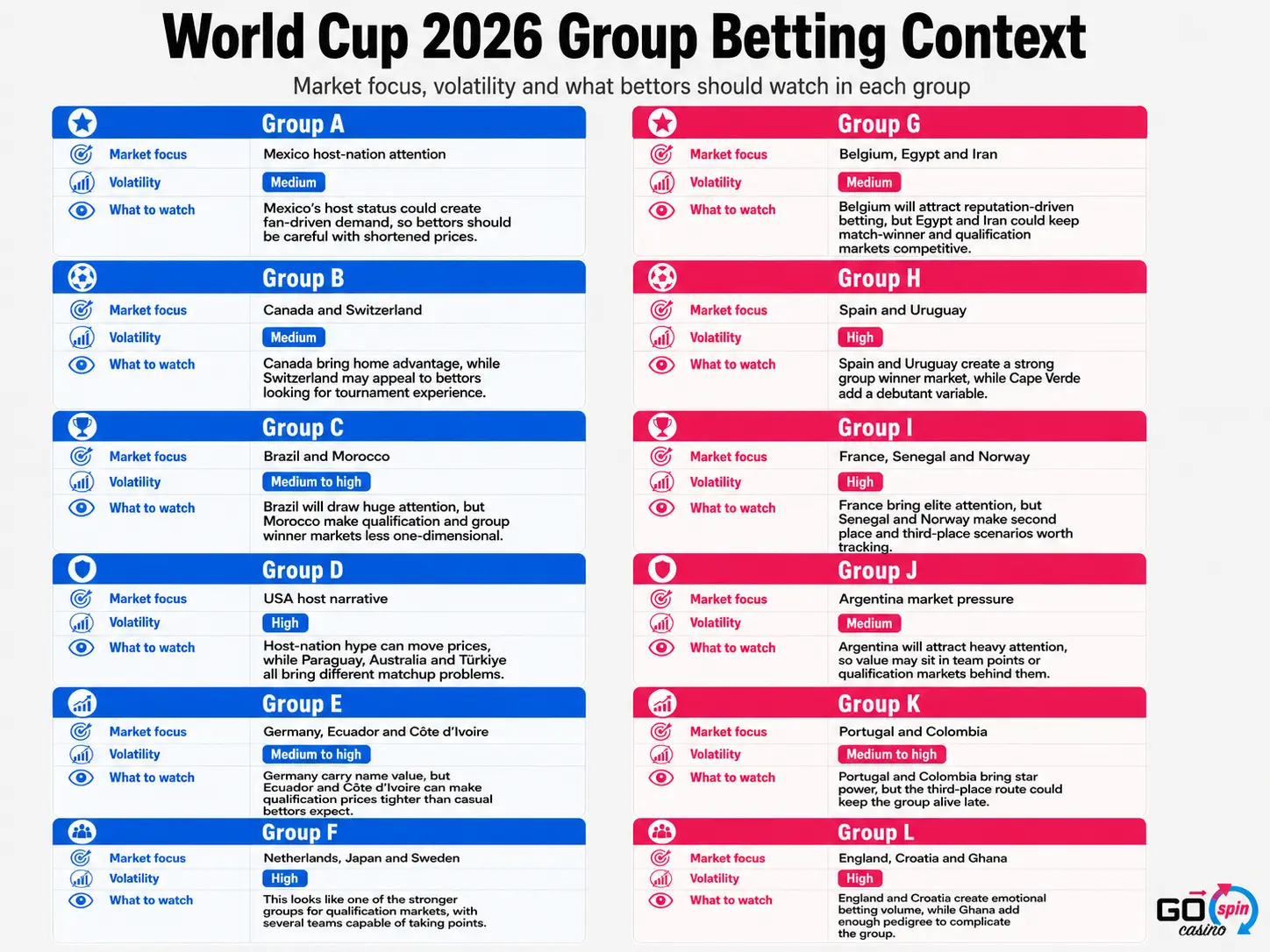
The strongest group-stage read usually comes from looking beyond the biggest badge. The key questions are simple: who needs points, who needs goals, who may rotate, and where could tournament narrative create a bad price?
Groups to Watch in the World Cup 2026
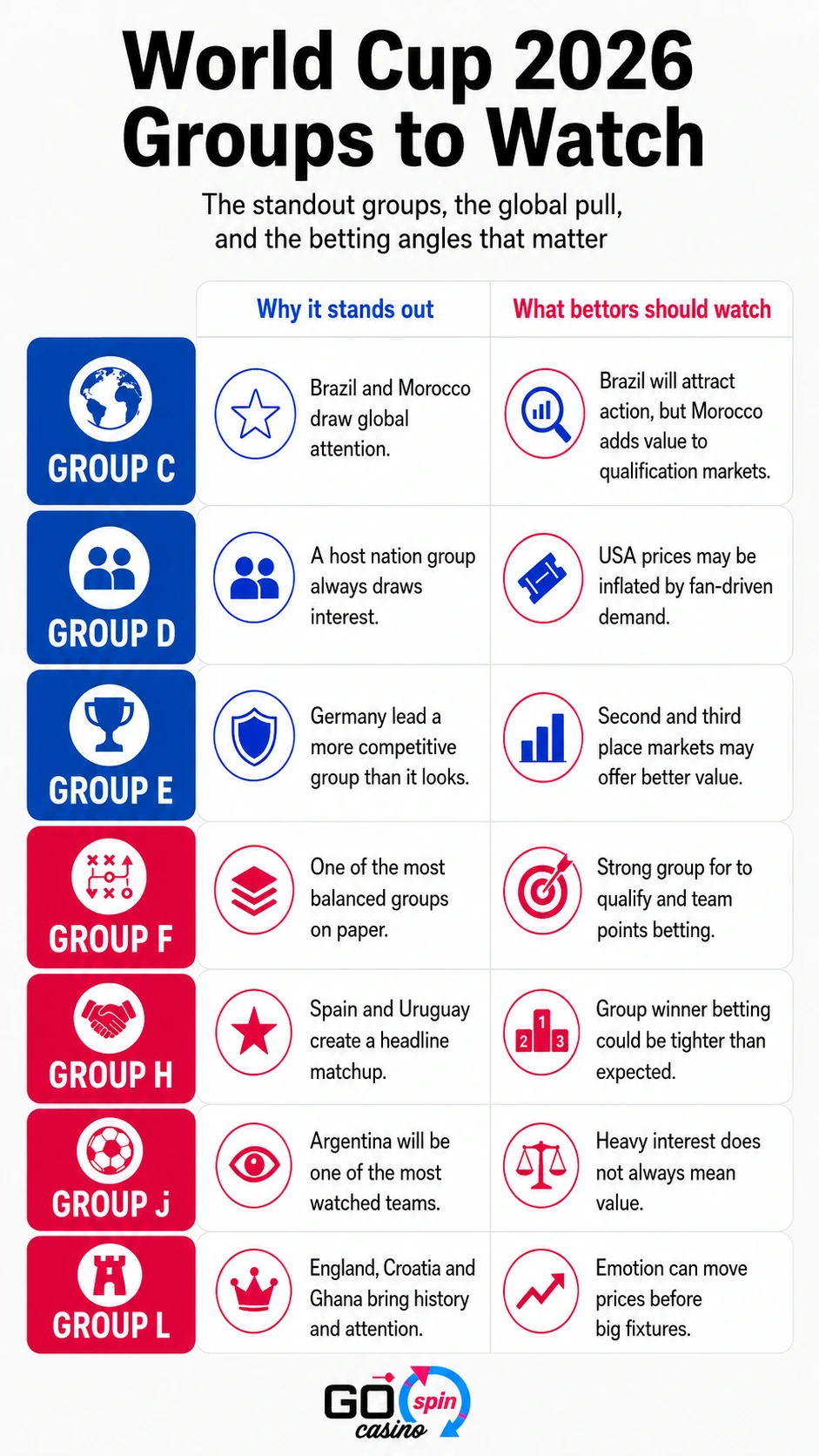
These are not official “groups of death”. They are groups with a strong mix of search interest, betting volume, competitive balance, host-nation attention or likely final-matchday uncertainty.
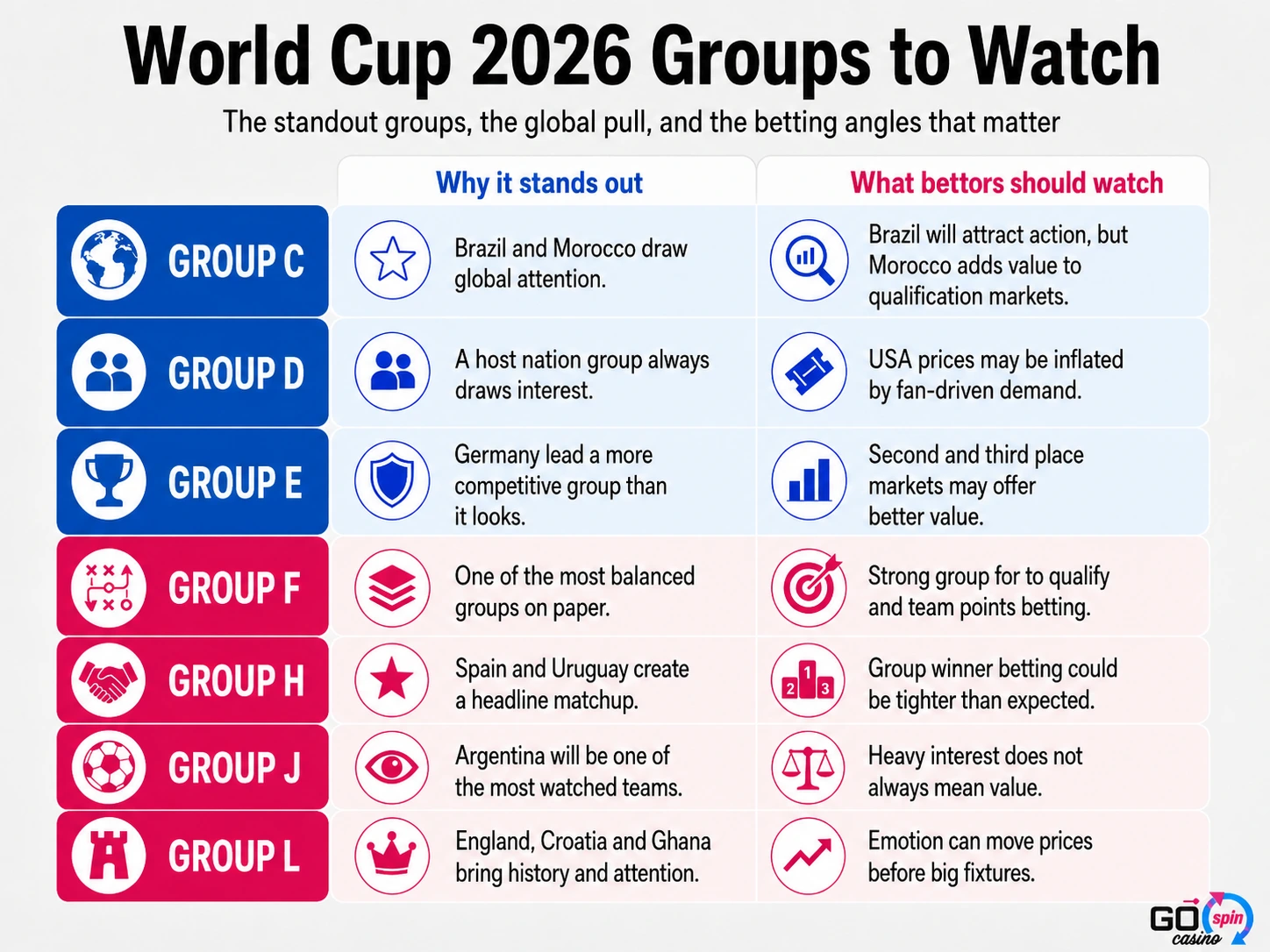
The better betting question isn’t always “who wins the group?” Sometimes it’s “who is priced too short?” or “which team only needs four points to survive?”
How the World Cup 2026 Group Stage Format Works
The World Cup 2026 group stage format has 12 groups, from Group A to Group L. Each group has four teams, and every team plays three matches. A win is worth three points, a draw is worth one and a loss is worth zero.
The top two teams from each group qualify automatically. That creates 24 direct places in the Round of 32. The remaining eight places go to the best third-place teams, which is the major difference from the older 32-team World Cup format.
The 2026 tournament features 104 matches across Canada, Mexico and the United States, making it the largest men’s World Cup so far. FIFA’s official match schedule covers fixtures, host cities and stadium details.
Who Qualifies for the Round of 32?
The top two teams from each World Cup 2026 group qualify automatically for the Round of 32. With 12 groups, that creates 24 automatic knockout places.
The remaining eight places go to the best third-place teams. That means a team does not always need to finish first or second to survive the group stage.
For the complete knockout path after the group stage, including how the Round of 32 connects to the later bracket, read Go Spin Casino’s World Cup 2026 Format Explained guide.
For bettors, this affects match betting, totals, team goals, live betting, and qualification markets. For a deeper breakdown of group-stage scenarios, tiebreakers, and third-place qualification, read the World Cup 2026 groups explained guide.
How Third-Place Teams Can Reach the Round of 32
The group stage is no longer just a top-two race.
In World Cup 2026, 12 teams will finish third in their groups. Eight of them will qualify for the Round of 32, while four will be eliminated. That creates a second table behind the main group standings, because third-place teams are compared across different groups.
This is where small moments can become expensive. A 2-1 defeat may be far better than a 4-0 defeat. A late consolation goal can improve a team’s position among third-place sides. A yellow card can matter if fair play criteria enter the tiebreaker chain.
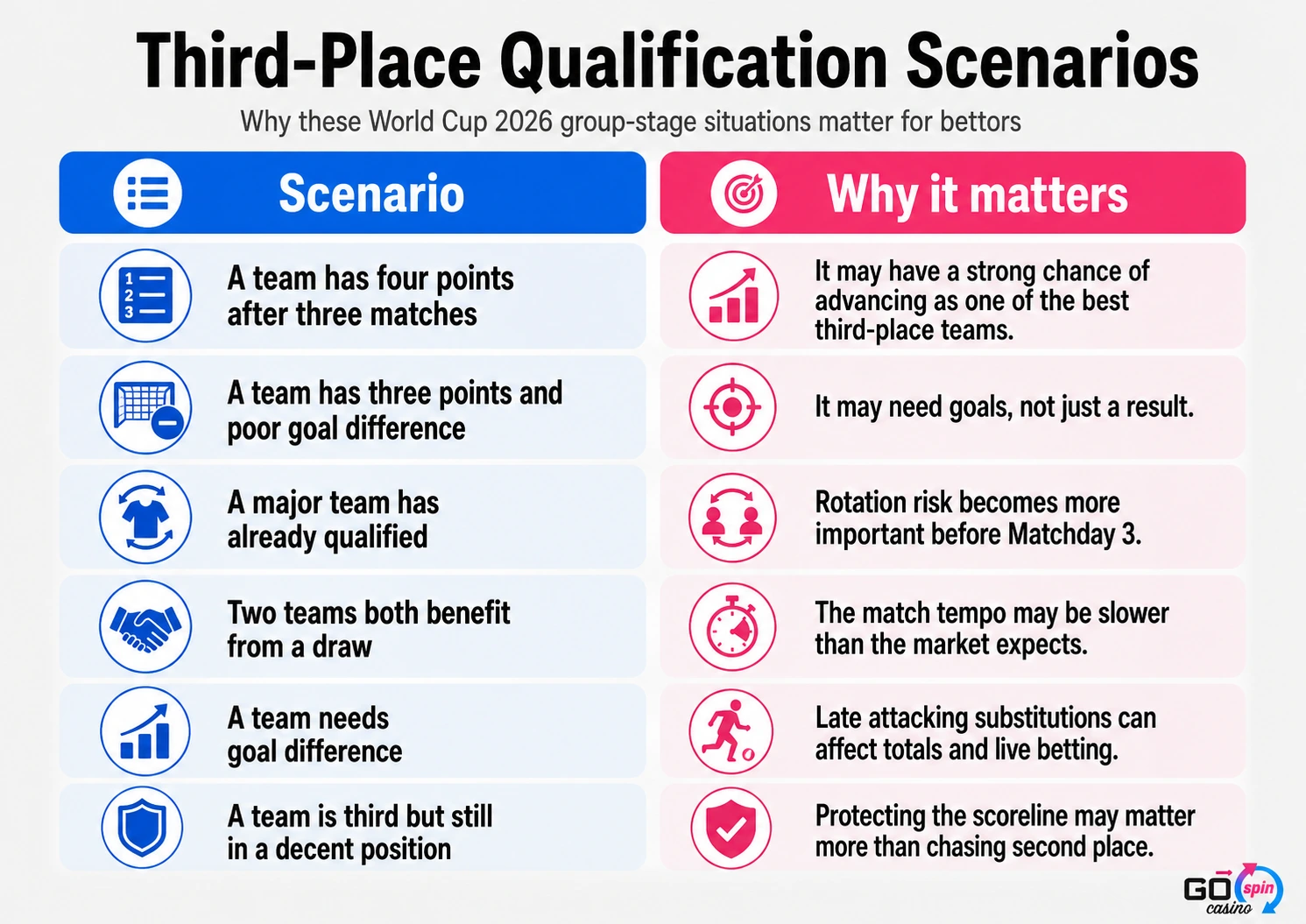
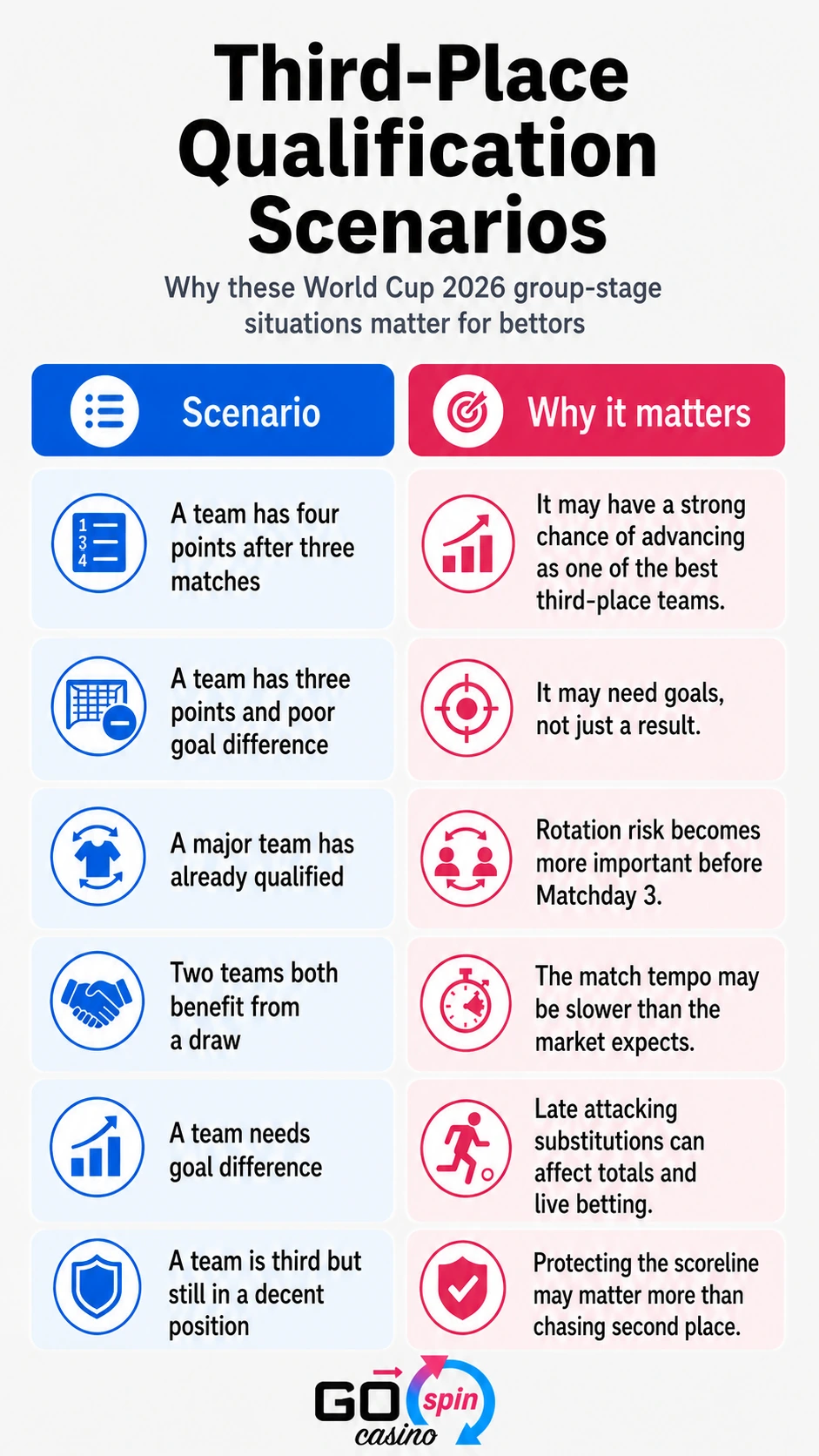
This is where surface-level betting gets expensive. Reputation matters, but the table situation matters more.
For a deeper breakdown of odds, group markets, futures and live betting, read Go Spin Casino’s World Cup 2026 Betting Guide.
What Happens if Teams Finish Level on Points?
If teams finish level on points, FIFA uses tiebreakers to separate them. The first checks are overall points, goal difference and goals scored. If teams are still tied, FIFA moves into criteria involving the matches between the tied teams, then fair play and, if needed, drawing of lots.
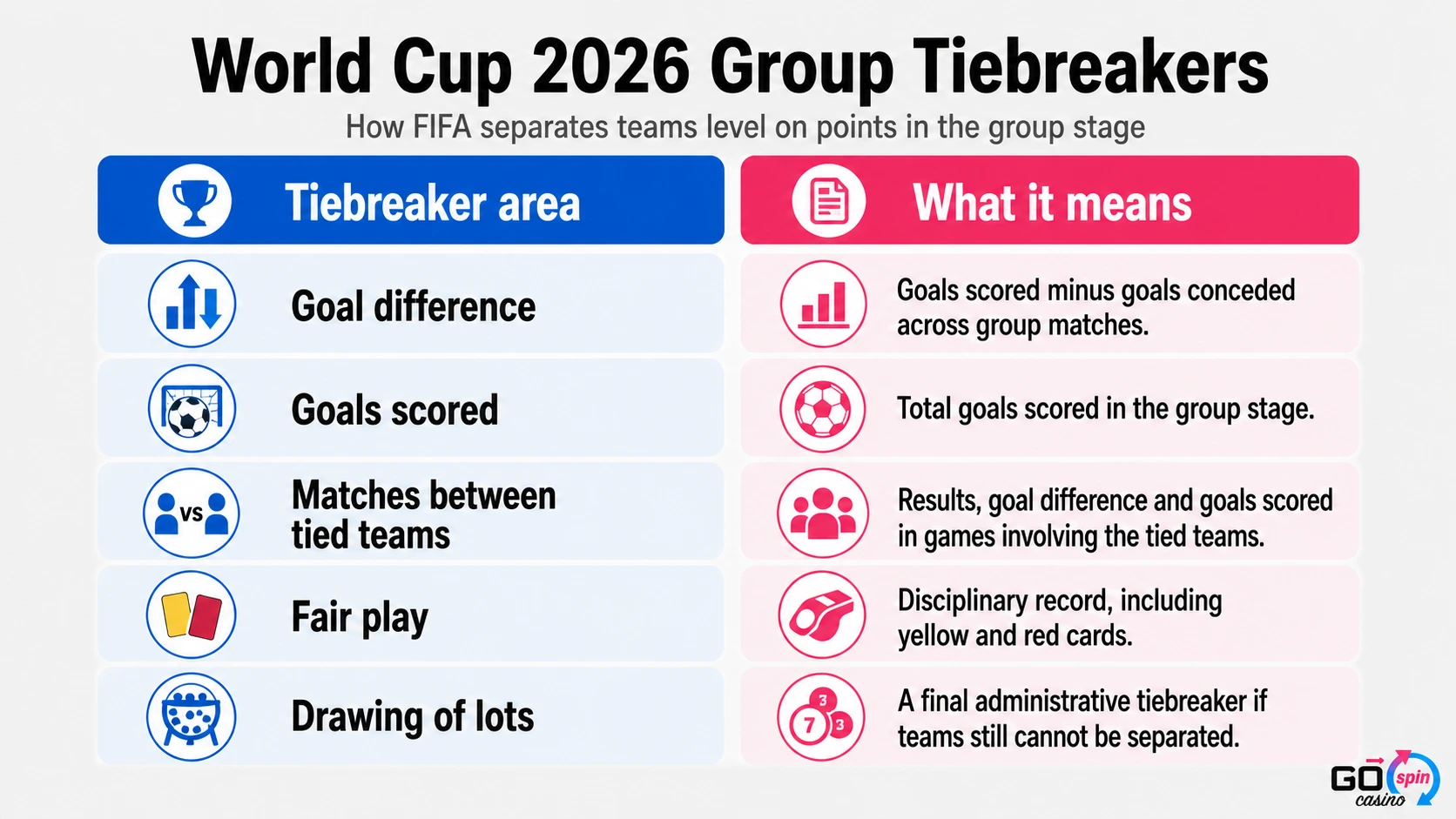
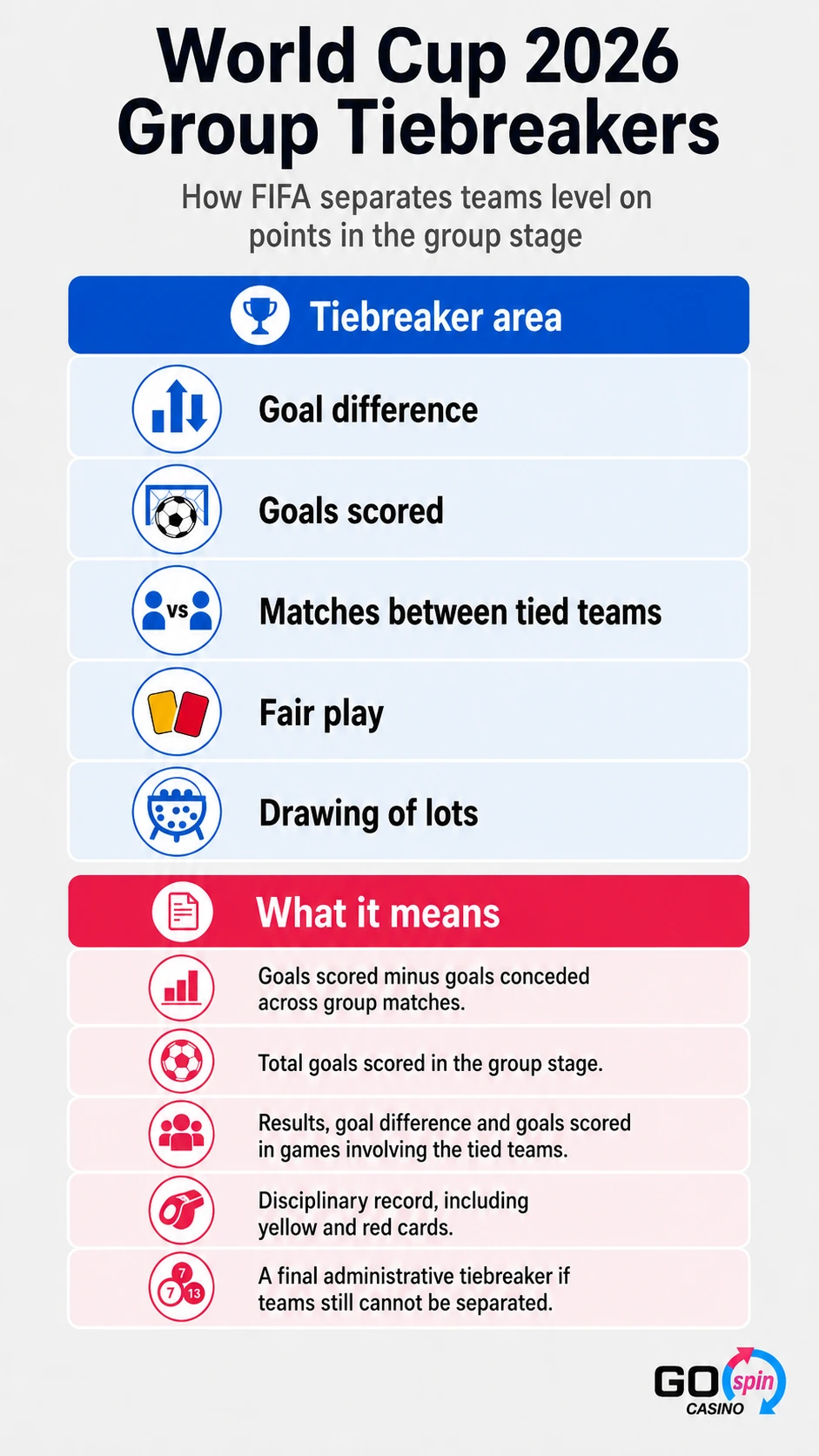
This can affect betting more than it looks. A team leading 2-0 may still chase another goal if goals scored could matter. Another team may protect a narrow defeat if damage limitation keeps its third-place chances alive.
Where Are World Cup 2026 Group Games Played?
World Cup 2026 group games are played across Canada, Mexico and the United States. FIFA’s official schedule lists fixtures, host cities, stadiums and updated match information for the 104-game tournament.
Venue context matters. Climate, rest time, travel distance and pitch conditions can all influence performance. A team moving between different conditions across the group stage may face a different physical challenge from one with a more stable schedule.
For fixtures, venues and kick-off times, use FIFA’s official schedule and fixtures as the live reference.
How World Cup 2026 Places Were Distributed by Confederation
The 48-team field came from an expanded slot allocation across FIFA’s confederations, with the final two places decided through the inter-confederation playoff tournament. This matters because the larger field creates more regional variety inside the groups.
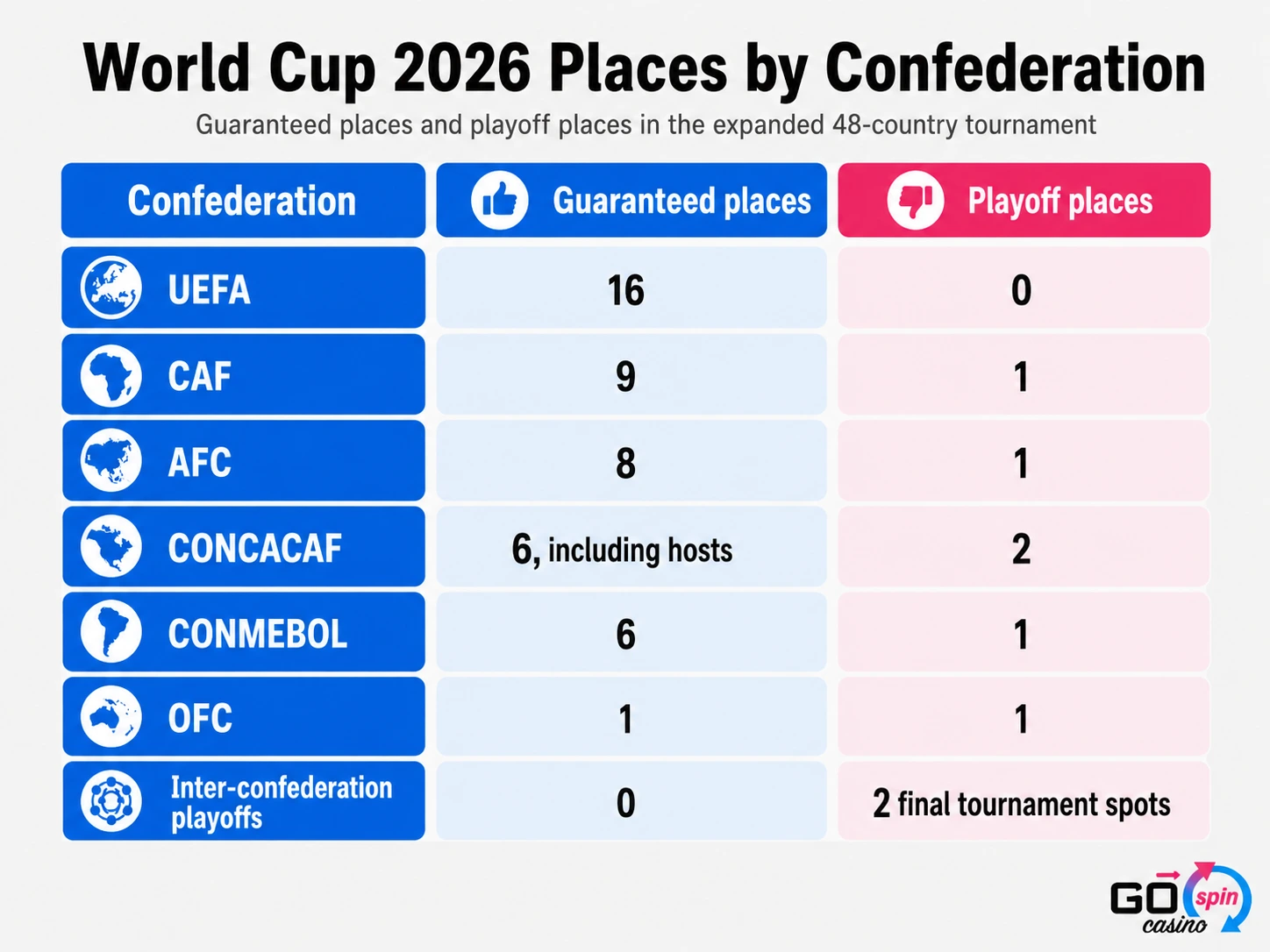
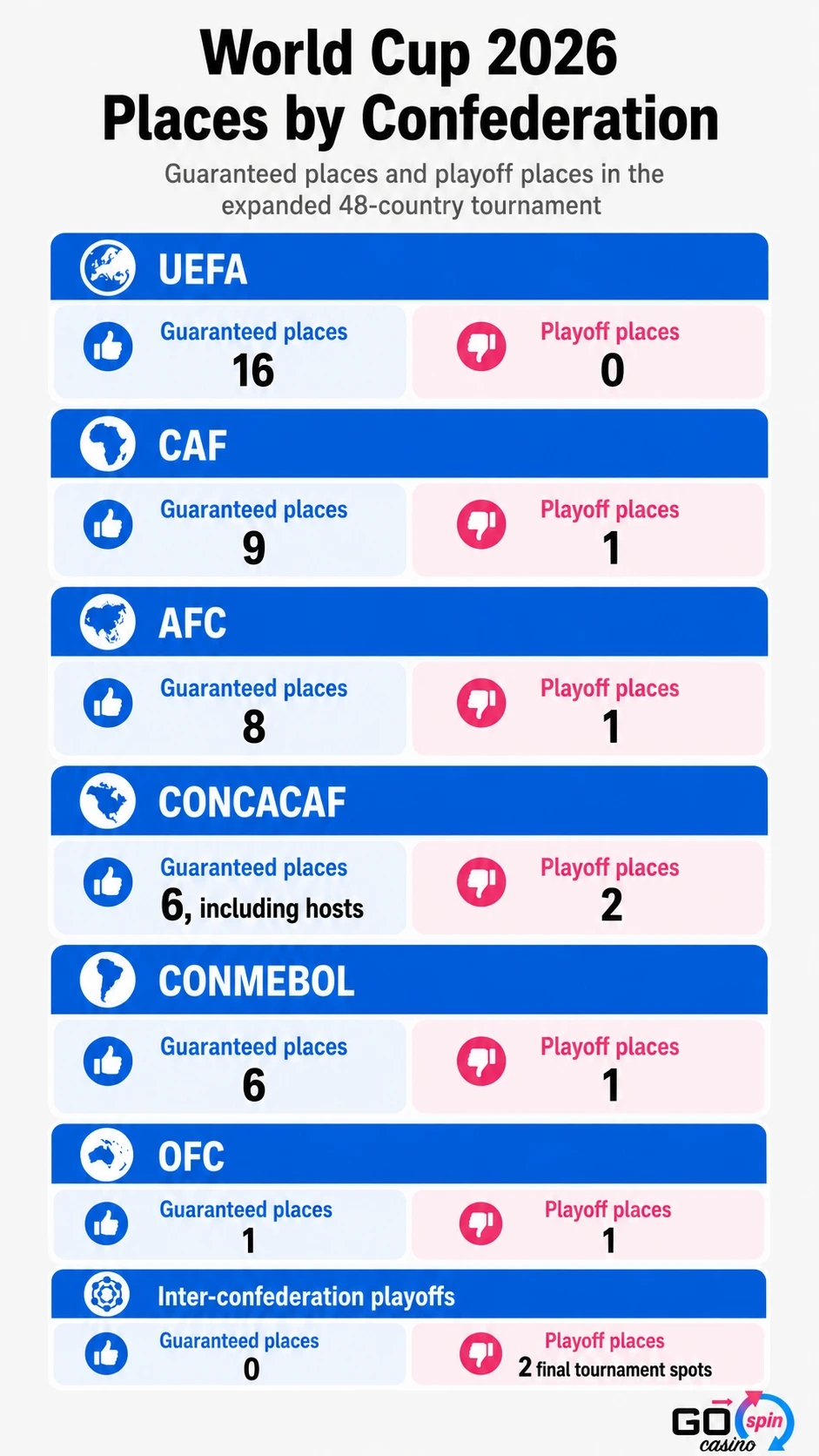
Playoff places were entries into the inter-confederation playoff tournament, not guaranteed extra World Cup spots for each confederation. FIFA’s Play-Off Tournament page explains that two teams from Concacaf and one team each from AFC, CAF, CONMEBOL and OFC competed for the final two qualification places.
For a wider look at the teams, hosts and qualification routes, read Go Spin Casino’s World Cup 2026 Teams Explained guide.
Why the Group Stage Matters for Bettors
The World Cup group stage is where many bettors overpay for reputation. A big-name team may deserve to be short in the market, but that doesn’t mean every price around them is fair.
The 2026 format adds more angles because qualification is broader. Group winner, to qualify, team points, exact group finish and live betting markets can all move based on motivation rather than pure team strength.


Major tournaments create hype, and hype creates bad prices. A smarter bet starts with the table, the motivation and the market, not just the team name.
Final Thoughts
The World Cup 2026 groups are bigger, more layered and more tactical than many fans will expect. The top two teams from each group still have the cleanest route, but the eight best third-place teams make the group stage more open and more volatile.
That matters for the tournament, and it matters for betting. Group winners, qualification markets, third-place scenarios, live odds and cashout decisions all depend on reading the table properly.
Once the group tables start moving, the best sportsbook is not always the one with the loudest promo. It’s the one with strong market depth, live betting, cashout control and clear player-protection tools.
Want to bet on group winners, qualification markets and third-place scenarios without chasing bad prices? Browse Go Spin Casino’s reviewed sportsbook casinos and compare platforms with dedicated World Cup group-stage markets, live betting, cashout options and clear player-protection tools.
FAQs About World Cup 2026 Groups
There are 12 groups in the World Cup 2026, from Group A to Group L. Each group has four teams.
Each World Cup 2026 group has four teams. Every team plays three group-stage matches.
Yes. Eight of the 12 third-place teams qualify for the Round of 32. That makes goal difference, goals scored and fair play criteria more important across the group stage.
There is no official hardest group, but Group F and Group L look like two of the most competitive on paper. Group F has Netherlands, Japan, Sweden and Tunisia, while Group L has England, Croatia, Ghana and Panama. The better betting question is not only which group is hardest, but which group has the smallest margin between second, third and fourth.
Groups featuring host nations and global football brands usually draw the most betting interest. That points to groups involving Mexico, Canada, the United States, Brazil, Germany, Spain, France, Argentina, Portugal and England. Betting interest does not always mean betting value.