
The World Cup 2026 format features 48 teams, 12 groups of four, and a new Round of 32 knockout stage. The top two countries from each group advance automatically, along with the eight best third-place teams. That means 32 countries move from the group stage into the knockouts, creating a longer tournament with more matches, more qualification scenarios, and more betting markets than previous World Cups.
For bettors, the key change is not just the larger field. It is the way the format changes incentives. A team chasing a draw does not play like a team chasing a win. A favorite already through to the knockouts may rotate. A third-place team with four points may still be alive, when that same finish used to mean elimination in the old 32-team format.
The new World Cup format gives fans more countries, more games, and more knockout drama. It also gives bettors more room to misread motivation, group tables, futures prices, and live markets.
Table of contents
- Quick answer: how the World Cup 2026 format works
- What changed in the World Cup 2026 format?
- How many teams are in the World Cup 2026?
- How the World Cup 2026 group stage works
- How teams qualify for the Round of 32
- How the World Cup 2026 knockout stage works
- Why the new format matters for bettors
- Pros and cons of the new World Cup format
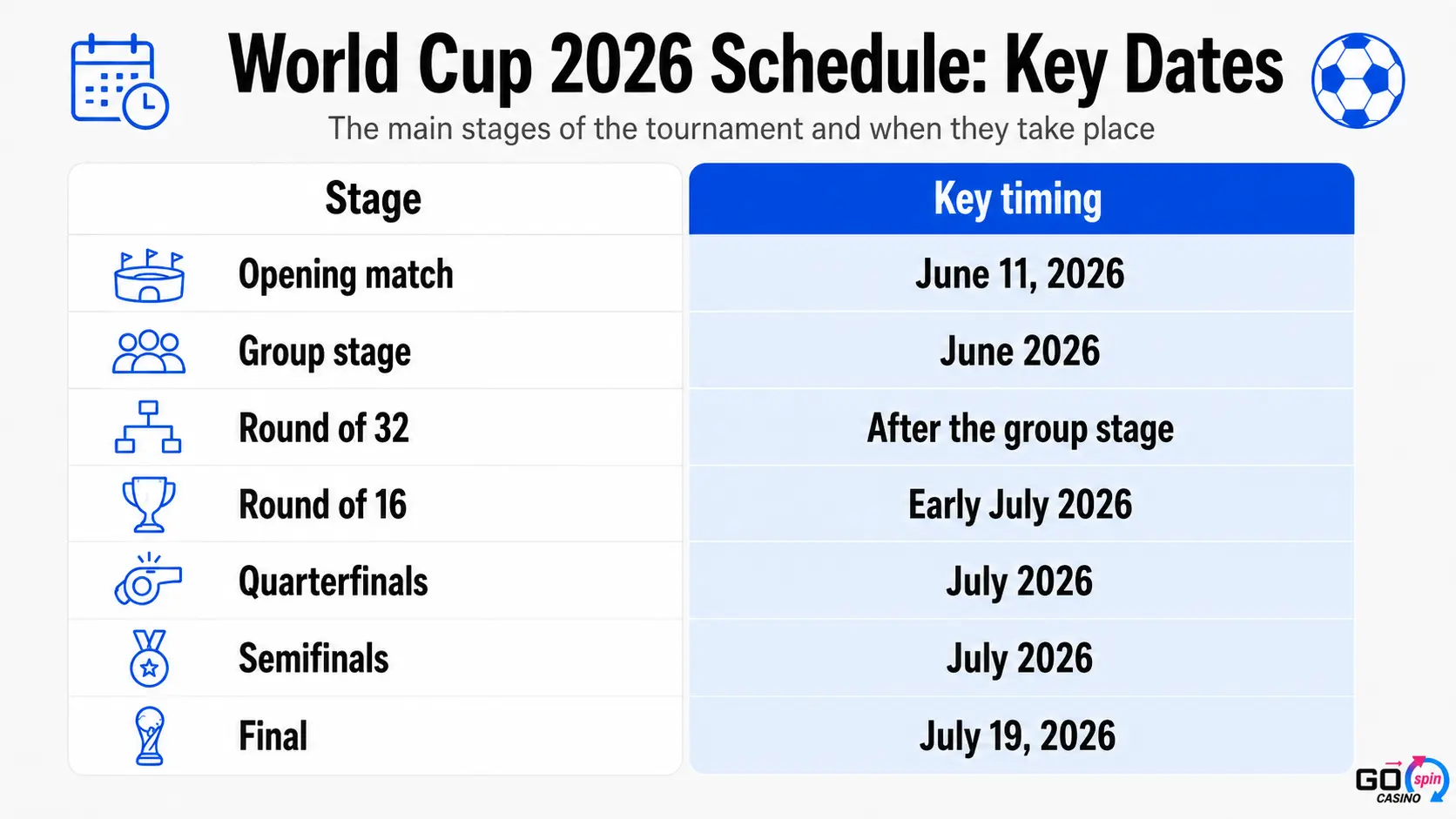
- World Cup 2026 schedule: key dates to know
- Is there a World Cup 2026 bracket?
- What bettors should not assume
- The Bottom Line for Bettors
- FAQs about the World Cup 2026 format
Quick answer: how the World Cup 2026 format works
The World Cup 2026 format has 48 teams split into 12 groups of four. Each team plays three group-stage matches. The top two teams in each group qualify automatically, and the eight best third-place teams also advance. That creates a 32-team knockout bracket, starting with the Round of 32.
World Cup 2026 format at a glance
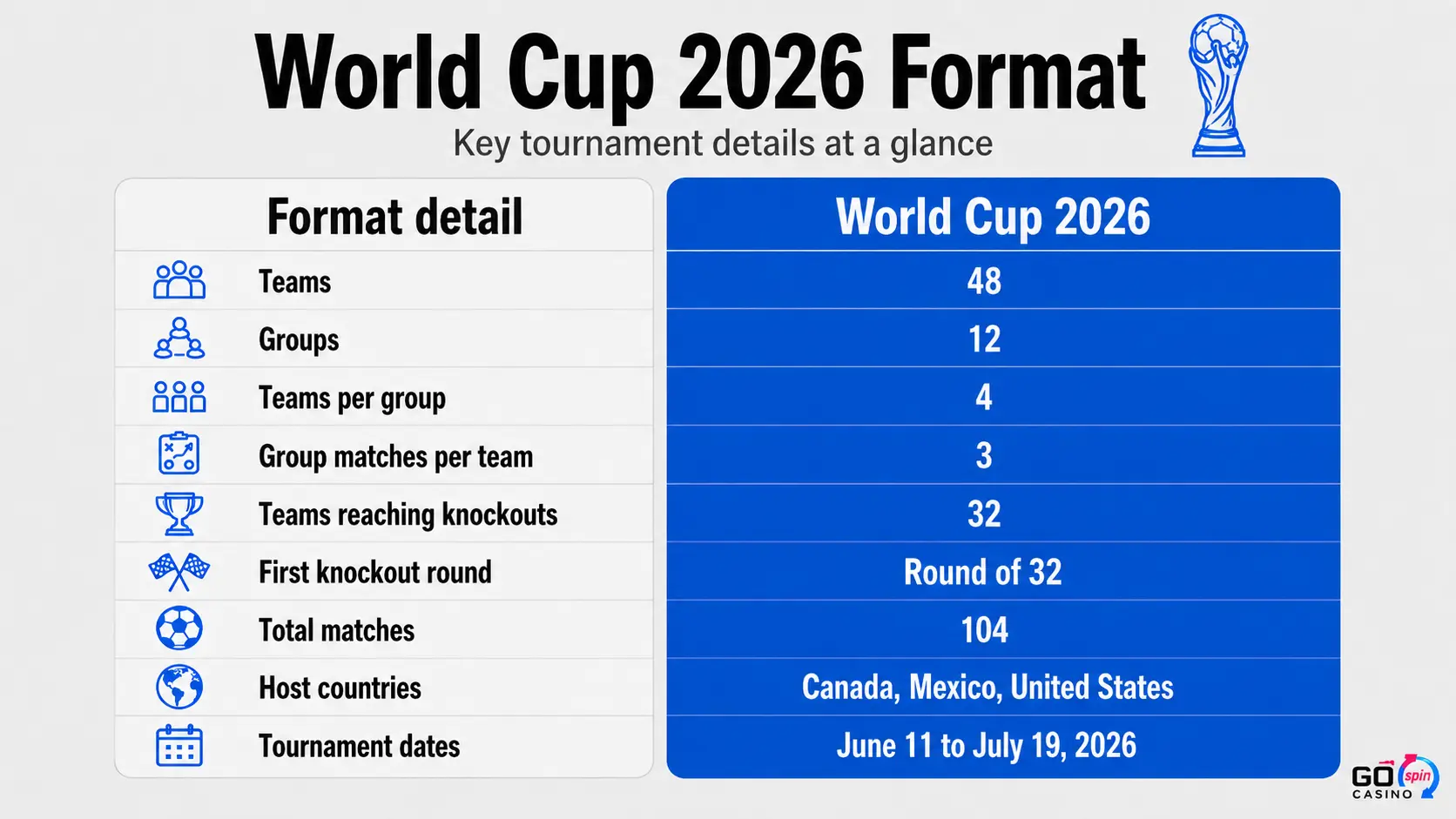
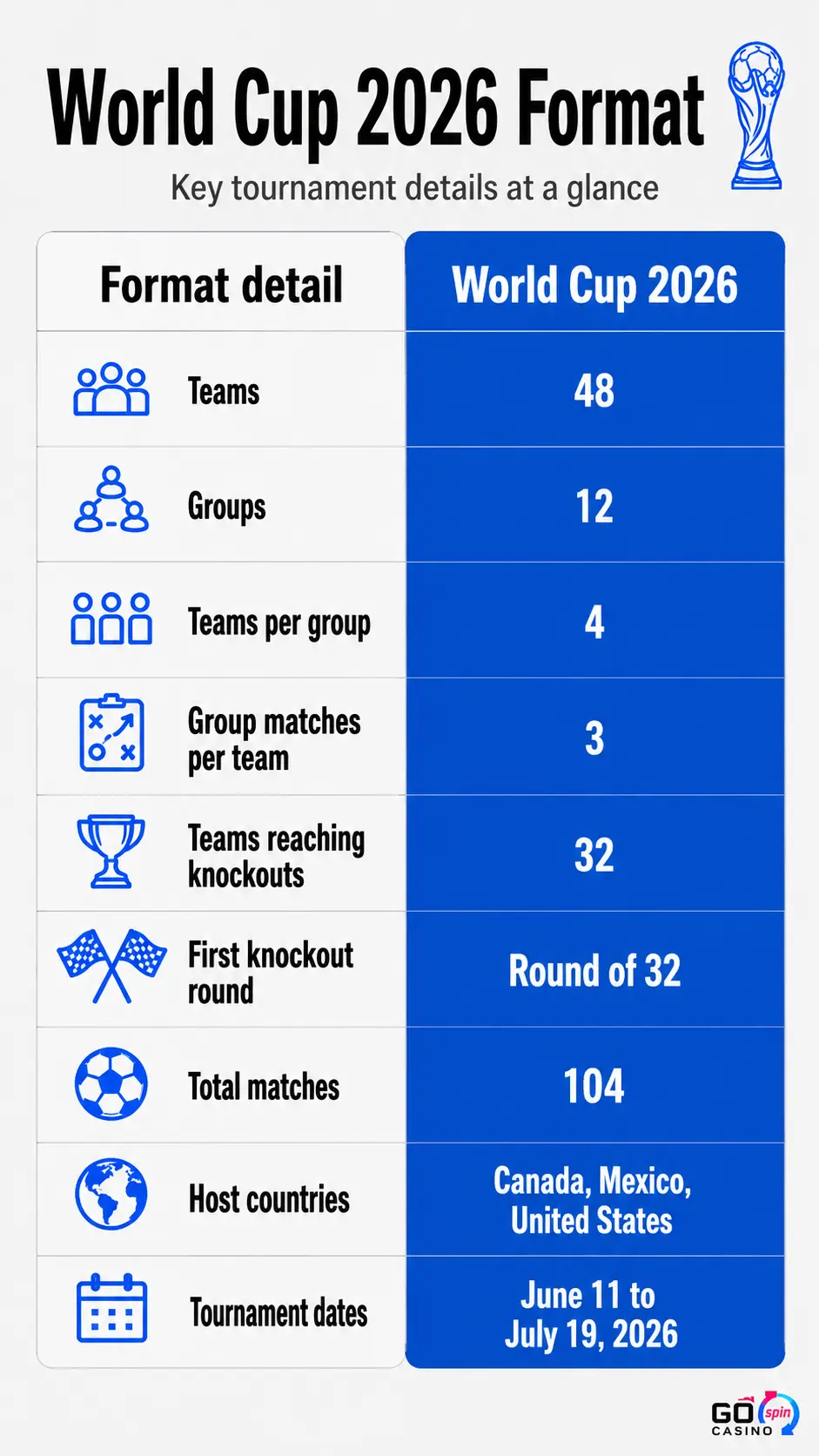
FIFA’s official schedule confirms the 104-match structure, while its tournament information confirms Canada, Mexico, and the United States as host countries and the June 11 to July 19 tournament window.
Format flow
48 teams → 12 groups of four → 24 top-two teams + 8 best third-place teams → Round of 32 → Round of 16 → Quarterfinals → Semifinals → Final
The format is easy to summarize. The important part is understanding what each team needs once the final group matches arrive.
What changed in the World Cup 2026 format?
The previous World Cup structure had 32 teams, eight groups of four, and a Round of 16 after the group stage. In 2026, the tournament expands to 48 teams, 12 groups, 104 matches, and a new Round of 32 before the Round of 16.
FIFA’s tournament timeline describes the 2026 format as a 104-match tournament with 12 groups of four, where the top two finishers and eight best third-place teams advance.
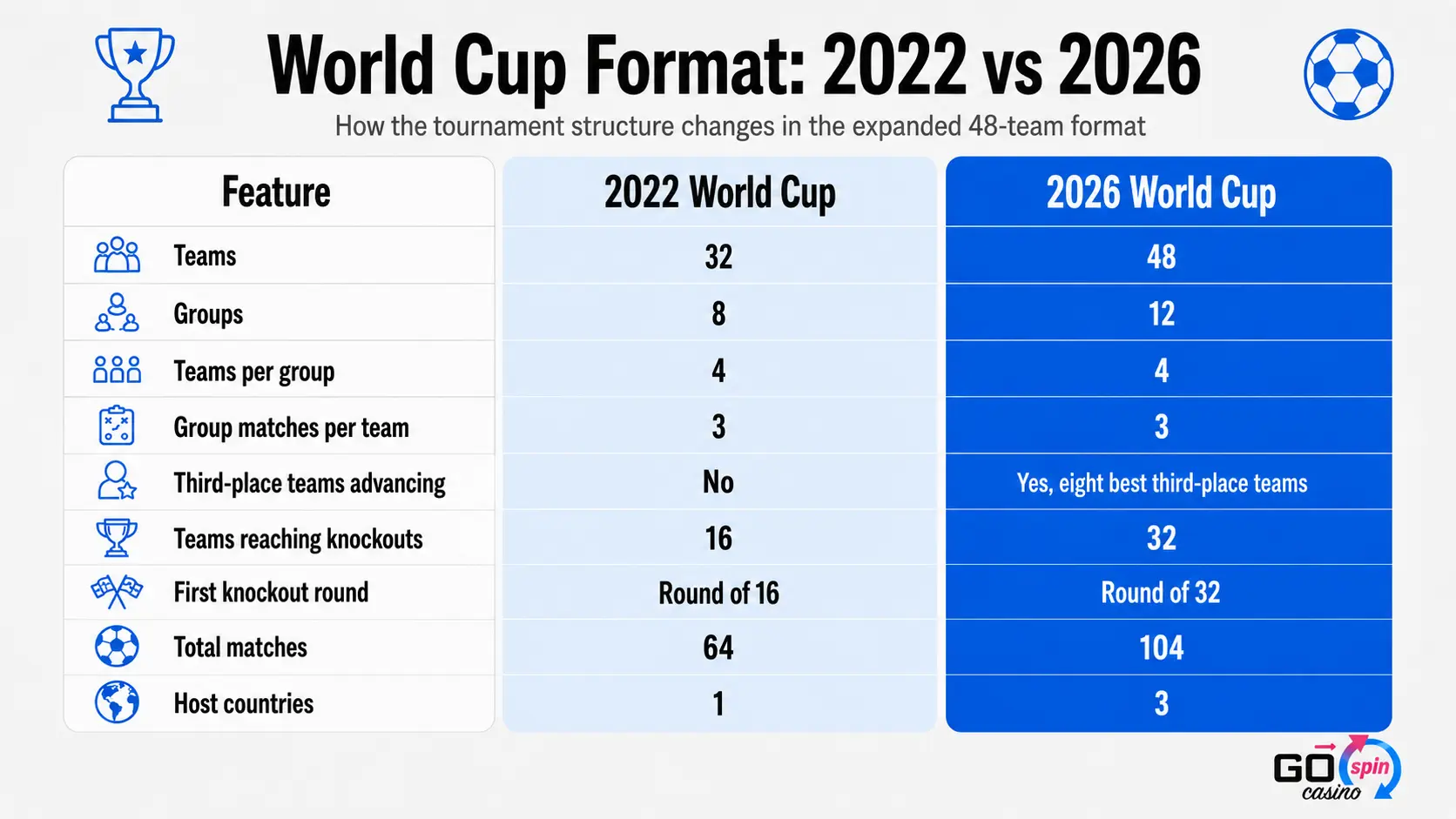
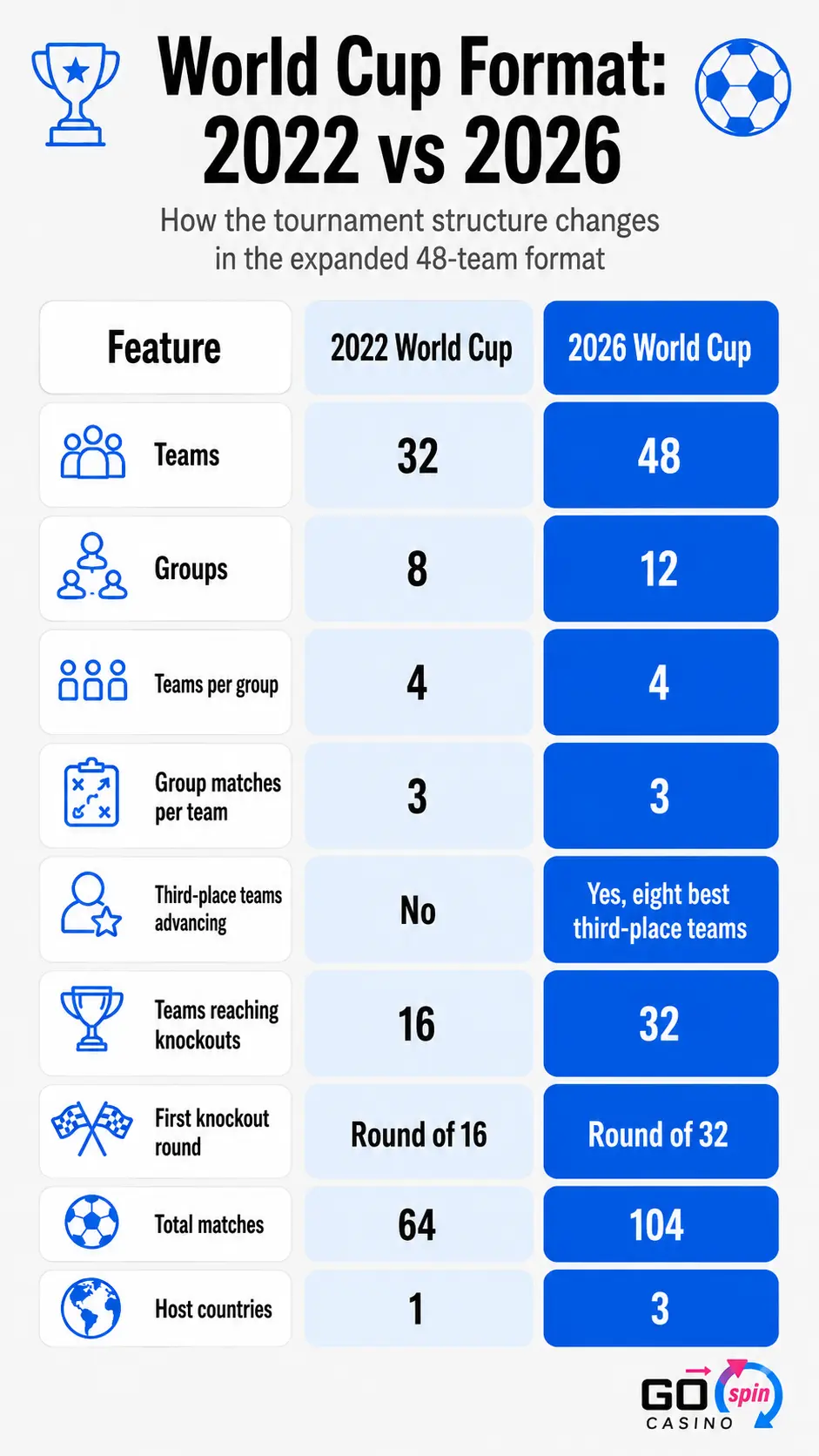
The biggest practical change is the extra qualification route. Third place no longer means automatic elimination. That creates more scenarios in the final group games, especially when teams are comparing points, goal difference, goals scored, and results elsewhere.
For bettors, this changes how group betting should be read. Some teams will still need a win. Others may only need a draw, a narrow loss, or a favorable result from another group. The table matters, but the wider tournament context matters more than before.
How many teams are in the World Cup 2026?
The World Cup 2026 features 48 teams, making it the first men’s World Cup played under the expanded 48-team format. It is also the first men’s World Cup hosted across three countries: Canada, Mexico, and the United States.
The expanded field gives more countries a route into the tournament and increases the number of matches. From a betting perspective, it also widens the range of team quality. That does not automatically make betting easier. Public favorites can be aggressively priced, especially in high-profile matchups, while smaller teams may be harder to evaluate without current squad, travel, and tactical context.
How the World Cup 2026 group stage works
The World Cup 2026 group stage format uses 12 groups of four teams. Each team plays the other three teams in its group once, which means every team gets three group-stage matches. The top two teams in each group advance to the Round of 32, along with the eight best third-place teams across all groups.
The standard group-stage points system applies:
| Result | Points |
| Win | 3 |
| Draw | 1 |
| Loss | 0 |
After three matches, each group produces two automatic qualifiers. That creates 24 knockout teams. The final eight places go to the best third-place teams.
Why the third-place route matters
The third-place route is the most important new wrinkle in the World Cup group stage format.
A team that finishes third with four points and a positive goal difference could still reach the Round of 32. A team entering its final group match on three points may not always need to win. In some scenarios, a draw may be enough to stay alive.
That can change the final 20 minutes of a match. A team protecting a qualification position may slow the game down. A coach may avoid risky substitutions. A side that looks desperate on paper may actually be managing goal difference.
For bettors, this affects match betting, totals, team goals, live betting, and qualification markets. For a deeper breakdown of group-stage scenarios, tiebreakers, and third-place qualification, read the World Cup 2026 groups explained guide.
How teams qualify for the Round of 32
The World Cup Round of 32 is the new knockout entry point. Instead of going directly from the group stage to the Round of 16, the 2026 tournament sends 32 teams into the first knockout round.
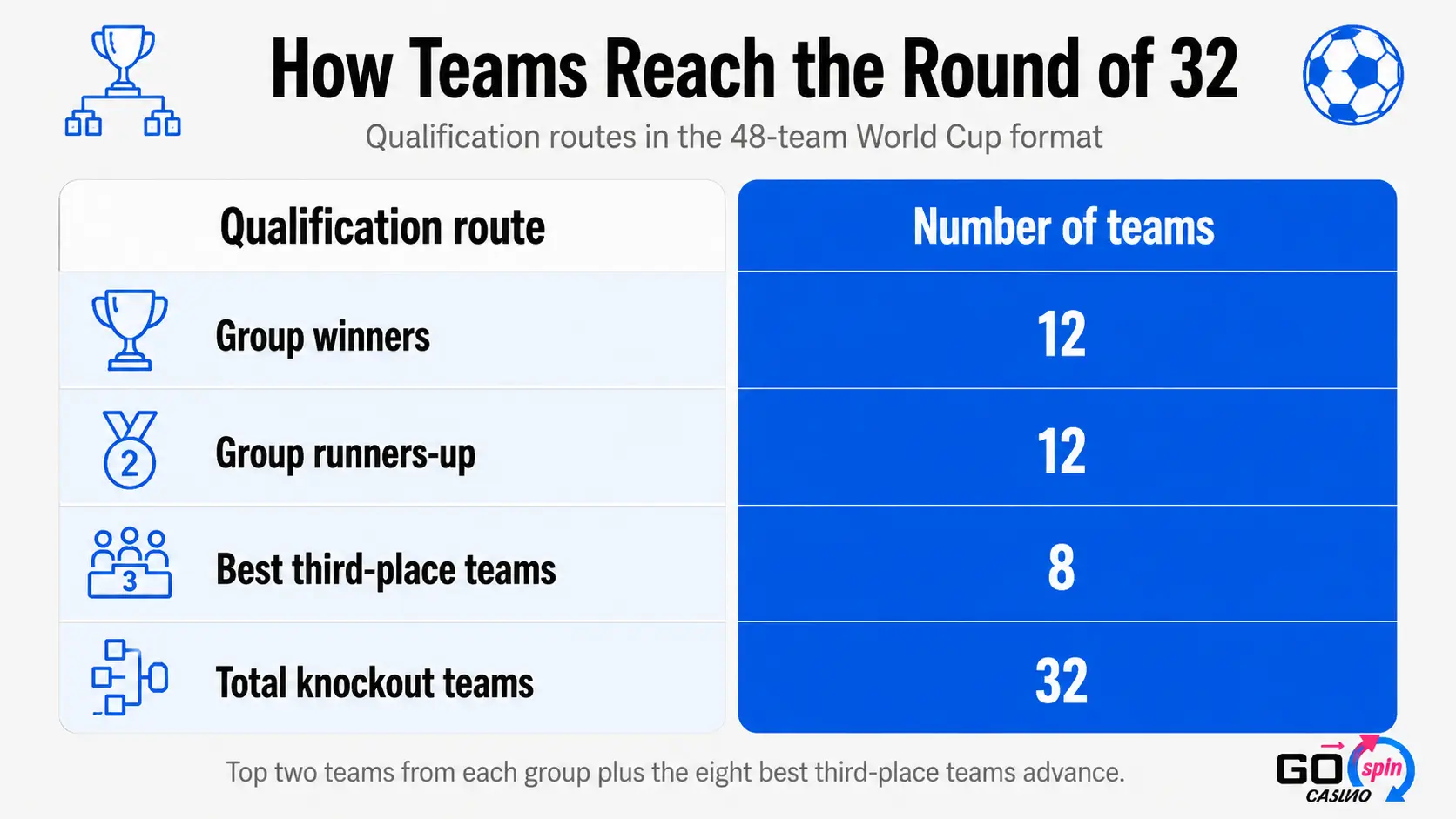
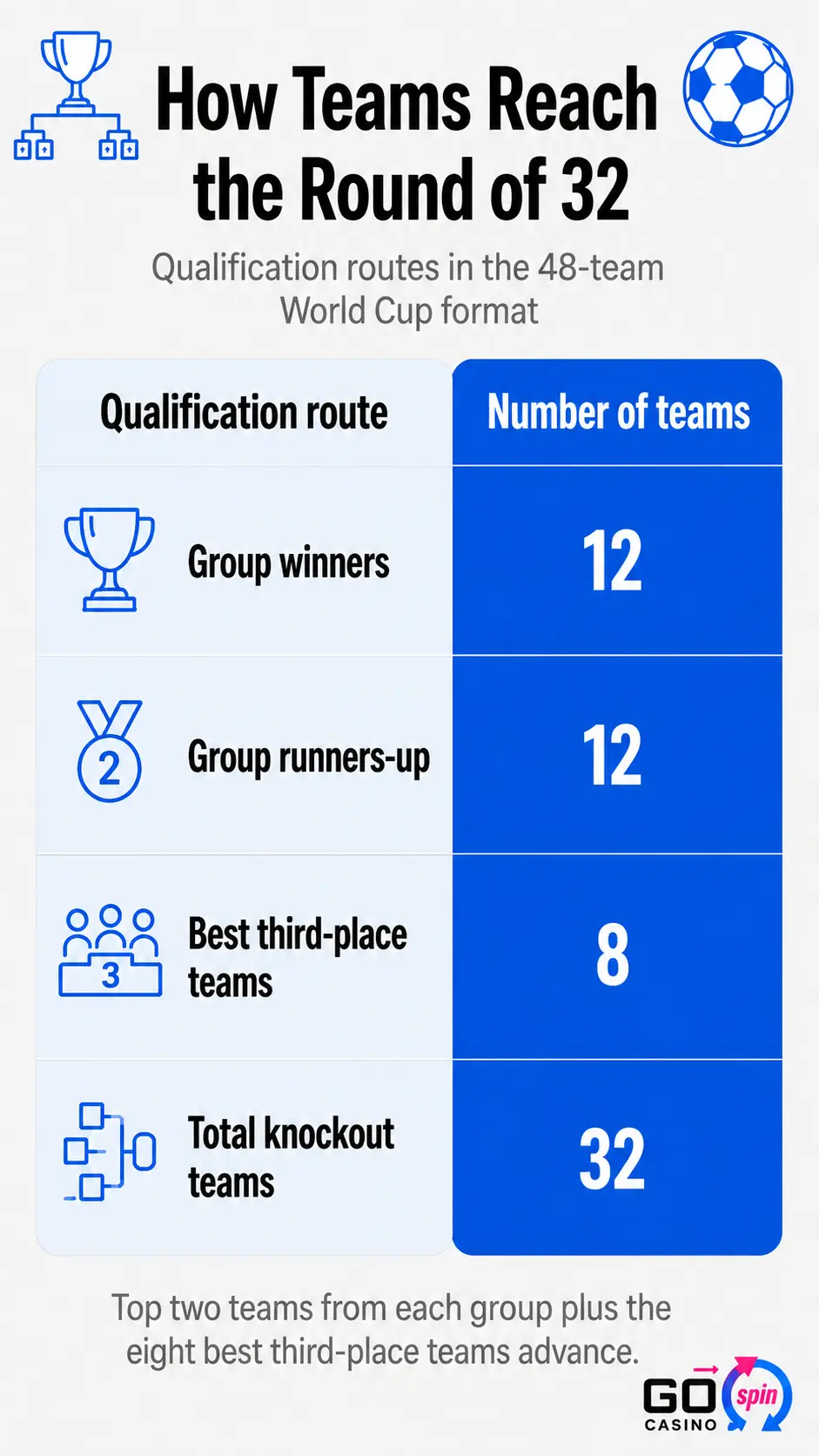
The top two route is straightforward. Finish first or second in the group, and qualification is automatic. The third-place route is more tactical because teams are compared across different groups.
Bettor’s takeaway
The final group match is not always a clean win-or-go-home situation. Before betting on urgency, check the wider third-place picture, goal difference, and what the team actually needs.
How the World Cup 2026 knockout stage works
The World Cup knockout format in 2026 starts with the Round of 32. From that point, the tournament becomes single elimination.
There is also a third-place match before the final. FIFA’s knockout-stage schedule page identifies the knockout path through Match 104, the final, on July 19, 2026.
The Round of 32 adds one more pressure point to the tournament. Compared with the old 32-team format, a champion now has to survive an extra knockout round. That matters for futures betting because one additional elimination match increases variance.
A strong squad with depth may be better built for the longer path than a team relying heavily on a small core of starters. That does not make favorites poor bets, but it does make bracket path, rotation, injuries, suspensions, and squad management more important.


Why the new format matters for bettors
The World Cup 2026 format creates more matches and more markets, but also more ways to misprice motivation. Casual bettors often focus on team reputation, star players, or national narratives. The sharper read is usually about incentives.
More group-stage markets
With 12 groups instead of eight, bettors should see a wider menu of group-stage markets.
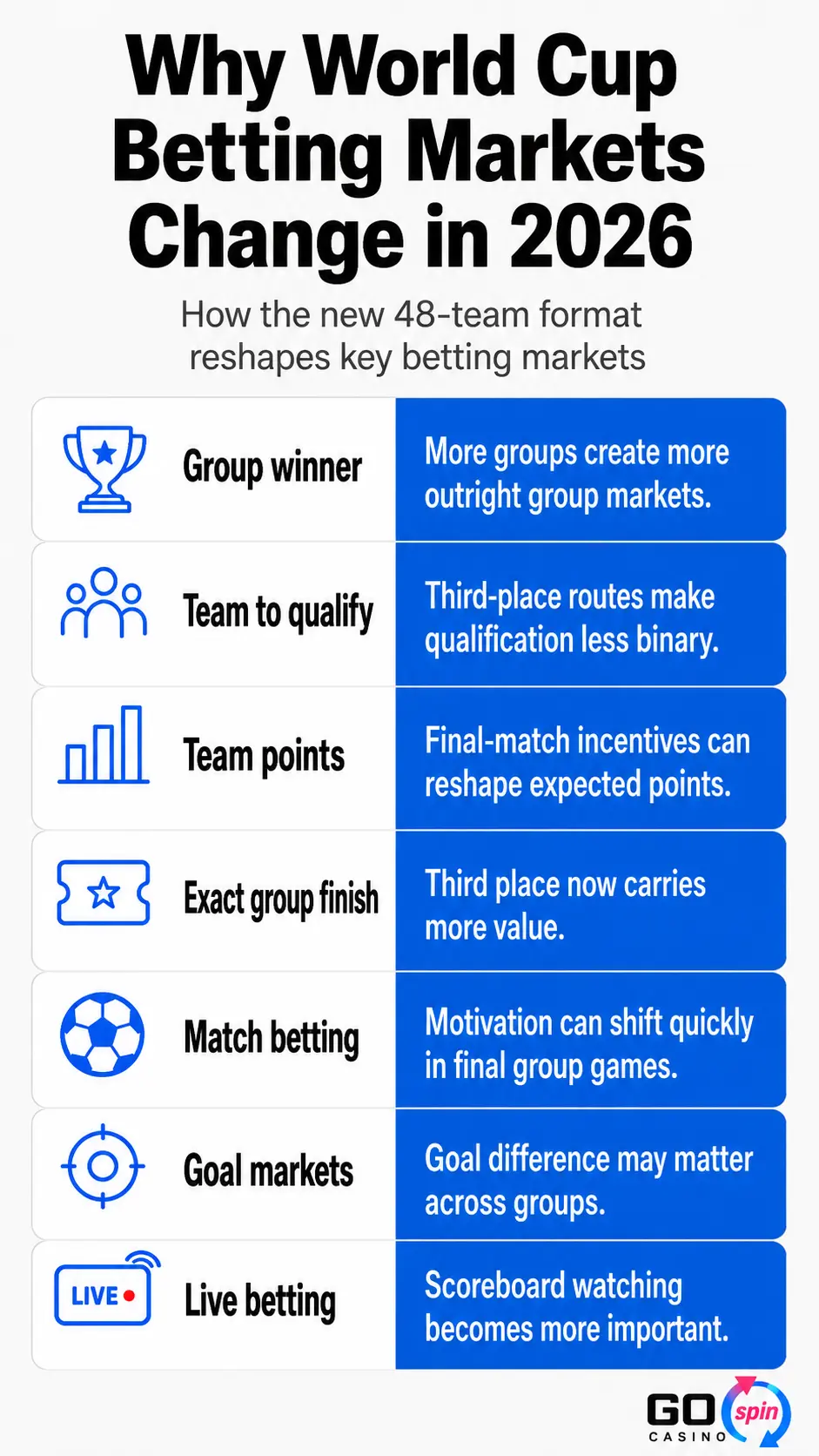
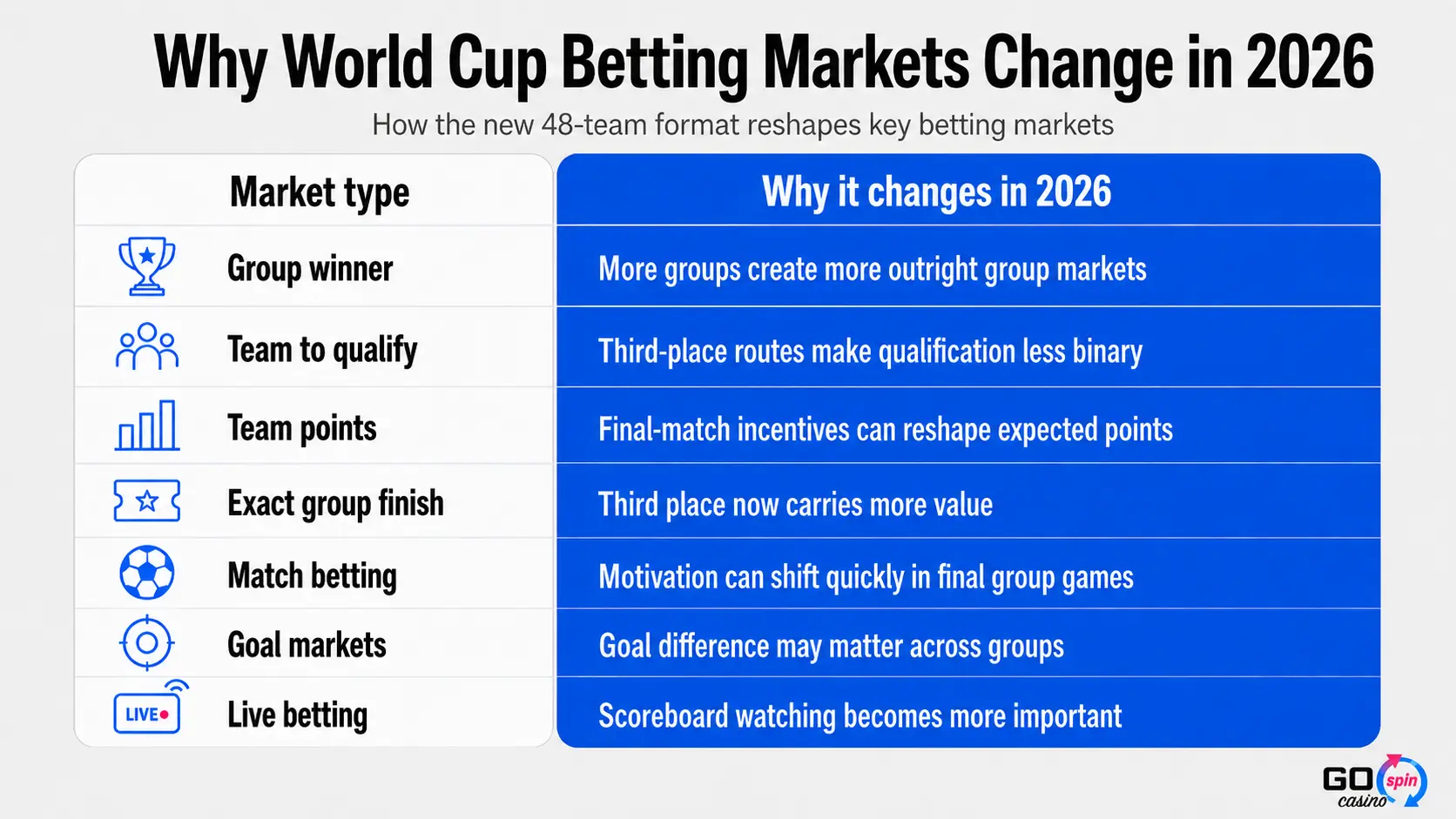
More markets do not automatically mean more value. The opportunity is in reading what each team needs better than the market does.
Third-place qualification changes incentives
Third-place qualification is the biggest betting shift.
In the old format, a team sitting third before the final match often needed a win. In 2026, that same team may only need a draw, a narrow loss, or help from another group.
That can change match tempo, substitution patterns, late-game risk, and live odds movement. “Must win” narratives should be treated carefully because the new format makes urgency more conditional.
Rotation matters more than casual bettors think
A team that wins its first two matches may already have enough to advance. If the coach protects key starters in the third match, markets can move quickly.
That matters for:
- moneyline bets;
- player props;
- anytime goalscorer markets;
- corners;
- cards;
- live betting;
- same-game parlays.
In a 104-match tournament, the better question is not only “Who is better?” It is “Who needs what, and how much do they need it?”
Futures markets get more volatile
The expanded knockout stage gives outright winner bets one extra elimination round to survive. That makes squad depth and bracket path more important once the group stage is complete.
A team can look strong before the tournament, then face a tougher route after one poor group result. Another team can start slowly, land in a favorable Round of 32 matchup, and become more interesting in futures markets.
For a deeper betting breakdown, including World Cup odds, futures, group betting, knockout markets, and sportsbook comparison, read the World Cup 2026 betting guide.
Pros and cons of the new World Cup format
The expanded format gives the tournament a bigger global stage, but it also adds complexity. For bettors, that trade-off matters.
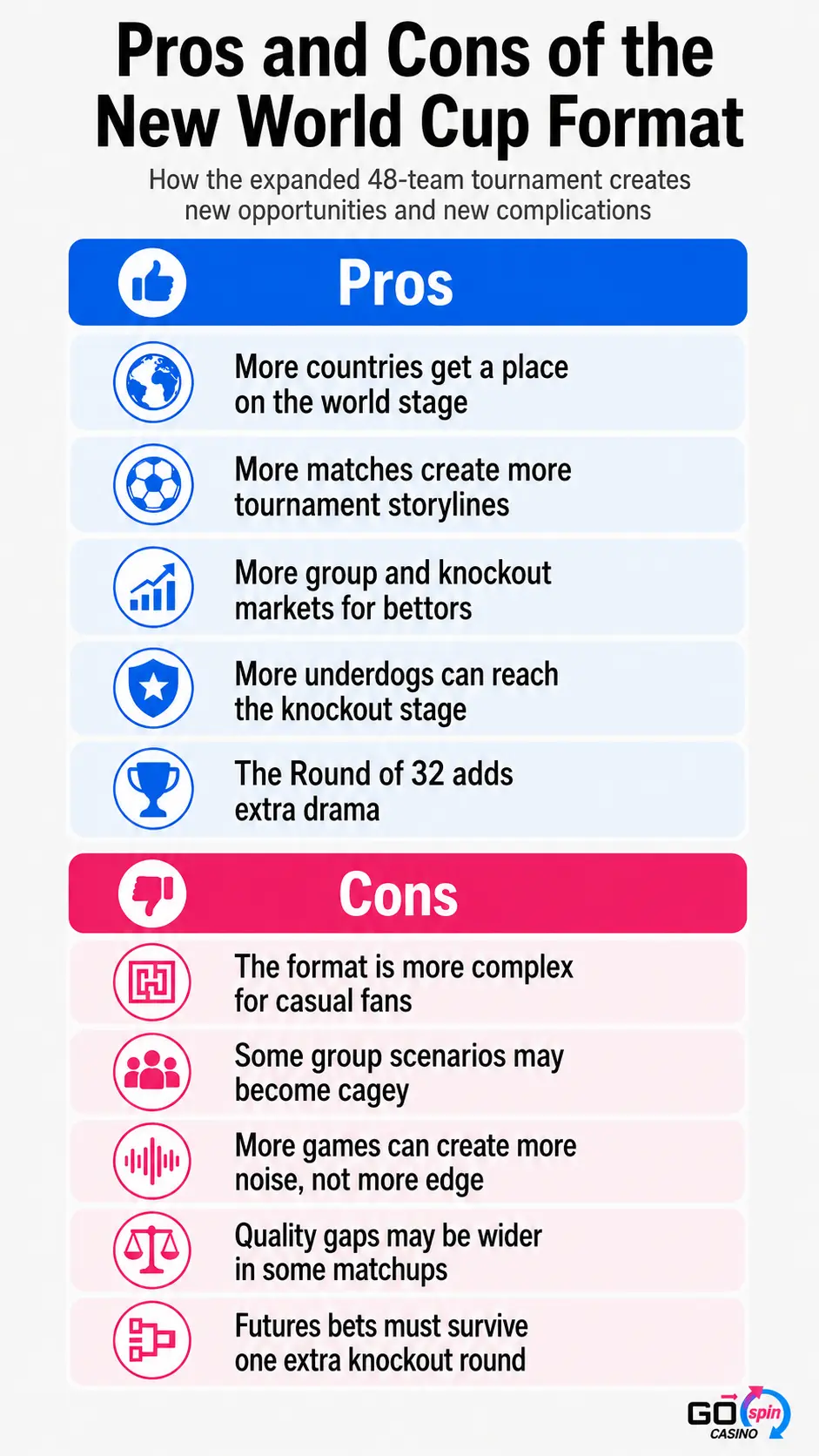
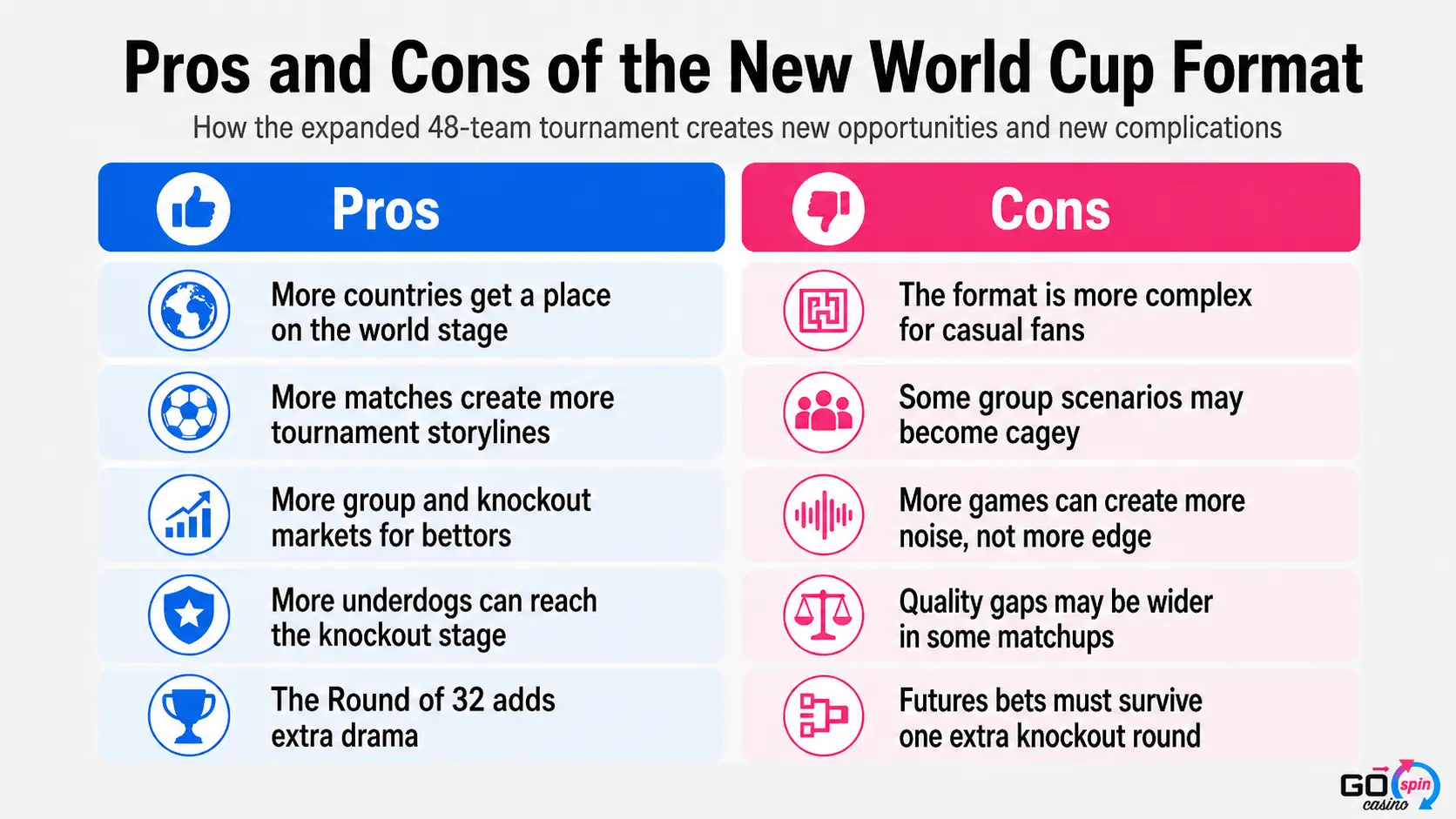
The third-place qualification system is the main trade-off. It keeps more teams alive, which adds drama, but it also makes final group matches harder to read. Some teams may push for a win. Others may manage risk. Some may be watching results from other groups as closely as their own match.
This format rewards patience. More games do not automatically mean more value. More context does.
World Cup 2026 schedule: key dates to know
The World Cup 2026 runs from June 11 to July 19, 2026. FIFA’s official match schedule covers fixtures and results from all 104 games.
This page should not be treated as a fixture tracker. Fixtures, team news, injuries, and kickoff times need regular updating. The purpose here is to explain the format, the structure, and how that structure affects the tournament.
Is there a World Cup 2026 bracket?
Yes, the World Cup 2026 has a knockout bracket. The final bracket depends on group results and which third-place teams qualify.
That makes pre-tournament bracket analysis useful, but limited. Possible routes can be mapped before the tournament, but the identity of the eight third-place qualifiers affects exact Round of 32 matchups.
For betting, projected brackets should be used as context rather than certainty. The Round of 32 gives strong teams more work to do and gives dangerous outsiders one more chance to disrupt the market.
What bettors should not assume
The 2026 format can punish lazy assumptions. These are the most important ones to avoid:
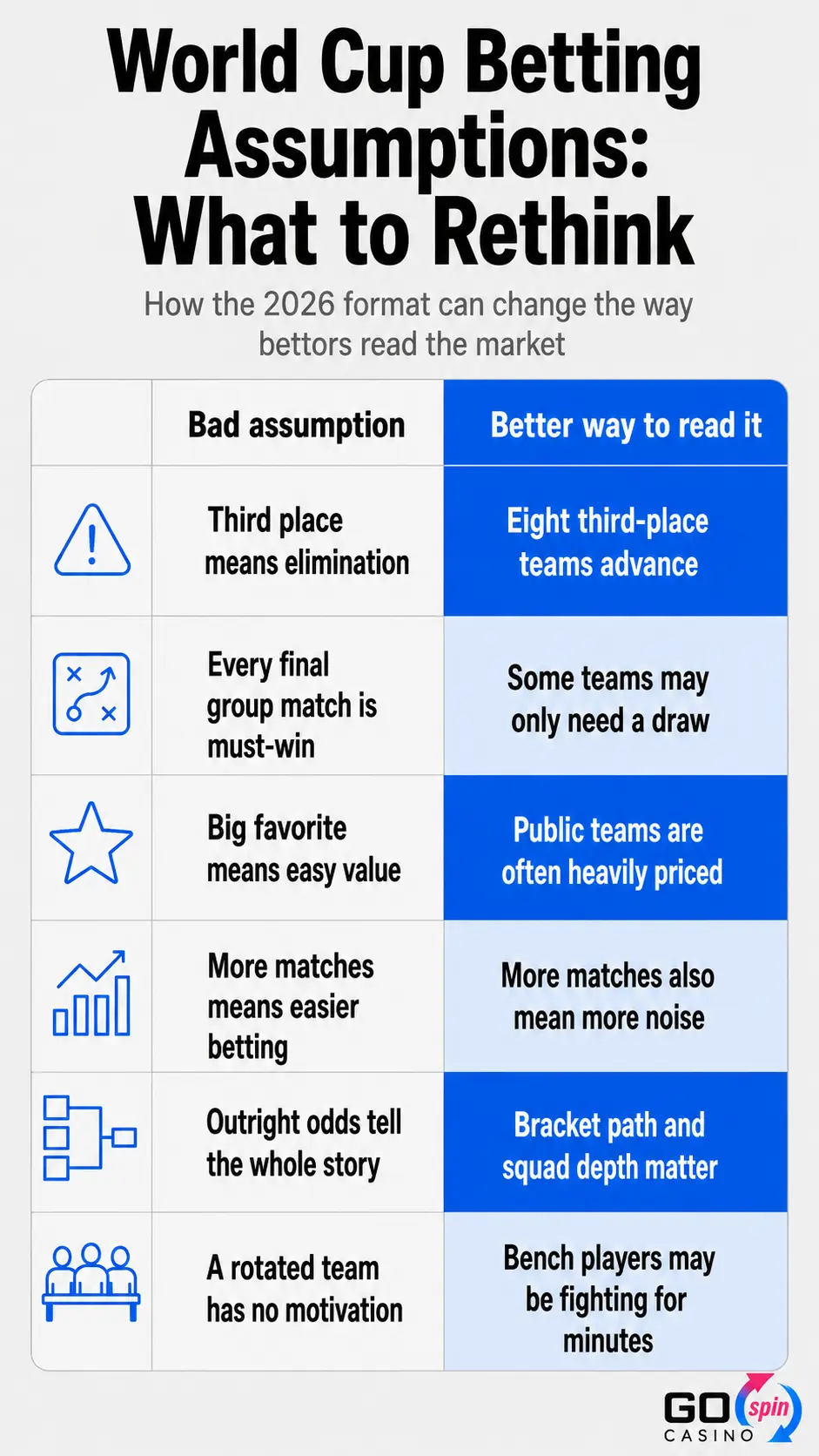
The format gives bettors more opportunity, but it also gives sportsbooks more ways to price emotion into markets. Major tournaments attract casual money. That can create value only when betting decisions stay disciplined.
The Bottom Line for Bettors
The World Cup 2026 format is simple at the top level: 48 teams, 12 groups, eight best third-place teams advancing, and a new Round of 32. The strategic layer is more complex.
Third place no longer means automatic elimination. Final group matches may depend on goal difference, other group results, and qualification math. Futures markets also become more sensitive to bracket path because contenders must survive an extra knockout round.
For fans, the new format means more soccer. For bettors, it means more context to check before trusting the obvious price.
Want to follow the tournament with stronger market context? Browse our reviewed sportsbook casinos and compare platforms that cover World Cup futures, group betting, live markets, and knockout-stage odds. Read the terms, bet within your limits, and use the format as context, not as an excuse to force action.
FAQs about the World Cup 2026 format
The 2026 World Cup format has 48 teams, 12 groups of four, and a new Round of 32. The top two teams from each group qualify automatically, along with the eight best third-place teams. After that, the tournament becomes single elimination.
The FIFA World Cup 2026 layout starts with a group stage and moves into a knockout bracket. The group stage has 12 groups of four teams, with each team playing three matches. The knockout stage starts with 32 teams instead of 16.
Third-place teams are ranked against the other third-place teams from all 12 groups. Points come first, then tiebreakers such as goal difference and goals scored can decide which eight third-place teams reach the Round of 32.
The World Cup 2026 format bracket begins with the Round of 32 after the group stage. The exact bracket depends on group results and which third-place teams qualify, so the final knockout path is only confirmed once all group matches are complete.
The biggest difference is expansion. The old format had 32 teams, eight groups, and a Round of 16. The World Cup 2026 format has 48 teams, 12 groups, eight best third-place teams advancing, and a new Round of 32.