

If you’ve ever sat at a live blackjack table, you’ve seen how fast money moves once chips hit the felt. Nobody fumbles with bills, nobody hesitates over a €/$ 25 bet. Chips glide across the table, and spending feels easier. That’s not an accident.
Casinos use chips instead of cash because they change how players think, play, and perceive value. It’s part psychology, part efficiency, and part security. Chips speed up every hand, tighten control over money flow, and keep the focus on action, not accounting.
From the player side, it’s striking how a simple swap (paper for clay) shifts your sense of risk and reward. From the casino side, it’s smart design and disciplined operations at scale.
Bottom line: chips improve table game speed, reduce errors, and leverage casino psychology to keep sessions flowing. This guide explains why casino money chips still anchor the floor even as digital payments grow.
Table of contents
The Psychology Behind Casino Money Chips
Tokenization, value perception, and risk taking
Chips change the mental math. Hand someone a €/$ 25 bill and they hesitate. Hand them a €/$ 25 green chip and the decision feels lighter. That’s tokenization at work. By converting cash into chips, casinos soften the pain of paying, so players focus on the game rather than the spend. You see it in average bet sizes creeping up and in how quickly players press after a small win. This is a core reason why casinos use chips: not just tradition, but a deliberate nudge that shifts perception from spending money to placing units.
Color, stack height, and on-table decision cues
Colors and stack height are visual shortcuts. A tidy column of reds signals five-dollar increments, so bumping a bet from three to four chips takes a fraction of a second. Players follow the stack, not the wallet, and it smooths bet sizing across the table. Dealers read colors instantly, so payouts feel seamless and players stay in rhythm. The color palette and edge spots also create confidence. If everyone can read the value at a glance, there’s less friction, fewer second guesses, and more flow.
Momentum and session flow
Momentum keeps sessions alive. Once players convert cash at the cage or the table, chips live in racks and the game becomes about action, not change-making. Reloads are quicker, side bets pop in without stopping the hand, and winnings slide back into the stack with zero ceremony. That low friction sustains engagement. Players measure progress in stacks and columns, not in dollars spent, which reduces decision fatigue and keeps the table moving. This is another practical reason why casinos use chips: they maintain a steady cadence that benefits both the player experience and the house’s throughput.
Speed and Operations: More Hands per Hour, Fewer Errors
Faster betting, faster payouts
Cash slows everything down. Chips speed everything up. Instead of counting and verifying bills, dealers move chips across the felt in seconds. A €/$ 5 bet is one red chip, a €/$ 100 win is four greens, clean, instant, and universally understood. That rhythm keeps tables alive and players engaged.
On high-volume games like roulette or blackjack, the gap is huge. When every hand, spin, or roll moves faster, the casino runs more rounds per hour, which means more action and more potential profit without raising stakes. That’s one of the most overlooked reasons why casinos use chips: efficiency drives revenue.
Dealer accuracy and fewer mispays
Cash invites mistakes. Chips standardize them out. Denominations and colors make it unlikely for a dealer to confuse a €/$ 25 bet with a €/$ 100 one. Payouts are calculated visually, not mentally, and a structured chip layout minimizes counting errors.
Newer dealers keep pace because the visual logic does the heavy lifting. Misunderstandings between player and dealer drop, and the table’s momentum holds. Over time, that consistency protects both sides, players feel fairness, and casinos maintain control over table game speed and accuracy.
Pit and cage workflows
Behind the scenes, chips are the lifeblood of operations. Each table has an inventory called a float that tracks every chip in play. When dealers run low, the pit authorizes a fill from the cage, where chips are logged, sealed, and swapped without stopping the game.
Cash rarely touches the table once chips are in rotation. Everything, fills, credits, drops, runs through internal accounting that keeps the pit balanced to the last chip. The system prevents theft, streamlines reconciliation, and lets management monitor flow in real time.
That operational control is why the live floor will not go fully cash-based again. Chips keep games fast, consistent, and auditable, three things every casino relies on to stay both profitable and compliant.
Security and Accounting: The House Needs Control
Physical security features
Casino money chips are built like mini security documents. Core materials and inlays are proprietary, edge spots create repeating patterns that are hard to copy, and artwork is unique to the property. Many chips include UV inks or microprint visible only under specific light. Paired with strict controls over ordering, storage, and issuance, you get a token that is far more secure than cash.
How do casinos know their chips are real? Floor staff and cage teams verify by sight and feel first, then by tools: UV checks, pattern matching, and in some rooms microscope inspections for high values. Suspicious pieces are pulled, logged, and escalated before they reenter circulation.
RFID and tracking at higher denominations
Higher-denomination chips often include RFID casino chips technology. Each chip carries a unique identifier that tables and pits can detect. This helps with counterfeit detection, because a fake will not ping the system. It also supports accurate table ratings for player tracking, since stack value and movement can be read in real time. For audits, RFID provides a digital trail of when chips entered and left the float, which simplifies reconciliation.
Are casino chips tracked, and can casinos tell if chips are stolen? In RFID environments, yes. Chips can be flagged, disabled, or quarantined at the cage if their IDs are on a watch list. Even without RFID, properties maintain counts by denomination and investigate anomalies between table inventories and cage totals.
Compliance and audits
Chips make accounting cleaner from pit to cage. Every fill and credit is documented, table inventories balance at shift change, and the cage maintains detailed logs. That discipline supports AML checks and broader compliance. Unusual activity, such as inconsistent buy-ins or suspicious cash-outs, triggers additional review. The combination of secure chip design, controlled workflows, and digital records is why chips remain the operational backbone of the casino floor.
Common Chip Denominations and Colors
Typical color mapping
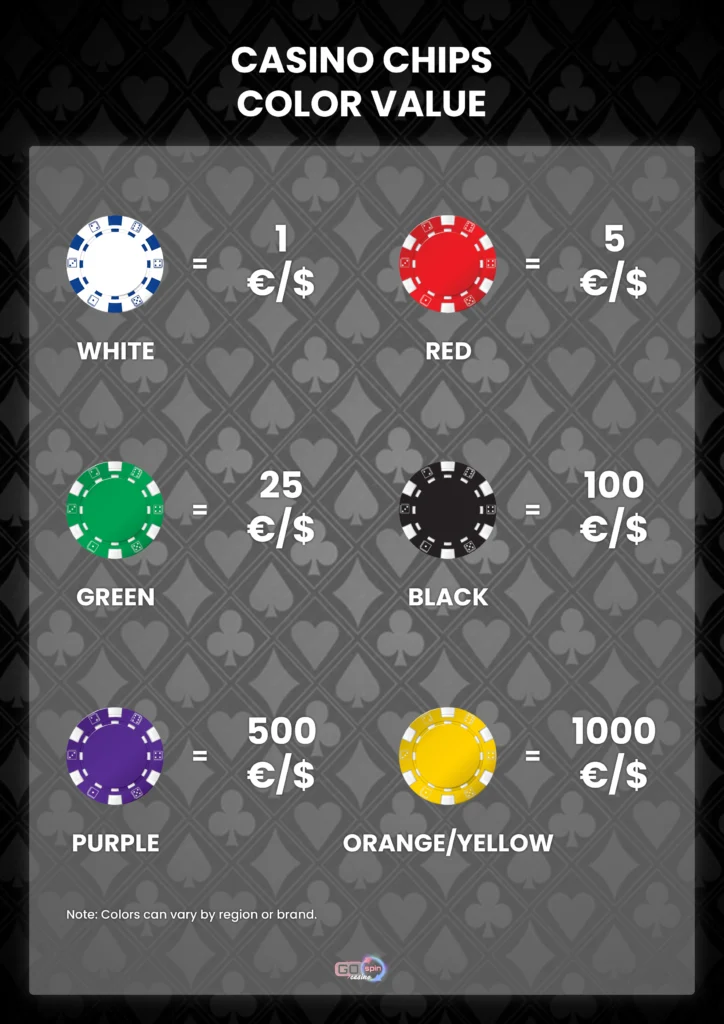
Across most casinos, chip colors follow a consistent logic that helps players and staff recognize value instantly. While palettes can vary by region or brand, the core system stays familiar:
| Color | Common Value (USD) | Notes |
| White | €/$ 1 | Sometimes blue in certain regions |
| Red | €/$ 5 | The classic “redbird” |
| Green | €/$ 25 | Standard for mid-tier table bets |
| Black | €/$ 100 | Common on higher-limit games |
| Purple | €/$ 500 | “Barney” chips, mostly in high-limit |
| Orange/Yellow | €/$ 1,000+ | Often paired with RFID tracking |
In European rooms, denominations track euros and follow similar color logic, with normal variation in shade or edge-spot patterns.
Why it matters: quick visual recognition keeps the game moving. A player or dealer can glance at the felt and know the stakes without reading numbers. That clarity keeps tables running smoothly, and familiar colors make moving between properties effortless.
Why standardization matters
Standardization is not aesthetic, it is operational safety. When chips look and feel consistent across pits and shifts, errors drop. Dealers color up or down without hesitation, surveillance tracks movement more easily, and players feel confident that the value in their stack matches the payout.
It also prevents disputes. If every green equals €/$ 25, there is no ambiguity at settlement. The uniformity keeps hands moving, balances stable, and accounting airtight. Over hundreds of tables and thousands of transactions, that reliability saves serious time and avoids unnecessary confrontations.
Cashless, TITO, and Cards: Do Casinos Still Use Cash?
Where cashless is growing and where chips still dominate
Slot floors have embraced digital. TITO tickets, carded play, and app-based wallets reduce bill jams and speed up cashouts. You insert cash once, then move with tickets or a balance tied to your player card. That solves a real pain point and shortens lines at kiosks.
Live table games are different. Chips still dominate because they keep betting fast, visible, and auditable. Dealers size bets and pay winners in seconds, surveillance reads values at a glance, and players get the tactile ritual that keeps the game engaging. So, do casinos still use cash? Yes, but it usually enters the ecosystem at the cage or buy-in, then becomes chips for the rest of the session.
Hybrids and player experience
Most properties run hybrid flows. You can fund with cash at the cage, a debit on a floor kiosk, or a cashless wallet where available. Once funded, you convert to chips at the table or cage and the game runs at full speed. Can you gamble without cash? On many slot products, yes. On tables, you can often start with a card or wallet, then receive chips for wagering.
This setup balances convenience with control. The cage handles deposits and identity checks, the pit tracks chip inventories, and accounting stays clean across fills and credits. Players get fast sessions and simple cashouts, while the floor keeps the familiar rhythm that chips were built to protect.
Practical Player Questions About Chips
Can a casino refuse to cash chips
Yes, in specific situations. Properties set redemption windows, cap cashouts without ID, and require verification for higher denominations. If chips look altered or are flagged, the cage can hold them for review. Keep your buy-in receipt for high values and cash out at the same property before you travel. House rules apply, and surveillance plus pit records back the cage when something looks off.
Do casino chips expire
Some properties set time limits on redeeming older designs or discontinued series, especially after security upgrades. Others honor legacy chips at the cage only. Practical rule: cash out before leaving town and, if you plan to return later, ask the cage about current validity. Design changes, RFID migrations, or anti-counterfeit updates can retire old stock.
Are chips interchangeable across casinos
Usually no. Chips are branded to a specific property with unique inlays and security cues. Even neighboring properties under the same parent often refuse each other’s chips at the cage. Rare exceptions can exist inside tightly linked resort complexes, but assume you must redeem chips where you played.
How casinos handle counterfeit or stolen chips
Teams use layered checks: feel, artwork, edge spots, and UV markings, then escalate if anything seems off. Higher denominations often carry RFID, so systems can flag suspicious IDs, disable known stolen chips, and create an audit trail. If a chip fails verification, it is pulled and logged, with review across surveillance, pit records, and purchase history.
Conclusion
Casinos use chips instead of cash because chips reshape player behavior, speed up every hand, and add built-in layers of security and control that cash simply can’t match. From the psychology of spending to RFID tracking behind the scenes, chips are the silent system that keeps the casino floor fast, fair, and profitable.
Prefer to test strategy before stepping onto the floor? Head to our Free Casino Games section and practice your betting rhythm. No cash, no pressure, just pure gameplay.
FAQs
Casinos use chips instead of cash because chips make games faster, safer, and more efficient. They help dealers process bets instantly, reduce payout errors, and let casinos track every transaction with precision. For players, chips also change how spending feels — turning real money into easy-to-play units.
In casino psychology, chips act as tokens that detach players from the emotional impact of spending cash. When bets are made with colored chips instead of paper bills, players feel less hesitation and tend to bet more freely. This simple shift in perception keeps games moving and engagement high.
RFID casino chips contain microchips that allow real-time tracking. They help prevent counterfeiting, speed up audits, and make player ratings more accurate. In high-stakes rooms, RFID also lets security flag, disable, or trace stolen chips instantly.
Every casino money chip has unique materials, designs, and security markers like UV ink or microprint. High-value chips with RFID can be verified digitally. If a chip looks off, it’s pulled from play and examined using surveillance and cage logs before being cleared or destroyed.
Yes. A casino can decline to cash chips that are expired, damaged, or not from their property. They can also hold chips for verification or request ID for large cashouts. Always redeem your chips where you played and within the casino’s redemption window.