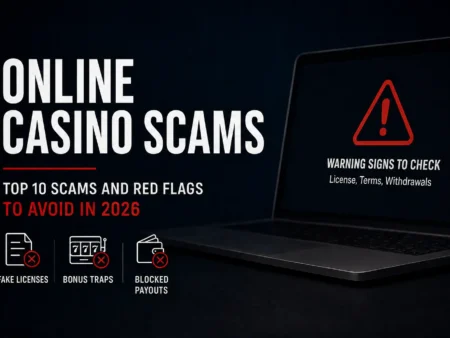

Crypto casino scams are fake or misleading gambling sites, bonus offers, payment flows or support channels designed to take deposits, block withdrawals, abuse player data or hide unfair terms. A safer way to avoid them is to check the licence, operator details, withdrawal rules, bonus terms, KYC policy, game providers and support quality before sending any crypto.
That sounds simple, but it’s exactly where most bad decisions happen. A scammy crypto casino rarely looks broken on the homepage. It usually looks exciting: a huge welcome bonus, instant withdrawals, no-KYC signup, slick game tiles, Bitcoin payments and maybe even a “provably fair” badge sitting neatly in the footer.
The real test doesn’t happen on the homepage. It happens in the boring parts most players skip: licence details, bonus terms, withdrawal limits, support quality, provider authenticity and what the casino says when money is actually involved.
Some crypto casinos are legitimate. Some process real withdrawals, use recognizable providers and explain their terms clearly. But accepting Bitcoin, Ethereum, USDT or any other crypto doesn’t make a casino trustworthy by itself. Crypto is just a payment method. Trust comes from how the operator behaves before and after a player deposits.
This guide focuses on scam detection, which matters wherever someone plays from because legality and legitimacy are not the same thing. Players should always check the gambling rules in their own country before using any casino. Here, the goal is sharper: spotting crypto red flags before the bankroll is already on the line.
Tabla de contenido
- Puntos clave
- The Biggest Crypto Casino Red Flags
- 3-Minute Crypto Casino Scam Checklist
- How Crypto Casino Scams Usually Trap Players
- Bonus and Withdrawal Traps to Check First
- Casino Licence Check: How to Verify a Crypto Casino Before Depositing
- No-KYC Crypto Casinos: Privacy Feature or Red Flag?
- Secure Gambling Means More Than Wallet Security
- What to Do If You Think a Crypto Casino Scammed You
- Final Rule Before Trusting Any Crypto Casino
- Preguntas frecuentes
Puntos clave
- Crypto casinos are not automatically scams, but the space attracts fake operators because deposits are fast and crypto payments can be difficult to reverse.
- The biggest crypto red flags usually appear before deposit: vague licensing, unrealistic bonuses, unclear withdrawals, fake support and weak responsible gambling tools.
- Never send extra crypto to unlock winnings, release a withdrawal, verify a balance or pay a surprise “tax” demanded by the casino.
- No-KYC can be useful for privacy, but it raises the bar for trust. A no-KYC casino needs clearer withdrawal rules, stronger operator transparency and reliable support.
- Before claiming any bonus, check wagering, max cashout, max bet, expiry rules, withdrawal limits and KYC triggers.
The Biggest Crypto Casino Red Flags
The first thing to check at a crypto casino is not the biggest bonus. It is the friction points. Real casinos usually explain the unglamorous details. Fake casinos often hide them behind urgency, big numbers and polished design.
Here are the crypto red flags players should never ignore.


One red flag doesn’t always prove a casino is fake. But when several appear together, the safer move is to walk away before money is involved.
The most dangerous sites tend to be very good at selling the dream and very bad at explaining the process. They show the win first and the rules later. That order is the problem.
3-Minute Crypto Casino Scam Checklist
This checklist is designed for the pre-deposit stage. It is not about proving a site is 100% safe, because no review can guarantee that. It is about deciding whether the trust signals are strong enough to continue.
Licence check: Does the casino list a regulator, licence number, legal operator name and registered domain? If the site only shows a vague “licensed and regulated” claim with no details, that is not enough.
Register check: Can the licence be verified in the official register connected to the licence the casino claims? A static badge in the footer is easy to copy. A live official record is harder to fake.
Ownership check: Is there a real company behind the brand? A trustworthy casino should show more than a brand name, logo and support email.
Bonus check: Do wagering, max cashout, max bet, expiry rules and game contribution match what the bonus page promises? A clean bonus page with messy terms is one of the oldest tricks in online gambling.
Withdrawal check: Are minimum withdrawals, maximum withdrawals, processing times and fees easy to find? If withdrawals are vague, the casino is unfinished at best and risky at worst.
KYC check: Does the casino explain when verification may be requested? “No-KYC” marketing does not mean the casino will never ask questions later.
Provider check: Do the games actually load from legitimate providers, or does the site only display famous logos? A fake casino can copy a footer. It can’t always offer the real game feed.
Provably fair check: Is there a real verification tool for provably fair games, or is the phrase used like decoration? “Provably fair” should come with a process players can actually inspect.
Support check: Does support reply before a deposit is made? A simple question about withdrawals or bonus terms can reveal a lot. If support can’t answer before money is involved, it is unlikely to improve after a cashout problem.
Reputation check: Is there evidence outside the casino’s own website? Search for the brand name plus terms like “withdrawal”, “not paying”, “scam”, “complaint” and “Reddit”. One complaint does not prove fraud, but patterns matter.
Domain check: Does the domain history match the casino’s claimed age? A site that says it has years of happy players but appears to have no footprint until last week deserves suspicion.
Responsible gambling check: Are deposit limits, self-exclusion, time-outs or help resources available? Secure gambling is not just about encryption. It’s also about player protection.
Test check: If a casino passes the basics, is a small test withdrawal possible before serious play? A first deposit should not feel like a trust fall. A small withdrawal can reveal how the cashier really works.
Read Go Spin Casino’s affiliate disclosure for more detail. This does not affect the focus on clear terms, safer play, transparent reviews and responsible gambling.
If a crypto casino fails several of these checks, depositing is not worth the risk. A better next step is to compare the site against what strong online casino reviews should actually cover: licensing, payments, bonus rules, support, UX, providers and player protection.
How Crypto Casino Scams Usually Trap Players
The most useful way to understand fake casinos is to look at patterns. Scam sites change names quickly, but the mechanics often repeat.
Mini-Case 1: The Deposit-to-Unlock Trap
A player sees a promotion promising a large withdrawable balance after a small crypto deposit. The account dashboard shows a fake balance, maybe $2,400 after a $100 deposit, and support says the player just needs to send one more payment to release the withdrawal.
The excuse changes. It might be a verification fee, tax fee, gas fee, anti-fraud deposit or account activation charge. The pressure is always the same: pay now, unlock later.
That is not how a legitimate casino bonus should work. A real casino may require wagering, identity checks or a minimum deposit. It should not keep asking players to send more crypto to unlock money that is supposedly already theirs.
This is one of the clearest fake casino patterns because the site turns withdrawal into a paywall. Once a player sends the first extra payment, another fee often appears.
Una licencia no garantiza que un casino sea perfecto. Los casinos con licencia pueden seguir ofreciendo bonificaciones poco atractivas, pagos lentos o un servicio de atención al cliente deficiente. Sin embargo, si no es posible comprobar la licencia, el jugador cuenta con muy poca protección en caso de que surja algún problema.
Antes de confiar en cualquier casino, la pregunta fundamental es sencilla: ¿quién gestiona esta página web y quién les exige que rindan cuentas?
Mini-Case 2: The Clone Casino
A clone casino can look surprisingly polished. It may have a modern lobby, provider logos, a live chat icon, a bonus page and a crypto cashier. The problem is in the details. The domain is very new, the terms read like they were copied from another site, the operator name is missing and the same layout appears under different casino names.
These sites are built to be disposable. If one name gets exposed, another one appears with a similar template, a new domain and the same promises.
When a casino has no meaningful brand footprint, no proper company details and a layout that feels recycled, caution is the right response. A pretty interface is not proof of a real operation. It is just packaging.
Mini-Case 3: The No-KYC Until You Win Casino
No-KYC can be a legitimate privacy feature, but it can also be used as bait.
The pattern usually looks like this: registration is instant, deposits work smoothly and the casino advertises fast withdrawals. Small players may even get tiny cashouts. Then someone wins a larger amount, requests a withdrawal and suddenly the rules change.
Support asks for unclear verification. The casino says the account is under review. The withdrawal stays pending. The player is told to wait, resubmit documents or prove something that was never mentioned clearly in the terms.
KYC is not automatically suspicious. Casinos may need verification for fraud prevention, age checks or regulatory reasons. The red flag is when a casino sells itself as no-KYC but only explains serious verification demands after the player wins.
Mini-Case 4: The Fake Support or Recovery Scam
Some scams don’t end when the casino stops paying. They move into a second stage.
A player complains publicly about a blocked withdrawal. Then someone claiming to be support, a recovery agent or a blockchain specialist offers help. They ask for wallet access, seed phrases, remote access, an upfront recovery fee or another payment to “release” the funds.
That is a second trap. Never share seed phrases. Never hand over wallet access. Never pay strangers who promise guaranteed crypto recovery.
If the original casino already behaved badly, anyone asking for more money around the same withdrawal should be treated with extreme caution.
Bonus and Withdrawal Traps to Check First
The bonus page is often where fake casinos look their best. A huge percentage match, free spins, cashback, rakeback and instant crypto cashout can make the offer feel irresistible. That is exactly why the terms matter more than the headline.
A casino bonus should not be judged only by the number. It should be judged by whether the money can realistically be withdrawn.
A strong bonus page should explain the basics clearly: minimum deposit, wagering, expiry period, max bet, max cashout, eligible games and country restrictions. If the casino hides those details, the headline is doing too much of the work.


Some of these issues can appear at weak casinos that are not outright scams. That still matters. From a player’s perspective, an unfair term can feel almost as damaging as a fake site if it blocks a legitimate withdrawal.
For a deeper bonus-specific breakdown, use Go Spin Casino’s guide to bonos de casinos de criptomonedas. A crypto bonus should be judged by its rules, not just by the percentage on the banner.
Crypto Casino Withdrawal Red Flags to Check Before Cashout
Withdrawals tell players more about a casino than deposits ever will.
A deposit system is designed to be smooth. That part is easy. The real test comes when the casino has to send money back.
The first crypto casino withdrawal red flag is a missing withdrawal page. If the casino talks endlessly about fast deposits but gives almost no information about withdrawals, that is a problem. Players should be able to find minimum cashout, maximum cashout, estimated processing times, supported coins, network fees and any account checks that may apply.
Another red flag is a minimum withdrawal that is much higher than the minimum deposit. A casino that lets players deposit small amounts but makes cashout difficult may be creating friction on purpose.
Pending periods also matter. Some casinos review withdrawals manually, which can be normal. But if there is no stated timeline, no status update and no explanation, the player is stuck in the dark.
The worst sign is an extra payment request before cashout. If support says more crypto is required to release winnings, pay a tax, activate an account or verify a wallet, that is a serious reason to stop.
Bonus-related withdrawals deserve special attention. If winnings are voided under vague language like “bonus abuse” with no clear rule broken, the casino has too much room to move the goalposts.
Casino Licence Check: How to Verify a Crypto Casino Before Depositing
“Check the licence” is common advice, but it is useless unless players know how to do it.
The register that matters is the official register or validation page connected to the licence the casino claims to hold. The reader’s country is not the deciding factor. The casino’s claimed licence is.
If a casino claims a Curaçao licence, check the relevant Curaçao register or official licence validation page. If it claims an MGA, UKGC, Kahnawà:ke or Isle of Man licence, check the relevant official register. Do not assume a footer badge is enough.


A proper casino licence check should look at more than the logo.
Check the licence number. Check the regulator name. Check the legal operator name. Check the registered domain. Check whether the licence is active, suspended, revoked or unrelated to the casino.
Then compare the details. Does the domain listed by the regulator match the domain being used? Does the operator name in the casino’s terms match the licence holder? Does the casino claim one company in the footer and another in the T&Cs?
Mismatches matter. They may be administrative mistakes, but they may also show that a casino is borrowing credibility from another entity.
A verified licence is a trust signal, not a guarantee. It does not prove a casino will treat every player fairly, pay every withdrawal quickly or write good bonus terms. It simply lowers one layer of risk. Players still need to check withdrawals, player complaints, support quality, provider authenticity and responsible gambling tools.
If a casino claims to be licensed but gives no searchable details, treat that as a red flag. Real operators should make verification easier, not harder.
No-KYC Crypto Casinos: Privacy Feature or Red Flag?
No-KYC casinos are popular for a reason. Players like fast registration, fewer documents and more privacy. In crypto gambling, that can be part of the appeal.
No-KYC is not automatically bad. Some operators use lighter registration while still maintaining clear rules, fair withdrawals and responsible gambling tools. The issue is that no-KYC removes one layer of traditional friction, so the rest of the casino needs to work harder to earn trust.
A no-KYC crypto casino should be clear about withdrawals. It should explain whether verification may ever be requested, when that might happen and what documents could be required. If the answer is vague, that is a problem.
The worst version is “no-KYC until you win”. The casino advertises privacy to get players in, then freezes withdrawals under unclear verification rules after a successful session.
No-KYC plus anonymous ownership is a bad combination. No-KYC plus vague bonus terms is also a bad combination. No-KYC plus support that only replies through Telegram is even worse.
Privacy is valuable, but it should not replace basic trust signals. If the casino wants less friction from the player, there should be more clarity from the operator.
Secure Gambling Means More Than Wallet Security
The phrase secure gambling gets thrown around too casually. In crypto casinos, people often reduce it to wallet safety, 2FA and HTTPS. Those things matter, but they are only one layer.
A secure gambling environment has three parts: platform security, operator security and player protection.
Platform Security
At the platform level, players should expect HTTPS, 2FA, a clean cashier flow and clear wallet deposit instructions. The casino should never ask for a seed phrase, private key or suspicious wallet connection that does not make sense for a gambling deposit.
Crypto payments require extra care because a wrong address or malicious prompt can be expensive. A good cashier should make supported coins, networks and deposit instructions clear before the player sends funds.
Operator Security
Operator security is about who is behind the casino and whether the site works like a real gambling business.
Look for transparent company details, a verifiable licence, recognizable providers, clear withdrawal rules, accessible support and consistent terms. If the homepage says one thing, the bonus page says another and support gives a third answer, that setup is weak.
Game providers matter too. A casino may display logos from major studios, but players should check whether the games actually load properly and match the provider experience. Footer logos alone are not proof.
If slot quality and game information matter, it also helps to check RTP before you play slots. Fake or low-quality game environments often hide behind familiar-looking thumbnails.
Player Protection
Secure gambling also means the casino gives players tools to control their play.
Deposit limits, time-outs, self-exclusion, reality checks and responsible gambling information are not just compliance decoration. They show whether the operator thinks about player protection beyond deposits.
Clear country restrictions matter too. A casino that allows signups from restricted markets and only mentions exclusions after a withdrawal request creates avoidable risk.
The best player protection habit is simple: set limits before the session gets emotional and Juegue responsablemente, especially when crypto deposits make funding an account feel instant.
What to Do If You Think a Crypto Casino Scammed You
If a crypto casino scam is suspected, the first priority is not revenge. It is stopping further loss and preserving evidence.
Crypto casino scams sit inside a wider crypto-fraud environment, where official consumer-protection and cybercrime agencies regularly warn about fake platforms, irreversible payments and recovery scams. The lesson for players is simple: prevention matters more than cleanup.
Crypto transactions can be difficult to reverse once confirmed, so every extra payment can make the situation worse. Do not pay “taxes”, “unlock fees”, “verification fees”, “release fees” or any other surprise charge demanded before withdrawal.
Start by saving everything: screenshots of the balance, bonus page, T&Cs, withdrawal request, account status and support chat. Save transaction hashes, wallet addresses, timestamps and email confirmations. If the casino later changes terms or deletes pages, those records matter.
Contact the casino once through official support channels. Do not continue through Telegram DMs, Discord accounts or people claiming to be private agents unless those channels are clearly listed by the casino itself.
If the casino claims a licence, report the issue to the regulator named by the casino. Reporting routes vary by country, so also check the consumer-protection, cybercrime or financial-fraud channels available locally.
If an exchange, wallet provider or payment platform was used, report suspicious activity there too. They may not be able to recover funds, but they can sometimes flag addresses or provide guidance.
If direct support fails and the casino is listed on Go Spin Casino, the quejas sobre casinos en línea process may be relevant. Evidence matters here, so keep the timeline clear and factual.
Be especially careful with recovery services. Some are scams built on top of the original scam. If someone promises guaranteed recovery in exchange for upfront payment, wallet access or seed phrases, walk away.
Also, do not chase losses. A scam casino wants the player emotionally invested, frustrated and willing to send “one more” payment. That is exactly when bad decisions happen fastest.
Final Rule Before Trusting Any Crypto Casino
If a casino hides the boring details, do not trust the exciting ones.
A real operator should be able to show who runs the site, what licence covers the brand, how withdrawals work, what rules apply to bonuses, what happens during verification and how disputes are handled. Those details are not side notes. They are the foundation.
Crypto casinos can be fast, transparent and useful when the operator is serious. They become risky when crypto is used as a shortcut around accountability.
The homepage sells the dream. The licence, terms, cashier, support and responsible gambling tools show whether the casino deserves serious attention.
Run the checklist before sending crypto to any casino. Then compare reviews, read the bonus terms, check the licence claim and only deposit when the trust signals are clear.
A smarter next step is to compare crypto casinos through reviews that break down the bonus rules, payment options, withdrawal limits, game providers and player protection tools. That way, the decision starts with evidence, not just a big welcome offer.
Preguntas frecuentes
Some crypto casinos are legitimate, but accepting crypto does not prove safety. A stronger casino should show a verifiable licence, transparent operator details, clear withdrawal rules, fair bonus terms, real providers and responsive support. Treat crypto support as a payment feature, not a trust signal.
Common signs of a fake crypto casino include no verifiable licence, anonymous ownership, unrealistic bonuses, deposit-to-unlock winnings, no clear withdrawal policy, fake support, cloned design and missing responsible gambling tools. One warning sign may not prove fraud, but several together are a reason to walk away.
The biggest red flags are hidden ownership, fake licensing, bonuses that look too generous to be real, unclear withdrawal terms, support that only works before deposit, sudden KYC after a win and any request to send more crypto before receiving a withdrawal.
The most common crypto casino scams include fake casino websites, clone casinos, bonus traps, withdrawal traps, fake customer support, wallet drainer prompts, fake celebrity promotions and recovery scams. These scams often look different on the surface, but most rely on urgency, confusion and extra payments.
Una racha de derrotas no demuestra que un casino esté amañado. Entre las señales de alerta más evidentes se encuentran los proveedores falsos, la falta de información sobre las pruebas realizadas, las afirmaciones sospechosas sobre el RTP, los juegos copiados, la ausencia de una licencia verificable y las quejas repetidas sobre un juego desleal o el bloqueo de pagos.