

Steam in sports betting is a rapid, significant move in odds or a betting line that spreads in the same direction across multiple sportsbooks. This is known as a steam move.
Sharp bettors or betting syndicates can trigger this type of movement, but new information such as injuries, lineup changes or other market updates can have the same effect. A steam move shows that the market has adjusted quickly, but it does not tell you on its own why the move happened, whether the selection will win or whether the new price still offers value.


Spis treści
How Does a Steam Move Work?
A steam move usually begins when betting activity or new information causes one or more sportsbooks to reassess the price of an outcome. One operator may move first after accepting significant action or reacting to a market update.
Other sportsbooks monitoring the same event can then adjust their own prices. When those changes spread quickly across several operators in the same direction, the movement starts to resemble steam rather than an isolated adjustment.
Consider this fictional example:
| Zakłady sportowe | 12:00 | 12:04 |
| Sportsbook A | 2.10 | 1.90 |
| Sportsbook B | 2.08 | 1.91 |
| Sportsbook C | 2.11 | 1.89 |
| Sportsbook D | 2.09 | 1.92 |
If only Sportsbook A changed from 2.10 to 1.90, that could simply reflect an adjustment specific to that operator. In this example, however, all four sportsbooks have shortened the same outcome substantially within four minutes.
That combination of speed and wider market participation is what bettors commonly describe as steam. Sports Insights uses a similar definition, describing steam moves as sudden and substantial movement across the wider betting market.
Steam does not have to involve decimal odds alone. A point spread could move from -3 to -3.5, while a totals market might shift from 2.5 to 3.0 or keep the same total while the price attached to either side changes.
If the distinction between the market, line and price is unclear, our guide to reading a sports betting line explains how those elements fit together.
There is no widely accepted industry threshold that defines steam according to a fixed number of sportsbooks, a specific amount of movement or a set time window. In practice, the most useful signs are that the move happens quickly, the change is meaningful and several sportsbooks are moving in the same direction.


What Causes Steam Moves?
ThSharp betting is closely associated with steam because sportsbooks may respond quickly to wagers placed by professional or highly skilled bettors. However, professional action is only one possible explanation.
Aktualności, changes in available information and sportsbooks reacting to movements elsewhere can create very similar patterns.


Sharp Money and Betting Syndicates
Sharp money is a common term for betting activity from professional or highly skilled bettors whose wagers may carry more weight in a sportsbook’s assessment of a market.
Sportsbooks do not necessarily respond only to the total amount being wagered. If a bettor has a track record of identifying mispriced lines, the operator may consider that action more informative than an equivalent recreational wager.
This relationship between professional betting activity and market movement is central to how sharp betting is interpreted in sports betting markets.
Betting syndicates can create similar pressure across several operators because they may coordinate wagers at multiple sportsbooks. If several operators receive meaningful action on the same outcome within a short period, prices can begin moving together.
This is why steam is often associated with professional betting, but the terms should not be treated as interchangeable. Sharp money refers to the source of the betting activity, while steam refers to the movement that appears in the market.
Aktualności and Market Information
Unexpected information can move sportsbooks just as quickly as professional betting activity. A key player being ruled out, a surprise starting lineup, a late roster change, significant weather developments or changes in playing conditions can all alter expectations for an event.
Bettors may respond immediately, while sportsbooks can also adjust their own prices without waiting for large volumes of money to arrive.
The timing of a move therefore matters. If important team or event information becomes public immediately before several sportsbooks make similar adjustments, there may be a clear informational reason for the movement.
In that situation, assuming that sharp bettors caused the steam would add a level of certainty that the movement itself does not support.
Sportsbooks Reacting to the Wider Market
A sportsbook does not always need to receive the original wager before changing its own price. Operators monitor prices elsewhere and may reassess their numbers if an influential sportsbook makes a meaningful adjustment.
Remaining significantly out of line with the wider market can leave an operator offering a price that other sportsbooks have already decided is no longer appropriate.
This can create a chain reaction in which an initial move is followed by adjustments elsewhere until the broader market settles around a new range. Market-following behaviour is one reason steam can spread from an originating sportsbook to the wider market.
Seeing several sportsbooks move together therefore tells you that the market changed quickly, but it does not necessarily reveal which bettor, sportsbook or piece of information started the process.
Steam vs Line Movement, Sharp Money and Reverse Line Movement
Steam is related to several other sports betting terms, but each describes a different part of the market.
| Termin | What It Describes | Key Difference |
| Line movement | Any change in betting odds or a line | Can be gradual or isolated |
| Steam move | A fast, meaningful move across multiple sportsbooks | Describes how the wider market moved |
| Sharp money | Betting activity from professional or respected bettors | Describes who is betting |
| Reverse line movement | A line moving against the side receiving the apparent majority of public bets | Describes movement relative to reported public action |
Every steam move is a form of line movement, but not every change in a betting line qualifies as steam. One sportsbook moving Team A from 2.10 to 2.08 would normally be an ordinary price adjustment.
If several sportsbooks move the same outcome from around 2.10 to around 1.90 within a short period, the movement is broader and much closer to what bettors mean by steam.
Reverse line movement describes something different. It refers to the direction of the line relative to reported public betting activity rather than the speed or reach of the movement itself.
Reverse line movement and steam can occur at the same time, but one does not imply the other.
What Is Chasing Steam?
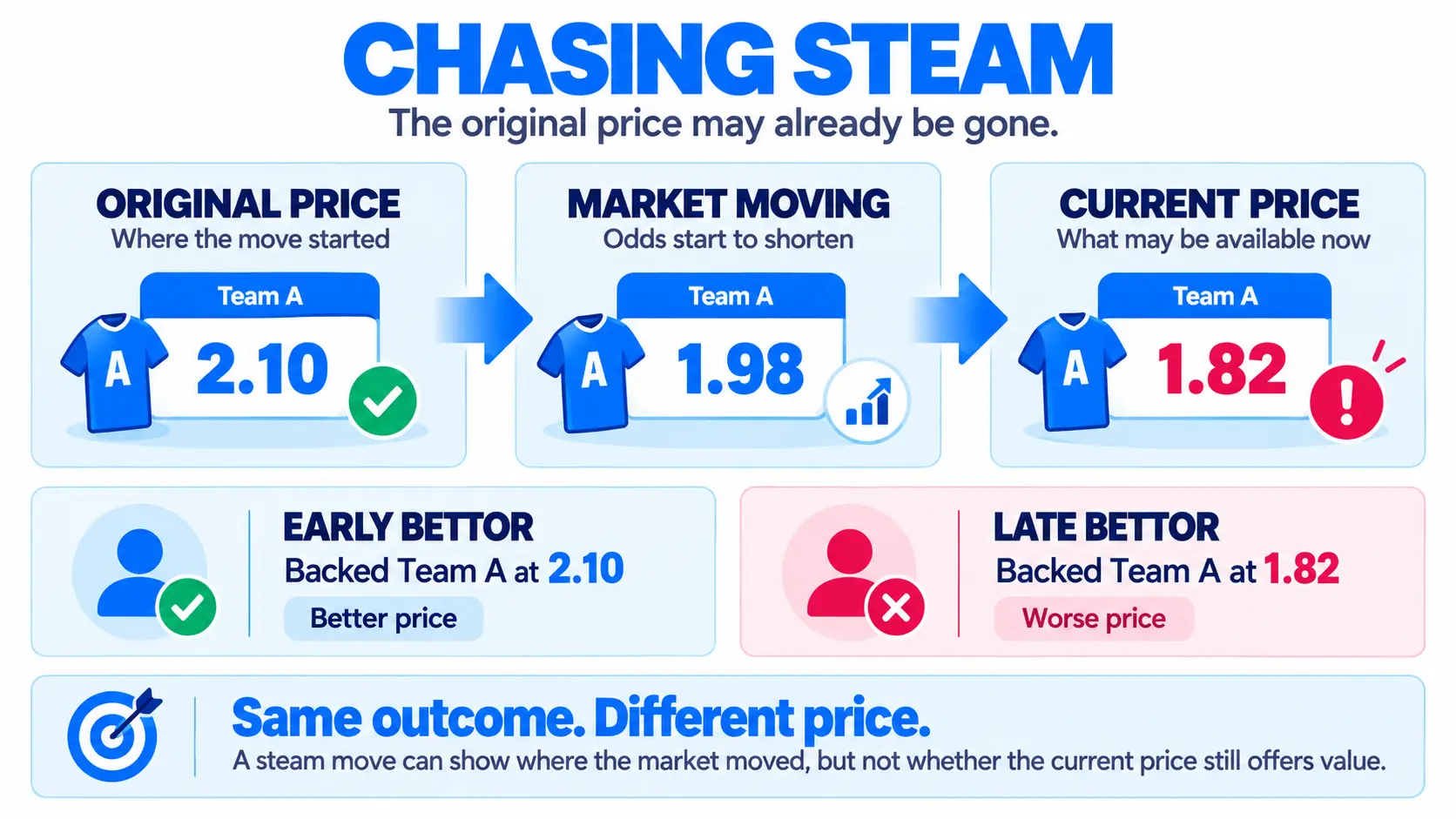
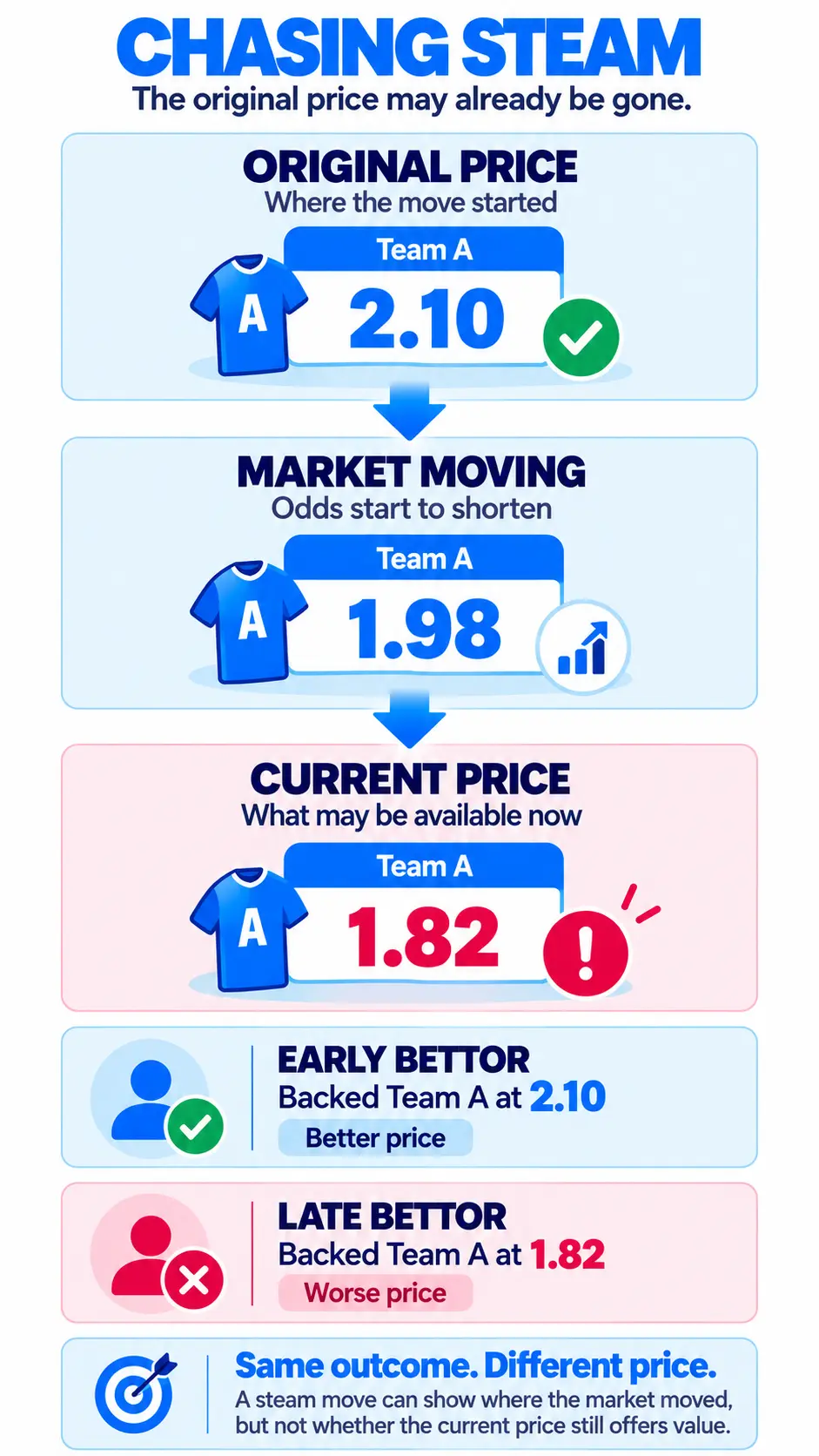
Chasing steam means trying to obtain an earlier price after the wider betting market has already started moving. If Team A is initially available at 2.10 and the market begins shortening that price through 1.98 toward 1.90, someone chasing steam may search other sportsbooks for an operator that is still offering 2.10 or 2.05.
A price that has not yet adjusted to the broader market is often described as a stale line. The basic idea behind chasing steam is to find a slower-moving sportsbook that still has an earlier number available.
In modern betting markets, those differences can disappear quickly because operators monitor many of the same events and can update their prices within a short period.
The important point is that the price available after a steam move may no longer resemble the one that originally attracted betting activity.
If Team A moves from 2.10 to 1.98 and then to 1.82, a professional bettor who considered 2.10 attractive has not made the same wager, in pricing terms, as someone entering later at 1.82. The outcome is identical, but the implied probability and potential return are not.
To jest miejsce expected value in betting becomes relevant. Whether a price is attractive depends on how it compares with the bettor’s estimate of the probability of the outcome, not simply on the fact that the market has already moved in that direction.
Steam can therefore provide useful information about market behaviour without automatically making the price available afterward attractive.
How to Read a Steam Move
Crypto payments give scammers another layer of technical language to exploit. Requests involving wallets, addresses and transaReading a steam move properly requires more than identifying which side of the market shortened. The speed and size of the move matter, but so do the number of sportsbooks involved, the type of market, any new information available at the time and the difference between the original and current price.
1. How Fast Did the Market Move?
Speed is one of the clearest characteristics of steam. A price that changes gradually over several hours is different from several sportsbooks making similar adjustments within a few minutes.
There is no fixed time limit that separates steam from ordinary movement. The useful question is whether operators appear to be reacting quickly to the same betting pressure or information.
2. How Many Sportsbooks Moved?
An adjustment at one sportsbook can reflect circumstances specific to that operator, including its own exposure or pricing.
When several sportsbooks make similar changes around the same time, there is stronger evidence that a broader market move is underway. The prices do not need to become identical; what matters is that they are moving in the same general direction.
3. How Large Was the Change?
The size of the adjustment helps provide context. A move from 2.10 to 2.08 is relatively small, while a change from 2.10 to 1.90 represents a much more substantial reassessment of the outcome.
Size should still be considered alongside speed and the number of sportsbooks involved. A large adjustment at a single operator does not necessarily amount to steam.
4. What Happened When the Move Started?
Market context can sometimes explain the movement more clearly than the odds themselves. Injury news, starting lineups, roster changes, weather or other event-specific information may appear shortly before prices begin changing.
If an important update immediately precedes the move, that provides a plausible reason for sportsbooks to adjust without assuming that professional betting activity was responsible.
5. What Type of Market Is Moving?
Different betting markets can react very differently to the same amount of money. An early or relatively inactive market with lower limits may move on modest betting activity.
A mature and heavily traded market may absorb considerably more action before showing an equivalent change. The size of a steam move therefore does not, by itself, reveal how much money was wagered.
6. What Price Is Available Now?
The final consideration is the price currently available compared with the point where the move began.
Steam can show that the market reassessed an outcome quickly, but by the time the movement becomes obvious, much of that adjustment may already be reflected in the odds.
If the market has moved from 2.10 to 1.82, the direction of the steam and the attractiveness of 1.82 are separate questions and should be treated that way.
Interpreting Steam in Context
Steam is most useful as an indication that the wider betting market has changed quickly. It does not establish with certainty what caused the movement, who initiated it or what the eventual result will be.
Looking at the speed and size of the move, how many sportsbooks followed, what information was available at the time and how far the current price has shifted from the original one gives a more complete picture than simply following the direction of the odds.
Często zadawane pytania
A steam move is a rapid, significant change in odds or a betting line that appears across multiple sportsbooks in the same direction. It usually shows that the wider market is reacting to betting activity, new information or changes made by influential sportsbooks.
No. A steam move describes how quickly and broadly a betting line changes across sportsbooks, while reverse line movement refers to a line moving against the side receiving the apparent majority of public bets. The two can happen at the same time, but they describe different market behaviour.
No. Sharp bettors and betting syndicates can cause steam, but they are not the only explanation. Injury news, lineup changes, weather or sportsbooks reacting to movements elsewhere can also cause several operators to adjust their prices quickly.
Look at how quickly the odds changed, how large the move was and how many sportsbooks moved in the same direction. A large adjustment at one sportsbook alone is not necessarily steam; the term is generally used when similar movement spreads through the wider market.
A steam move can provide useful information about how the market is reacting, but it should not be followed automatically. By the time the move becomes visible, the original price may already be gone, meaning the odds available now may offer very different value from the price that first attracted the betting activity.