
PK in soccer betting means Pick’em or Pick. It is a zero-handicap line where neither team gets a goal advantage. Your selected team must win for the bet to cash, while a draw usually results in a push, meaning your stake is returned.
If you’ve ever opened a soccer betting market and seen PK next to a team, it’s easy to see why it feels confusing. In football language, PK looks like it could mean penalty kick. On a sportsbook, it usually means something very different.
You may see the same type of line displayed as PK, Pick, Pick’em, 0, 0.0, +0, -0 ou Asian Handicap 0. The label changes by sportsbook, but the idea is usually the same: no team starts with a handicap advantage.
That draw protection is the whole reason PK matters in soccer. In a sport where 1-1 can feel like the most natural scoreline in the world, removing the draw as a losing result changes the bet completely.
If you’re looking at a PK line right now and wondering whether to take it, compare the Draw No Bet price first. If both markets have the same odds and the same settlement rules, they are effectively the same bet. If one pays more, that’s usually the better number.
Table des matières
How a PK Soccer Line Works
UN PK soccer line is best explained with a betting slip.
Say the market is:
Liverpool PK vs Chelsea
Odds: 1.87 decimal, or -115 American
Stake: €100
If Liverpool win, the bet wins. At 1.87 odds, your €100 stake returns €187 total, which is €87 profit plus your original stake.
If the match ends in a draw, the bet pushes. A push in betting means no win and no loss. Your €100 stake is returned, but you don’t make profit.
If Chelsea win, the bet loses. You lose the €100 stake.
PK protects you from the draw, but the sportsbook usually charges for that protection through shorter odds.
That’s why PK should not be treated as a safer bet by default. It should be treated as a price decision.
If Liverpool are 2.60 on the 1X2 market and 2.20 on PK, the sportsbook is giving you draw protection, but you’re accepting a smaller payout if Liverpool win. The question is whether that tradeoff is worth it.
PK vs 1X2 Moneyline in Soccer Betting
For European football bettors, the standard market is usually 1X2:
1 means home win.
X means draw.
2 means away win.
Some sportsbooks call this the soccer moneyline, especially in US-facing markets. But for most European readers, 1X2 is the normal starting point. PK is the extra market you compare against it.
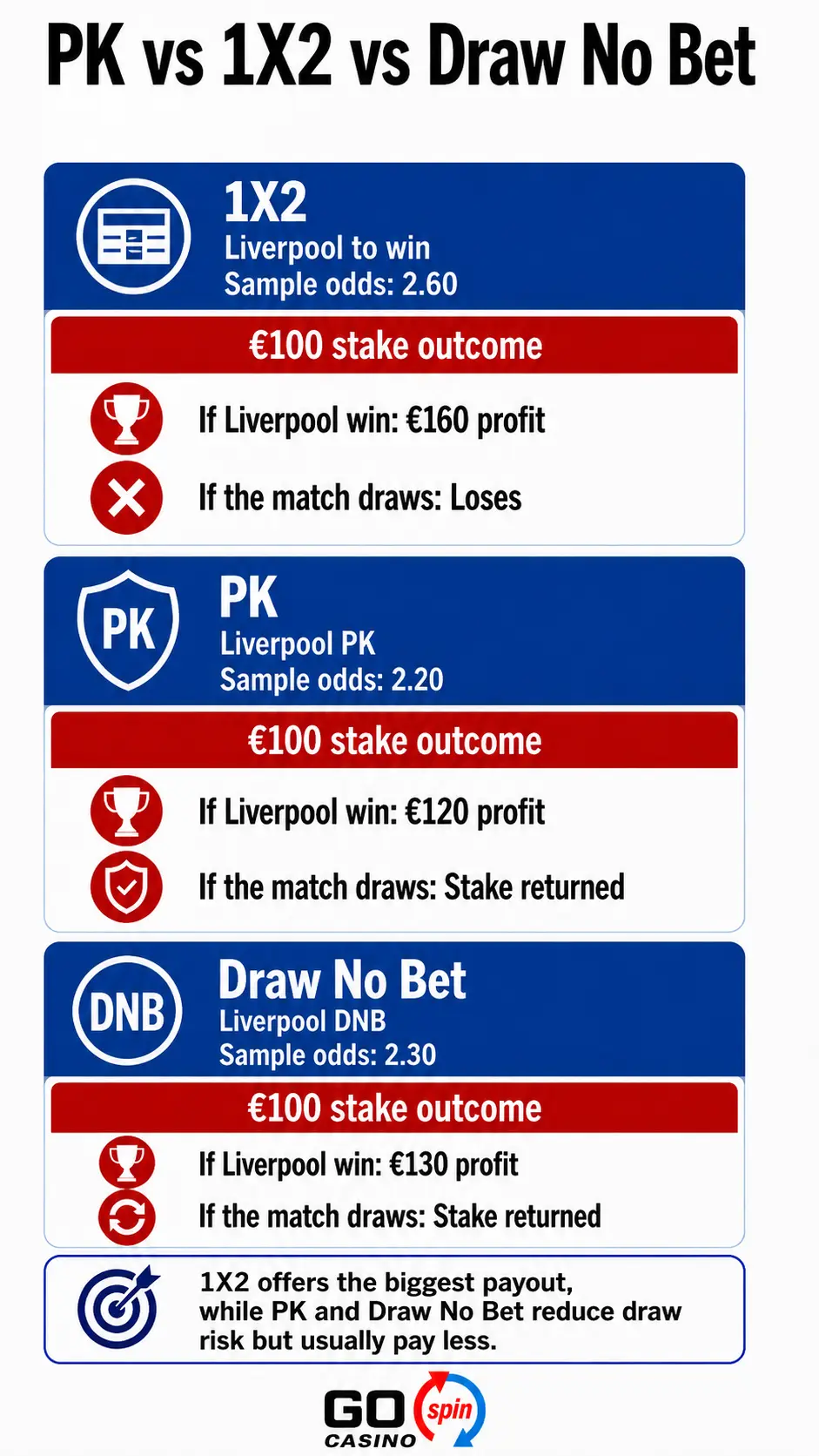

These are sample odds, not current prices.
The 1X2 price is higher because the draw can beat you. PK and Draw No Bet are usually lower because the draw is no longer a full losing result.
So the real question for a bettor is not “what is PK?” for very long. It quickly becomes:
When does PK give me better value than the Draw No Bet market I already understand?
If PK and Draw No Bet settle the same way, the better price matters. If Liverpool PK is 2.20 and Liverpool Draw No Bet is 2.30 under the same 90-minute settlement rules, the 2.30 is the stronger number.
If the PK price is better, or if the sportsbook gives more liquidity in the handicap market, then PK becomes more interesting.
That’s the practical edge: not memorising another betting term, but comparing the market properly before clicking confirm.
PK vs Draw No Bet: Same Outcome, Different Market
PK and Draw No Bet often lead to the same settlement in regular soccer betting.
Your team wins, your bet wins.
The match draws, your stake comes back.
Your team loses, your bet loses.
For casual bettors, that can feel identical. In many cases, it effectively is.
The difference is how the sportsbook packages the market.
Draw No Bet is usually a standalone market. It tells you clearly that the draw is removed.
PK is usually listed inside handicap or spread markets. That means it may sit beside lines like -0.25, +0.25, -0.5 and +0.5. On some sportsbooks, PK is shown as Asian Handicap 0.0.
This matters because once you’re inside handicap markets, nearby lines may settle differently. A player who understands PK but blindly clicks -0.25 because the odds look better can get a nasty surprise if the match ends in a draw.
The rule is simple: if PK and Draw No Bet have the same settlement rules, compare the odds and take the better price. If the rules are not clear, don’t assume they’re identical.
Settlement Rules: 90 Minutes, Extra Time and Penalties
This is one of the most important details in soccer betting, especially in cup matches.
Most standard match markets are settled on 90 minutes plus stoppage time. Extra time and penalties usually do not count unless the sportsbook clearly says they do.
That means a team can qualify, but your PK bet may still not win.
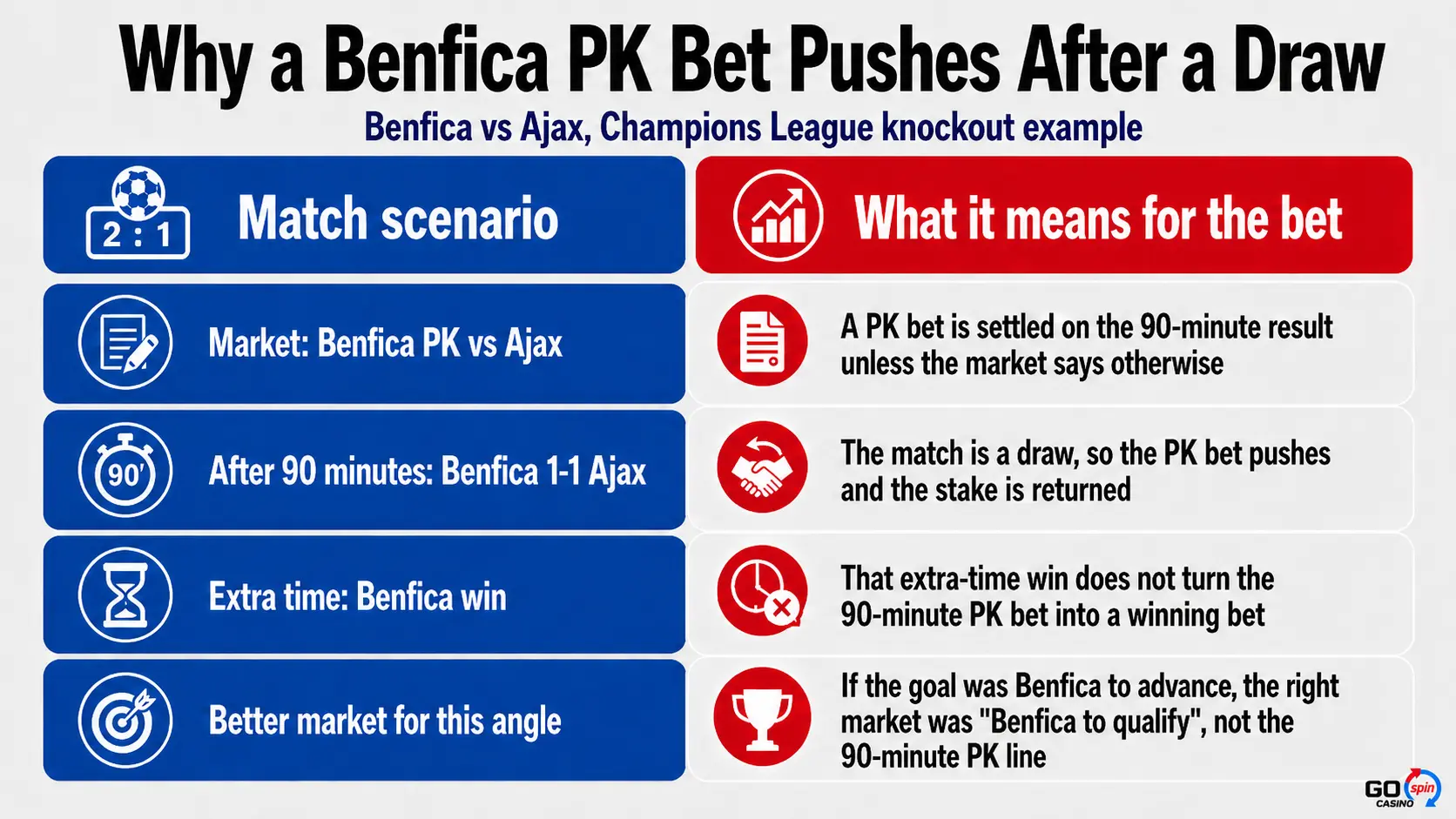
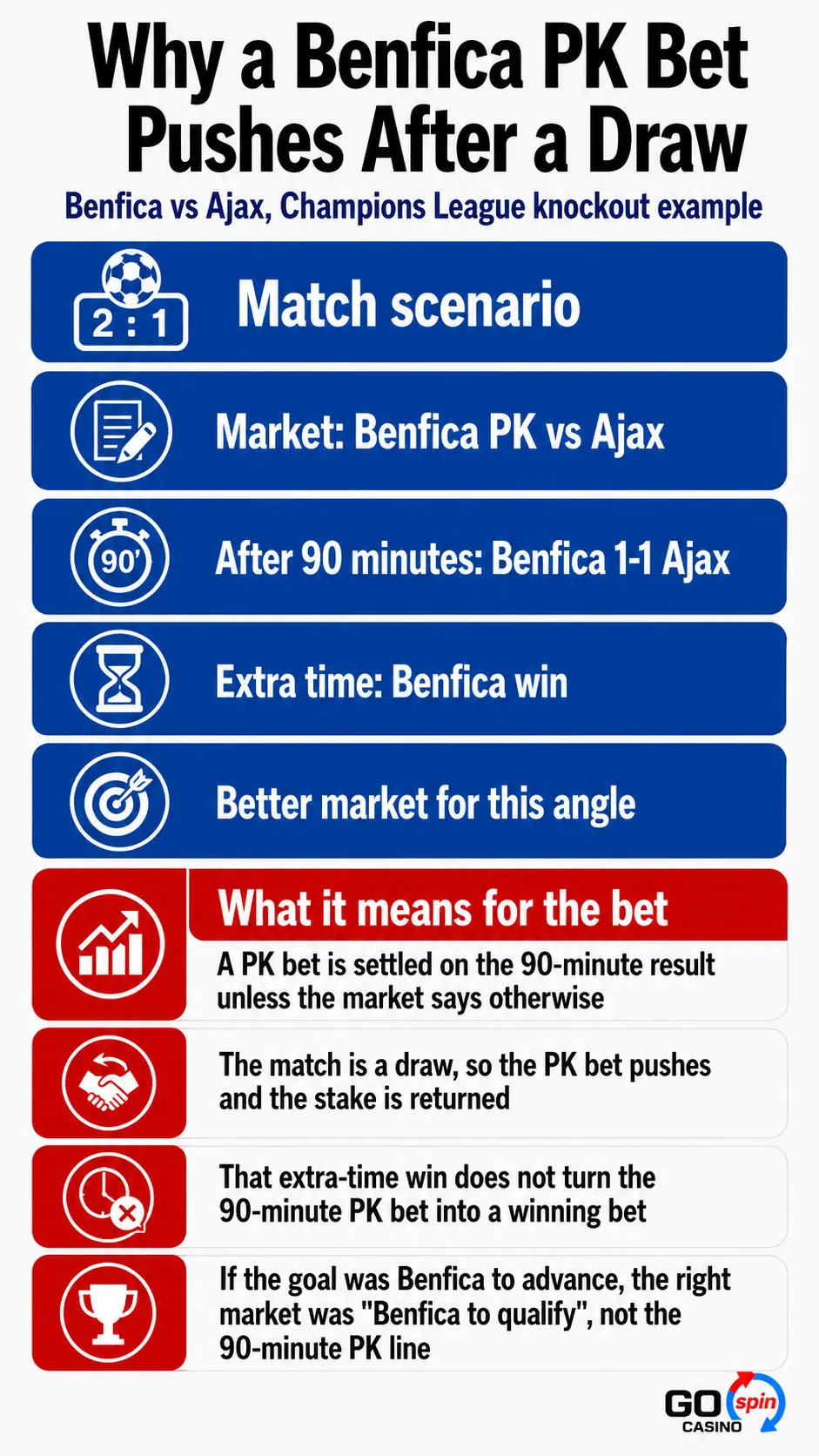
This is where market selection matters. Plenty of bettors get the match prediction right but the market wrong. They back the better team, the team advances, but the bet doesn’t settle the way they expected because they ignored the market rules.
Before betting PK in knockout football, check whether the market is for the 90-minute result, qualification, trophy winner, extra time included or penalties included. The difference is not cosmetic. It changes the bet.
PK vs Asian Handicap 0.0 and Quarter Lines
PK is closely linked to Asian Handicap 0.0.
Asian Handicap 0.0 usually works like a PK bet:
Team wins, bet wins.
Match draws, stake returned.
Team loses, bet loses.
That part is clean.
The confusion starts when bettors move from Asian Handicap 0.0 to quarter lines like -0.25 ou +0.25.
Quarter lines split your stake across two handicap positions.
| Arsenal -0.25 Scenario | What Happens With a €100 Stake |
|---|---|
| How the bet is split | €50 goes on Arsenal 0.0 and €50 goes on Arsenal -0.5 |
| Arsenal win | Full bet wins |
| Match draws | €50 on Arsenal 0.0 pushes, €50 on Arsenal -0.5 loses. So if Arsenal draw, you don’t get a full refund. You lose half your stake. |
| Arsenal lose | Full bet loses |
Now flip it:
| Chelsea +0.25 Scenario | What Happens With a €100 Stake |
|---|---|
| How the bet is split | €50 goes on Chelsea +0.5 and €50 goes on Chelsea 0.0 |
| Chelsea win | Full bet wins |
| Match draws | €50 on Chelsea +0.5 wins, €50 on Chelsea 0.0 pushes. So if Chelsea draw, half the bet wins and half the bet is refunded. |
| Chelsea lose | Full bet loses |
This is why PK is useful to learn first. Once you understand the zero line, you can read the lines around it with less guesswork.
Why Can a PK Soccer Line Have Plus or Minus Odds?
A common beginner question is: if PK means pick’em, why does one team have shorter odds?
Because PK describes the handicap, not the payout.
The handicap is zero. The odds still reflect probability, market movement and sportsbook margin.
Exemple:

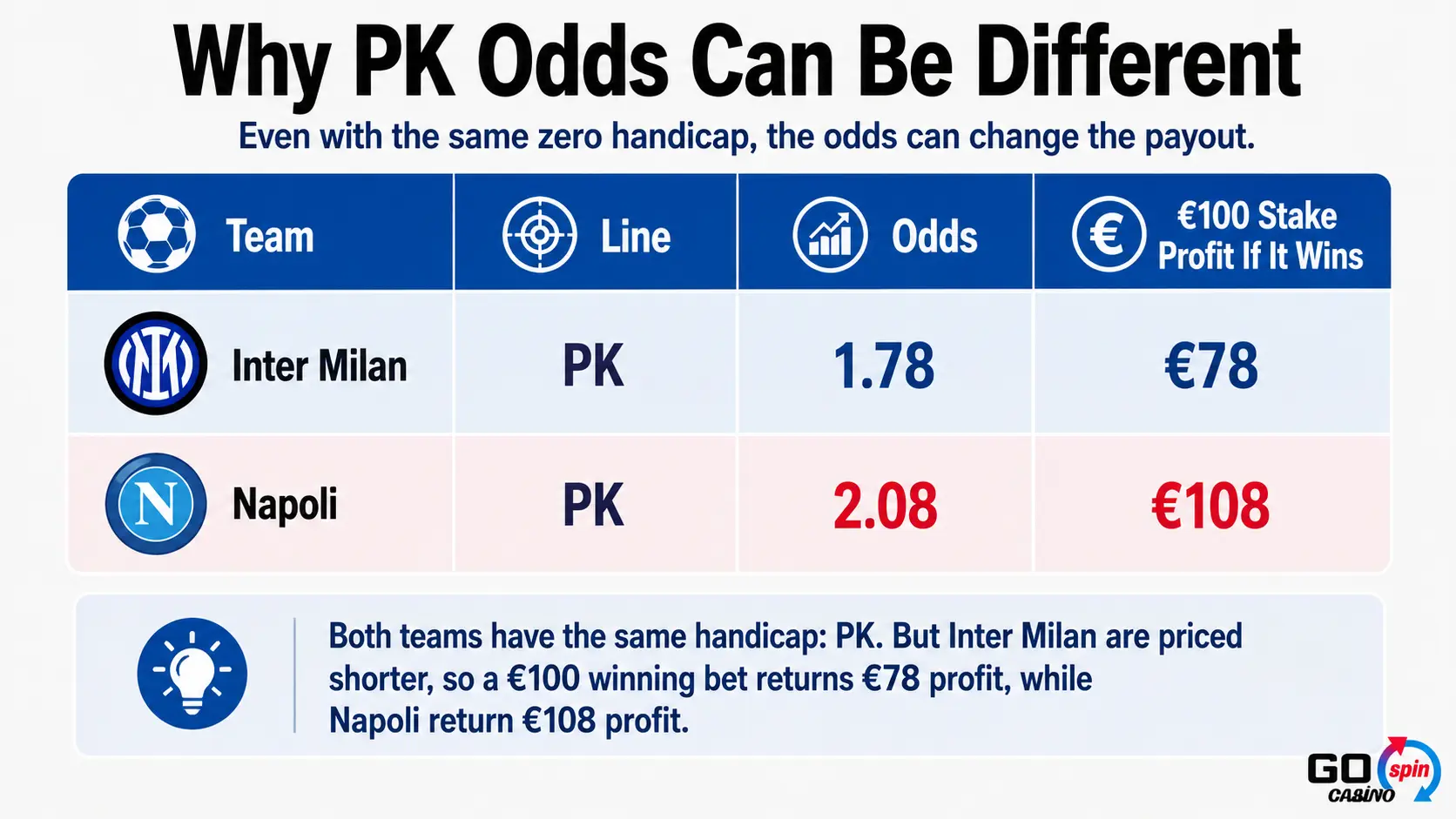
Both teams have the same handicap. Neither gets a goal start.
But Inter are priced as more likely to win. Napoli pay more because the market sees that side as less likely to win, or at least less trusted.
A PK line can move because of team news, injuries, suspensions, rotation, home advantage, recent form, weather, betting volume or sharp market action.
That’s why “pick’em” does not always mean “perfectly equal teams.” It means the handicap is equal. The odds tell you where the market leans.
A useful way to read it:
PK tells you the starting point. The odds tell you the opinion.
When Does a PK Bet Make Sense?
A PK bet makes sense when you like one team to win, but you respect the draw enough to avoid the standard 1X2 price.
That happens a lot in football.
Think about a Champions League group match where Benfica face Ajax and both teams would not hate a draw. Benfica may be the better side at home, but Ajax are organised enough to slow the match down. In that kind of spot, the 1X2 price may look tempting, but the draw risk is very real.
A PK line can be useful there if the price is fair.
PK is also worth checking in derbies, first legs of knockout ties, low-scoring matchups, away favourites that are better on paper but not dominant enough to trust fully, group-stage matches where the table situation makes a draw valuable, and games where the underdog is disciplined and hard to break down.
But there are spots where PK does not make sense.
If the team you like is already too short on PK, the draw protection may be overpriced. If the match looks more likely to be chaotic, open and decisive, the 1X2 price may offer better upside. If the team only needs a draw and has no reason to chase the game, PK can become a trap because you’re paying for win exposure in a match where urgency may be limited.
Back to the Benfica vs Ajax type of scenario: if Benfica PK is only slightly shorter than their 1X2 price, it can be worth considering. If the PK price has been squeezed too far because everyone sees the same draw risk, passing may be smarter than paying too much for comfort.
That’s the line that matters. PK is useful when it protects you at a fair price. It’s weak when it makes you feel safe while quietly killing the value.
Common PK Betting Mistakes
The most common mistake is thinking PK means penalty kick. On a sportsbook line, it usually means Pick’em. Penalty markets are normally labelled separately.
The most expensive mistake is assuming PK is automatically good value. It protects against the draw, but that protection is already priced in. If you never compare PK with 1X2 and Draw No Bet, you’re probably leaving value behind.
Another costly mistake is treating a push like a win. A push only returns your stake. It protects the bankroll in that one bet, but it doesn’t grow it.
A more advanced mistake is jumping from PK to Asian Handicap quarter lines without understanding the split stake. PK and AH 0.0 are straightforward. Lines like -0.25 and +0.25 change the draw outcome.
The last mistake is betting the right team in the wrong market. If you think a team will qualify after extra time or penalties, a 90-minute PK line may not be the market you want.
Conclusion finale
PK in soccer betting means Pick’em. It’s a zero-handicap line where your team must win for the bet to win, while a draw usually returns your stake.
The basic definition is simple. The betting decision is sharper.
If you’re looking at a PK line before kick-off and need a fast decision, do this first: compare the PK price with Draw No Bet. If the odds and settlement rules are the same, they are effectively the same bet. If Draw No Bet pays more, take that. If PK pays more, take PK. If the 1X2 price is much higher, decide whether accepting draw risk is worth the extra payout.
That is the practical way to use the term.
PK works best when the draw is a real concern but one side still has the cleaner win condition. It works poorly when the sportsbook has made the draw protection too expensive.
If you’re comparing PK, Draw No Bet, and 1X2 prices before a football match, the sportsbook you use matters. Look for platforms with deep football markets, clear settlement rules, competitive odds, live betting, and useful cashout options, especially for tight matches where one goal or one draw can change the whole bet.
FAQ
No. In soccer, the standard 1X2 moneyline has three outcomes: home win, draw and away win. PK is usually a two-way handicap market where the draw returns the stake.
Often, yes in practical settlement. Both usually refund the stake if the match ends in a draw. The difference is that Draw No Bet is normally a standalone market, while PK usually appears inside handicap or Asian handicap markets.
Only if the price is better and the settlement rules are the same. If PK is 2.20 and Draw No Bet is 2.30 for the same team under the same rules, Draw No Bet offers the better payout.
Usually, no. Most standard soccer PK bets are settled on 90 minutes plus stoppage time unless the sportsbook clearly says extra time or penalties count.
Because PK describes the handicap, not the price. Both teams can have a zero handicap, but the odds still reflect team strength, market opinion, injuries, home advantage and sportsbook margin.