
Skill-based slot machines can let your performance influence what you win, but being better at the game does not automatically give you an edge over the casino. Depending on the design, skill might change a particular payout, affect the return you can achieve over time, or determine a substantial part of the game outcome.
Unlike a traditional slot, where player ability does not change the result of a spin, a skill-based game introduces actions such as aiming, timing, puzzle-solving or decision-making.
The important question is not simply whether a game contains skill. It is what that skill actually changes.
Table of contents
- What Are Skill-Based Slot Machines?
- How Do Skill-Based Slot Machines Work?
- Can Skill Actually Make You Win More?
- Skill-Based Slots vs Traditional Slots
- Skill-Based Slots vs “Skill Machines”
- Which Skills Can Affect Payouts?
- What Do Skill-Based Games Look Like in Practice?
- Skill and the Illusion of Control
- Are Skill-Based Slot Machines Legal?
- What Should You Check Before Playing a Skill-Based Game?
- Skill Matters, but the Math Still Comes First
- FAQs About Skill-Based Slot Machines
What Are Skill-Based Slot Machines?
Skill-based slot machines combine gambling with gameplay where player ability can influence at least part of the result or payout.
The term is used fairly loosely. Some games resemble conventional slots and introduce skill through a bonus feature. Others are closer to arcade or video games and make player performance much more important.
There is therefore no single formula that every skill-based game follows.
A useful distinction is:
Interaction is not the same as influence.
Pressing buttons, selecting objects or completing an animated challenge does not automatically mean skill affects the money you can win. For skill to matter financially, your performance needs to have a genuine connection to the payout or expected result.
How Do Skill-Based Slot Machines Work?
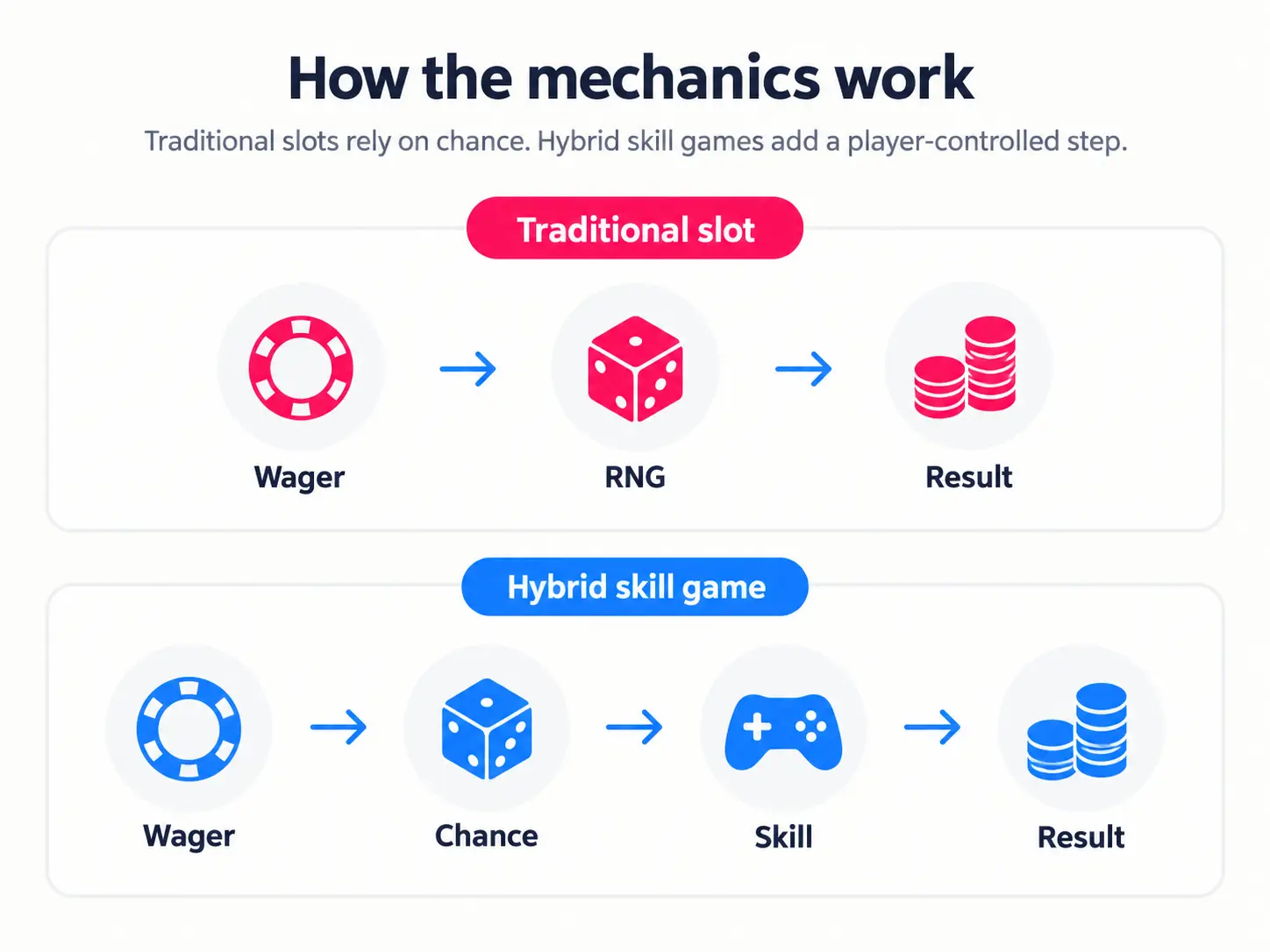
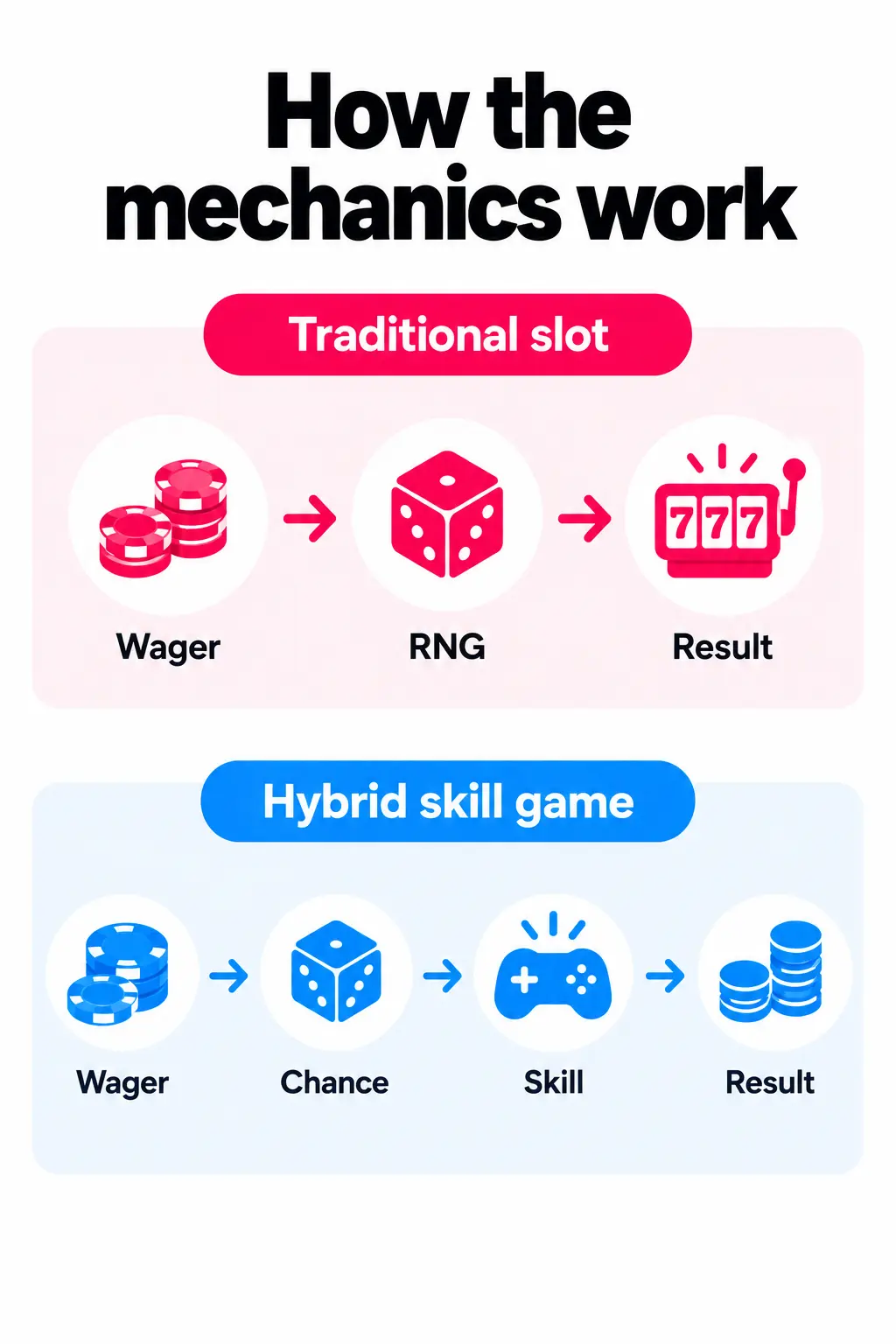
There is no universal architecture for a skill-based game, but one common format combines a chance-based component with a skill-sensitive component.
That makes a useful starting point for understanding how these games differ from conventional slots.
The Random Part
The game may initially operate much like a traditional slot.
You make a wager and a random system determines an event such as:
- the symbols appearing on the reels;
- whether a feature triggers;
- which starting position you receive;
- or another chance-based part of the game.
In a conventional slot, the random number generator (RNG) determines the result without using the player’s ability. Timing the spin or reacting faster does not improve the expected outcome.
For a closer look at what happens after you press Spin, see our guide to how slot machine RNGs work.
The Skill-Based Part
A skill feature introduces something the player can do that genuinely affects the result.
Depending on the game, you might have to:
- hit moving targets;
- react within a time limit;
- control a vehicle;
- solve a puzzle;
- recognise patterns;
- or make decisions that influence an award.
A better performance can then produce a different payout from a weaker one.
Imagine two players reaching the same shooting challenge. One hits six targets and the other hits ten. If the payout is directly tied to accuracy, the second player could receive the larger award.
That is different from an interactive-looking slot feature where the player’s actions do not alter the underlying result.
Can Skill Actually Make You Win More?
Yes, potentially. But “winning more” can describe three very different things.
Understanding that difference is central to judging how much advantage skill actually provides.
Skill Can Increase an Individual Payout
This is the simplest case.
If a bonus pays according to how accurately you shoot, how quickly you react or how well you complete a challenge, playing that section better can produce a larger award.
In that sense, a skilled player really can win more from the same opportunity than a less-skilled player.
But one larger payout tells us nothing by itself about the mathematics of the game over a very large number of plays.
Skill Can Improve Your Expected Return
Some designs can make player performance relevant over the long term.
If stronger performance repeatedly produces higher awards, a good player may achieve a better expected return than a weaker player.
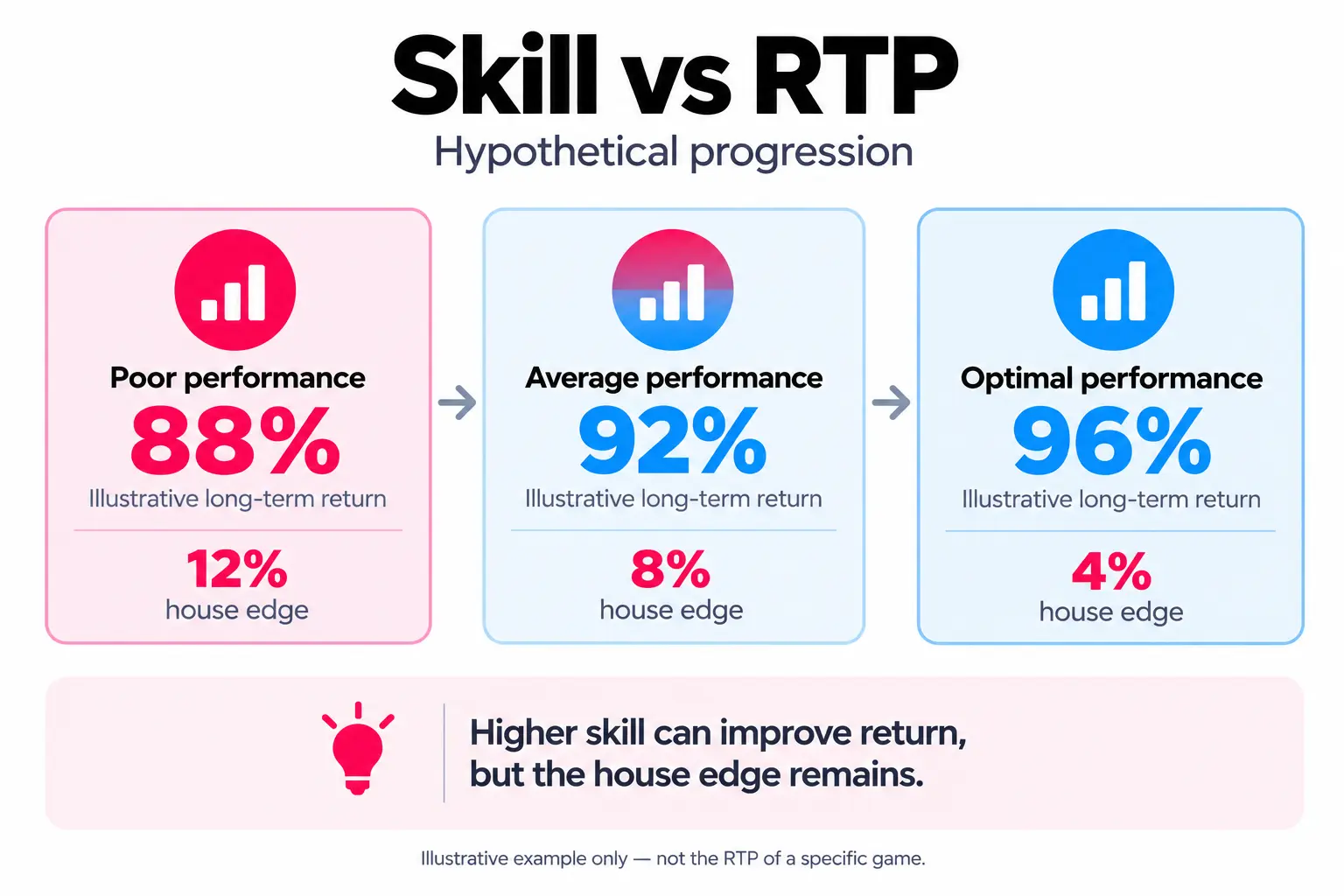
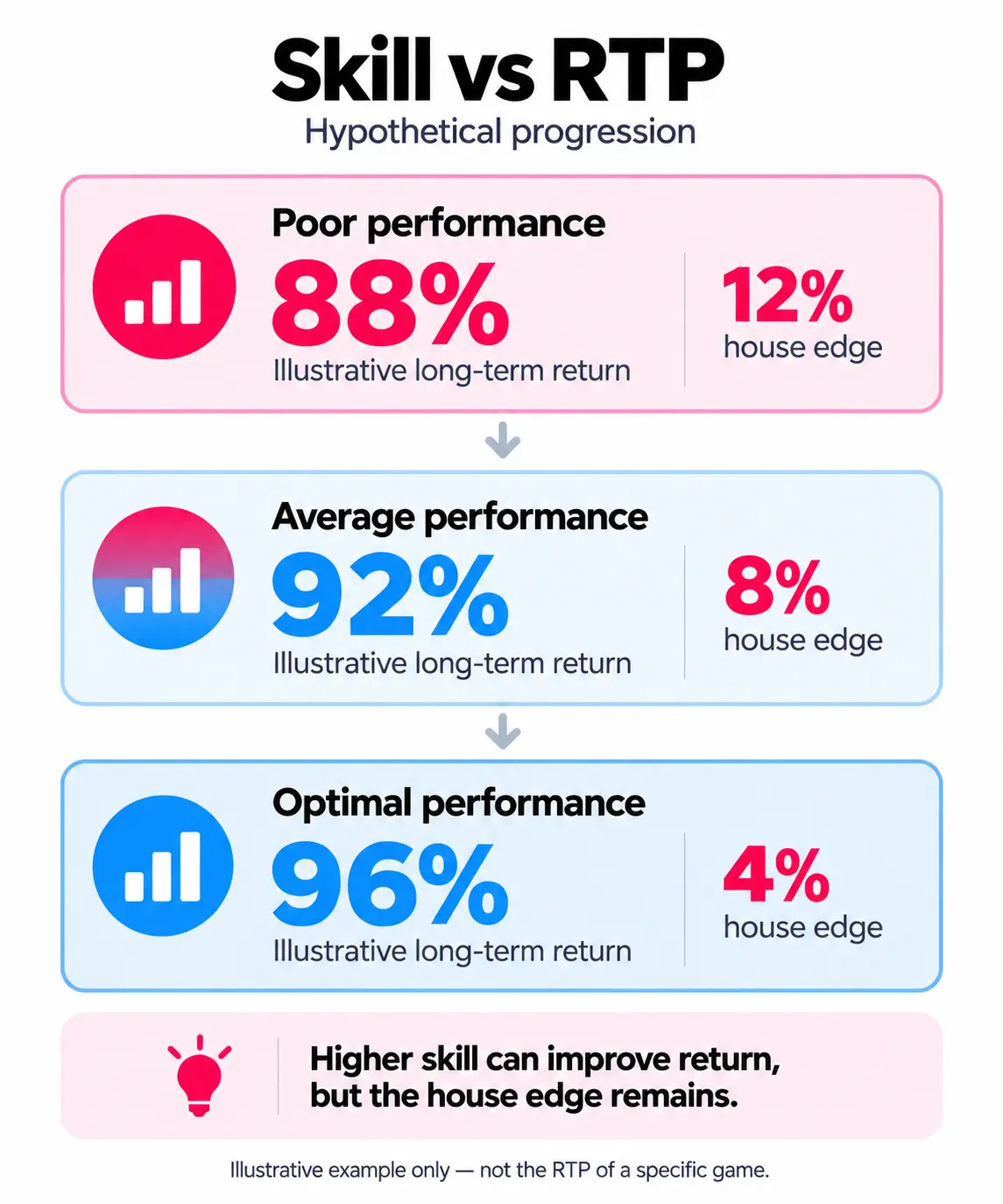
Consider a purely hypothetical game designed around the following performance levels:
| Player Performance | Illustrative Long-Term Return | Illustrative House Edge |
| Poor | 88% | 12% |
| Average | 92% | 8% |
| Optimal | 96% | 4% |
The optimal player is clearly in a better mathematical position.
Moving from an 88% return to 96% would be a meaningful improvement.
But the final column matters just as much: a 96% theoretical return would still leave a 4% house edge.
Skill can reduce a disadvantage without turning it into an advantage.
A Higher Return Does Not Automatically Mean a Player Edge
This is where statements such as “skill affects your chances of winning” need more context.
A game could reward excellent play while still being designed so that even the strongest achievable performance leaves the casino with a mathematical advantage.
It is also important not to assume that every skill-based game has one published RTP that dynamically rises or falls while you play.
In some hybrid designs, the theoretical return may be calculated using an assumed level of player performance. Other skill-based formats work differently and cannot necessarily be reduced to the same chance-based RTP model used for a conventional slot.
This distinction also appears in regulation. New Jersey, for example, separately defines certain skill-based games whose theoretical RTP cannot be determined through a precise chance-based mathematical model because outcomes depend on physical dexterity or mental ability.
So when a game provides an RTP or expected-return figure, check what assumptions sit behind it. Does it represent a fixed chance-based return, an assumed level of performance or optimal play?
Skill-Based Slots vs Traditional Slots
The biggest difference is not how the game looks. It is whether player ability can change a financially relevant outcome.
| Feature | Traditional Slot | Skill-Based / Hybrid Game |
| Chance affects the outcome | Yes | Usually |
| Player skill affects payout | No | Can |
| Reaction or accuracy matters | No | Sometimes |
| Decisions can influence an award | Normally no | Can |
| Skill level changes expected return | No | Potentially |
| House advantage can exist | Yes | Yes |
| Better play can reduce the house edge | No | Potentially |
A conventional slot can still contain interactive features.
Choosing between objects, pressing buttons or tapping symbols on a screen may make the experience feel more active without changing the mathematical result.
That is why the underlying rules matter more than whether a feature simply looks like a game of skill.
Skill-Based Slots vs “Skill Machines”
The terminology becomes confusing because “skill machine” does not always mean a casino skill-based slot.
In the US in particular, the term can also describe machines found outside traditional casino environments, including convenience stores, bars, restaurants and truck stops.
These retail products may resemble slots and can contain puzzles, nudges or other player actions. They are not automatically the same type of product as a regulated casino skill game.
The label alone therefore tells you very little.
It is more useful to ask how the game works, how skill affects the payout and what type of product it actually is.
Which Skills Can Affect Payouts?
The exact ability being tested varies by game. Common examples include:
- Reaction and timing — responding to an event or performing an action within a limited window.
- Accuracy and coordination — aiming, shooting or controlling an object successfully.
- Memory and pattern recognition — remembering sequences or identifying matching combinations.
- Puzzle-solving — completing challenges efficiently or achieving a higher score.
- Decision-making — choosing between options where the decision can affect the result.
The presence of one of these mechanics does not prove that the game offers a better mathematical return.
What matters is whether better performance actually changes the payout or expected outcome.
What Do Skill-Based Games Look Like in Practice?
Several early regulated products are useful for showing how these mechanics have been implemented in gambling. These are historical examples of the format, not a list of games that are necessarily available to play today.
| Format | Skill Being Tested | Example of Player Input |
| Shooting | Accuracy / reaction | Hitting targets |
| Puzzle | Pattern recognition | Completing combinations |
| Racing | Reaction / control | Driving performance |
| Sports | Timing / accuracy | Executing shots or actions |
| Strategy | Decision-making | Choosing between possible moves |
One important early example was Danger Arena, developed by GameCo.
The first machines went live at Harrah’s Atlantic City in November 2016. Danger Arena used a first-person action format in which players shot targets and their performance determined the payout. GameCo’s launch announcement described it as the first skill-based video game gambling product approved by a US regulator, while contemporary reporting documented the machines operating on the Atlantic City casino floor.
This was part of a wider regulatory push in New Jersey. The state’s Division of Gaming Enforcement had already invited submissions for skill-based casino products and continues to list skill-based games among the gaming products tested by its Technical Services Bureau.
The example matters because it demonstrates that a skill-based gambling product does not need to resemble a traditional three- or five-reel slot once player ability becomes central to the experience.
Skill and the Illusion of Control
A genuine skill component can give the player more influence than a conventional slot spin.
But there is an important difference between having some control and accurately judging how much control you have.
A 2024 study published in the Journal of Behavioral Addictions examined this issue using 1,260 participants who played either a simulated skill-based gambling machine or a traditional reel-based electronic gaming machine.
Despite the simulated games having identical payout structures, participants assigned to the skill-based version showed stronger illusions of control. They were more likely to believe that skill influenced the outcome and that practice could improve their results.
That does not mean every skill component is meaningless.
It shows why the player needs to separate:
the part genuinely affected by performance
from
the part that remains determined by chance or the game’s underlying mathematics.
Conventional slots can create similar perceptions through interactive features that do not alter an RNG-selected result. If that sense of control starts influencing how long or how much you play, our Responsible Gambling resources cover practical limits, warning signs and support options.
The practical takeaway is simple: more interaction does not automatically mean more mathematical control.
Are Skill-Based Slot Machines Legal?
There is no universal answer.
The classification depends on the game mechanics and the jurisdiction where the product is offered.
New Jersey provides a useful example. The current New Jersey rules for skill-based games require approved games to disclose that player skill affects the outcome and to provide information including rules, wagers, payouts, fees and other details needed to understand how the game works.
The rules also restrict undisclosed changes that make an event more or less likely during play based on a player’s skill. New Jersey’s Division of Gaming Enforcement Technical Services Bureau lists skill-based games among the products it tests and approves before they can be offered to players.
Retail skill machines present a separate issue. Their legal treatment can differ by jurisdiction because regulators and courts may classify individual products differently according to the role played by skill and chance.
The practical rule is straightforward:
do not assume that one jurisdiction’s treatment of a skill machine applies somewhere else, or that every product described as “skill-based” belongs to the same regulatory category.
What Should You Check Before Playing a Skill-Based Game?
The word “skill” tells you surprisingly little by itself.
Before playing, check the rules and try to answer these questions:
- Which part of the game actually uses skill?
Does your ability affect the entire wager or only one feature? - Does better performance change the payout?
An interactive feature is not necessarily a financially meaningful one. - Can player performance affect the expected return?
Look for an explanation of how scoring connects to payouts. - What assumptions are behind the published RTP?
If an RTP is provided, check whether it assumes a particular or optimal level of play. - What is the strongest return the game allows?
A higher achievable return may still leave a house advantage. - Which parts of the result remain random?
Knowing where chance enters the game helps show how much control you actually have. - How is the game regulated?
A regulated casino skill game and a retail “skill machine” can be very different products.
There is no universal strategy that answers these questions for every skill-based game.
The mechanics have to be assessed game by game.
Skill Matters, but the Math Still Comes First
Skill-based games can give you more influence than a traditional slot without giving you a mathematical advantage over the casino.
Before focusing on how well you can play the interactive part, understand what the game’s return, house edge and random components are doing behind it.
Want to understand those numbers first? Read our guide to RTP in slots to see how theoretical return and house edge actually work.
18+ | Play Responsibly.
FAQs About Skill-Based Slot Machines
Skill-based slot machines are gambling games where player actions, such as timing, accuracy, decision-making or puzzle-solving, can influence part of the result or payout. Chance can still determine other parts of the game.
A traditional slot relies on chance and RNG-generated outcomes, while a skill machine allows player performance to influence at least part of the result. However, “skill machine” can also refer to retail gaming machines outside casinos, so the exact meaning depends on the product and jurisdiction.
Not on a conventional slot. On some skill-based games, better performance can increase a payout or improve the return a player can achieve. That does not necessarily remove the house edge or make the game profitable over time.
Skill-based gambling can include shooting, puzzle, racing, sports and strategy-style games where performance influences an award. Historical casino examples include GameCo’s Danger Arena, which used first-person shooting mechanics.
Not necessarily. A skilled player may achieve a better result in a game where performance affects payouts, but this does not mean skill-based slots have better odds than traditional slots. The game’s RTP, payout structure and house edge still need to be considered.