
To read a betting line, start with the market, not the team. In a football/soccer match such as Team A vs Team B, a 1X2 market asks whether Team A wins, the match ends in a draw or Team B wins. A handicap asks whether a team covers a goal margin. An over/under asks whether the total goals finish above or below a number. The odds then show the price. If the same match is shown in American odds, -145 means risking $145 to win $100, while +180 means a $100 winning bet makes $180 profit. The line is not a prediction. It is the sportsbook’s price for a specific outcome.
The confusing part is that a sportsbook rarely shows just one number. A single football match can have 1X2, draw no bet, handicap, Asian handicap, over/under goals, both teams to score, player props, futures and different odds formats depending on the country or platform. That can make a betting screen look like a code sheet at first glance, even when the underlying idea is simple.
The useful habit is to read the line in order: market first, number second, odds third, win condition last. Once those pieces are separated, the line stops being a blur of plus signs, minus signs, decimals and fractions. It becomes a price sheet. That does not make a bet safe or profitable, but it does help players understand exactly what they are choosing before they stake.
Table of contents
- What Is a Betting Line?
- How to Read a Betting Line Step by Step
- Betting Line Examples at a Glance
- How to Read American Odds: Plus and Minus Explained
- Decimal and Fractional Odds for International Bettors
- 1X2, Match Winner and Moneyline Explained
- Handicap Betting Explained
- Over/Under Goals Explained
- Two-Way vs Three-Way Betting Lines
- Line Movement, Juice and Break-Even Price
- NFL and NBA Lines as a Quick Comparison
- Common Mistakes When Reading Betting Lines
- Final Thoughts
- FAQ
What Is a Betting Line?
A betting line is the sportsbook’s posted price and condition for a specific betting market. It tells the bettor what they are betting on, which side or outcome they are choosing, what number applies to that bet and how much the odds pay if the bet wins.
The market is the first thing to identify. In football, the most common starting point is often 1X2: home win, draw or away win. If Team A vs Team B is listed as Team A 2.10 / Draw 3.30 / Team B 3.60, each result is a separate outcome with its own price. A handicap asks whether one side covers a goal margin. In American sports content, the same core concept is usually called a point spread. An over/under asks whether the combined goals finish above or below a number. A futures line asks about an outcome decided later, such as a club winning a league or a national team winning the World Cup.
The number tells the condition. In Team A -1.5, the number is the handicap. In Over 2.5 goals, the number is the total. In Team A +700 to win the tournament, the number is part of the odds, not a handicap or total.
The odds tell the price. Decimal odds show total return including stake. Fractional odds show profit relative to stake. American odds use plus and minus signs to show risk or profit around a $100 reference point.
The cleanest way to think about it is this: the market tells you what you are betting on, the number tells you the condition and the odds tell you the price.
How to Read a Betting Line Step by Step
The fastest way to read a betting line is to slow down before looking at the team name. A familiar club, country or player can pull attention away from the market. That is where mistakes start.
Check the market rules. Extra time, penalties, 90-minute betting rules, regulation-only markets and player availability rules can all affect whether a bet wins or loses.
Identify the market. Check whether the bet is 1X2, match winner, handicap, over/under, futures or player props.
Read the selection and number. In Team A -1.5, the -1.5 is the handicap. In Team B +180, the +180 is the odds.
Check the odds format. Decimal odds use numbers like 2.50, fractional odds use prices like 5/1, and American odds use plus and minus signs.
Confirm what must happen to win. A 1X2 bet needs the selected result to happen. A handicap needs the team to cover the margin. A total needs the combined goals to finish over or under the listed number.
Betting Line Examples at a Glance
The table below uses the same fictional football match, Team A vs Team B, to show how different betting lines can sit around one event. These are example prices only and should not be treated as live odds or betting recommendations.
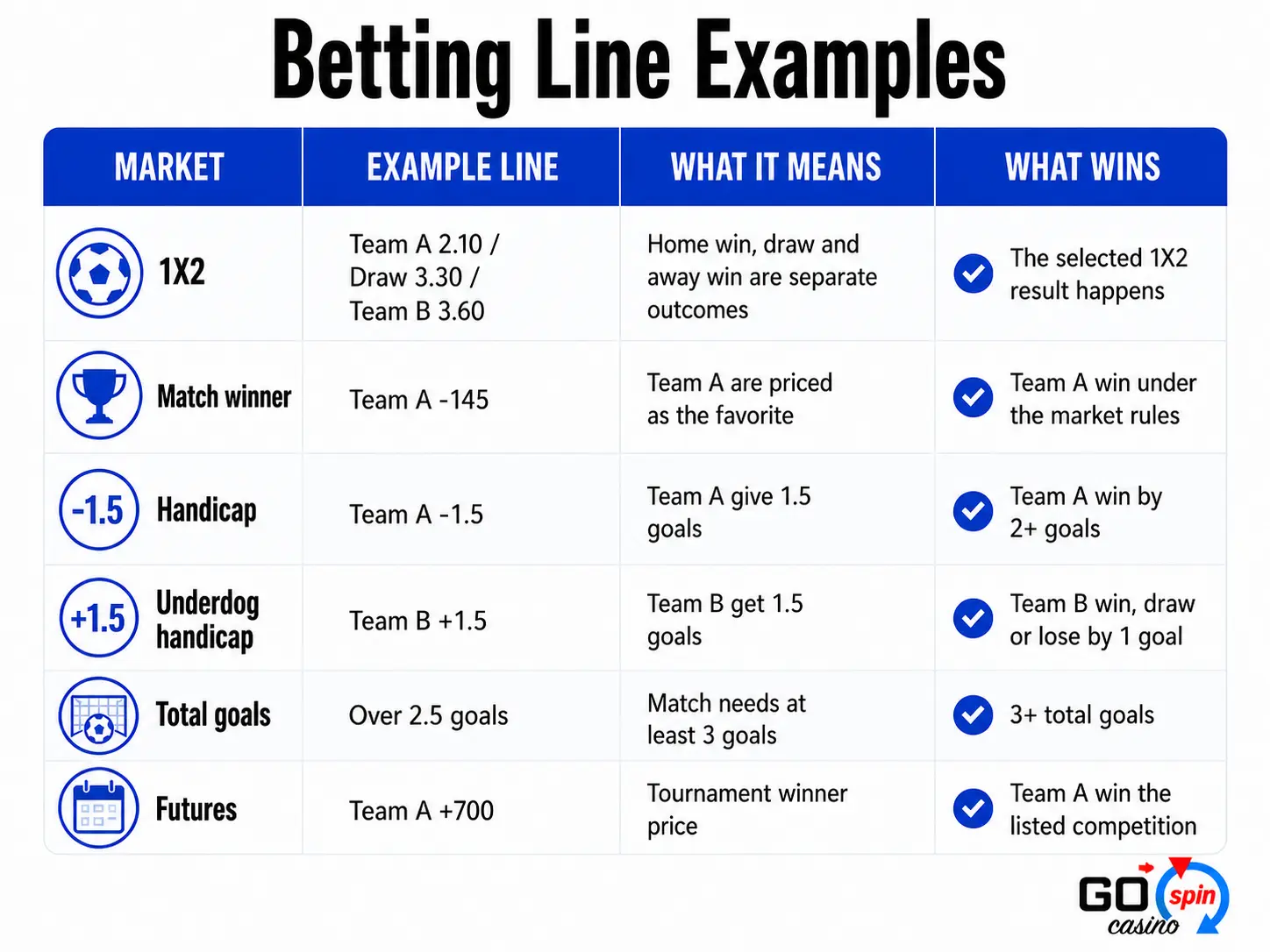
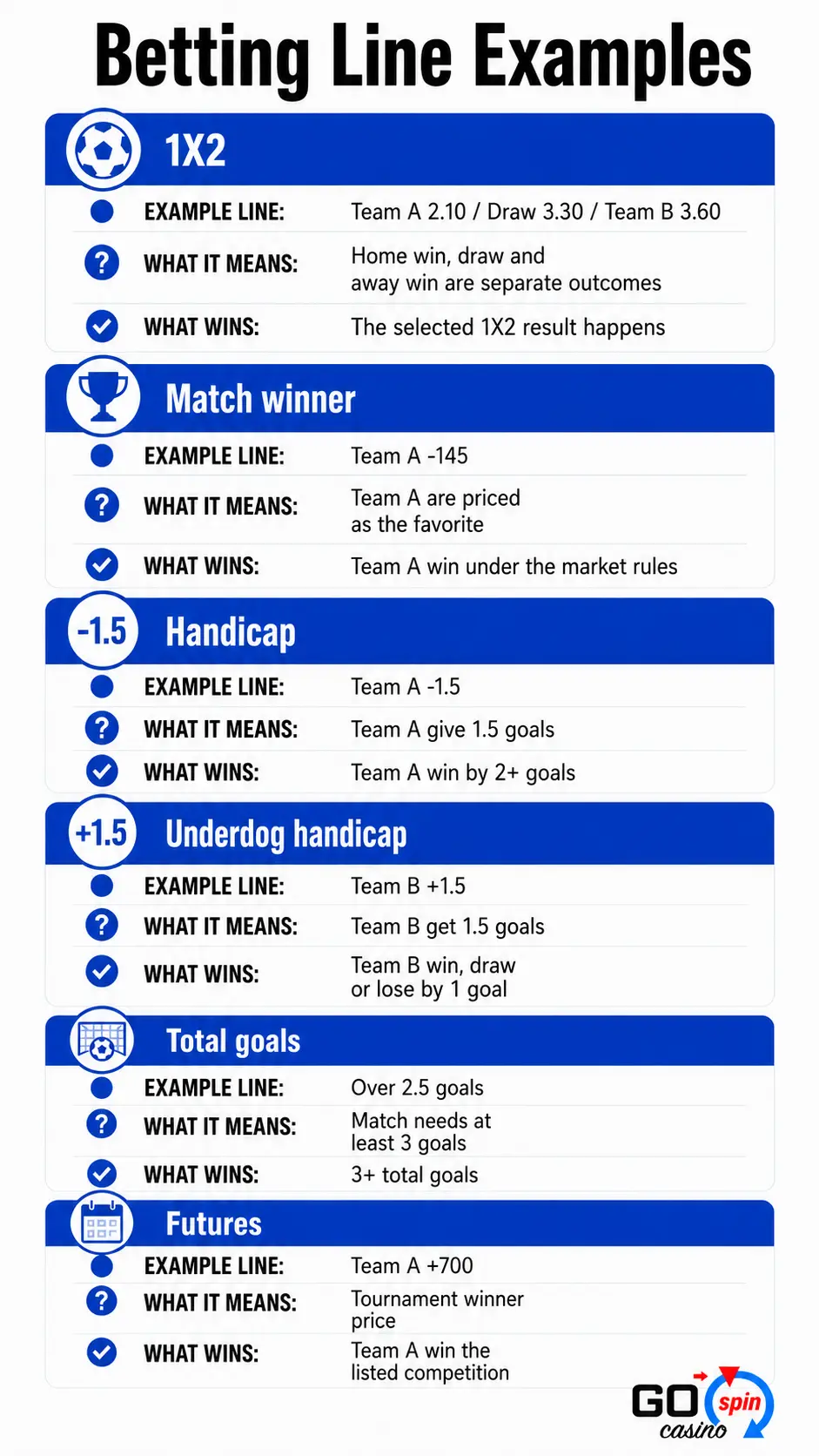
This is why reading the market first matters. Team A -145 and Team A -1.5 both include a minus sign, but they do not mean the same thing. One is an odds price. The other is a handicap number.
How to Read American Odds: Plus and Minus Explained
American odds are not the default format for every international football bettor, but they remain important because betting media, sportsbook guides and many odds comparison pages use plus and minus pricing. The same football match can be shown in American odds even if a bettor normally uses decimal or fractional odds.
American odds are built around a $100 reference point. Players do not have to bet $100. Smaller and larger stakes scale proportionally.
Negative odds show how much must be risked to win $100 in profit. If Team A are -145, a bettor would risk $145 to win $100 profit. If the stake were $14.50, the profit would be $10. If the odds are -110, which is common on handicaps, point spreads and totals in American-style markets, a bettor risks $110 to win $100.
Positive odds show how much profit a $100 winning bet would make. If Team B are +180, a $100 bet would win $180 profit, plus the original $100 stake back. If the stake were $10, the profit would be $18. If a futures market shows +1200, a $100 winning bet would make $1,200 profit, plus the original stake.
Negative odds often point to the favorite, while positive odds often point to the underdog, but price is not the same thing as value. A favorite can still be overpriced. A long shot can still be a bad bet if the true chance is lower than the payout suggests.
The main rule is simple: negative odds tell you what to risk for $100 profit, while positive odds tell you the profit on a $100 winning bet.
Decimal and Fractional Odds for International Bettors
For many international bettors, decimal odds or fractional odds are more familiar than American odds. Decimal odds are common across much of Europe and many global sportsbook interfaces. Fractional odds remain familiar in the UK, Ireland and horse racing markets. The betting logic is the same, but the payout is displayed differently.
Decimal odds show total return, including the original stake. If Team A are priced at 2.10, a €10 winning bet returns €21 total. That total includes €11 profit and the original €10 stake. Decimal odds of 1.50 mean a €10 bet returns €15 total, which is €5 profit plus the stake.
Fractional odds show profit relative to stake. Odds of 2/1 mean a €10 winning bet makes €20 profit, plus the original stake. Odds of 1/2 mean a €10 winning bet makes €5 profit, plus the original stake.
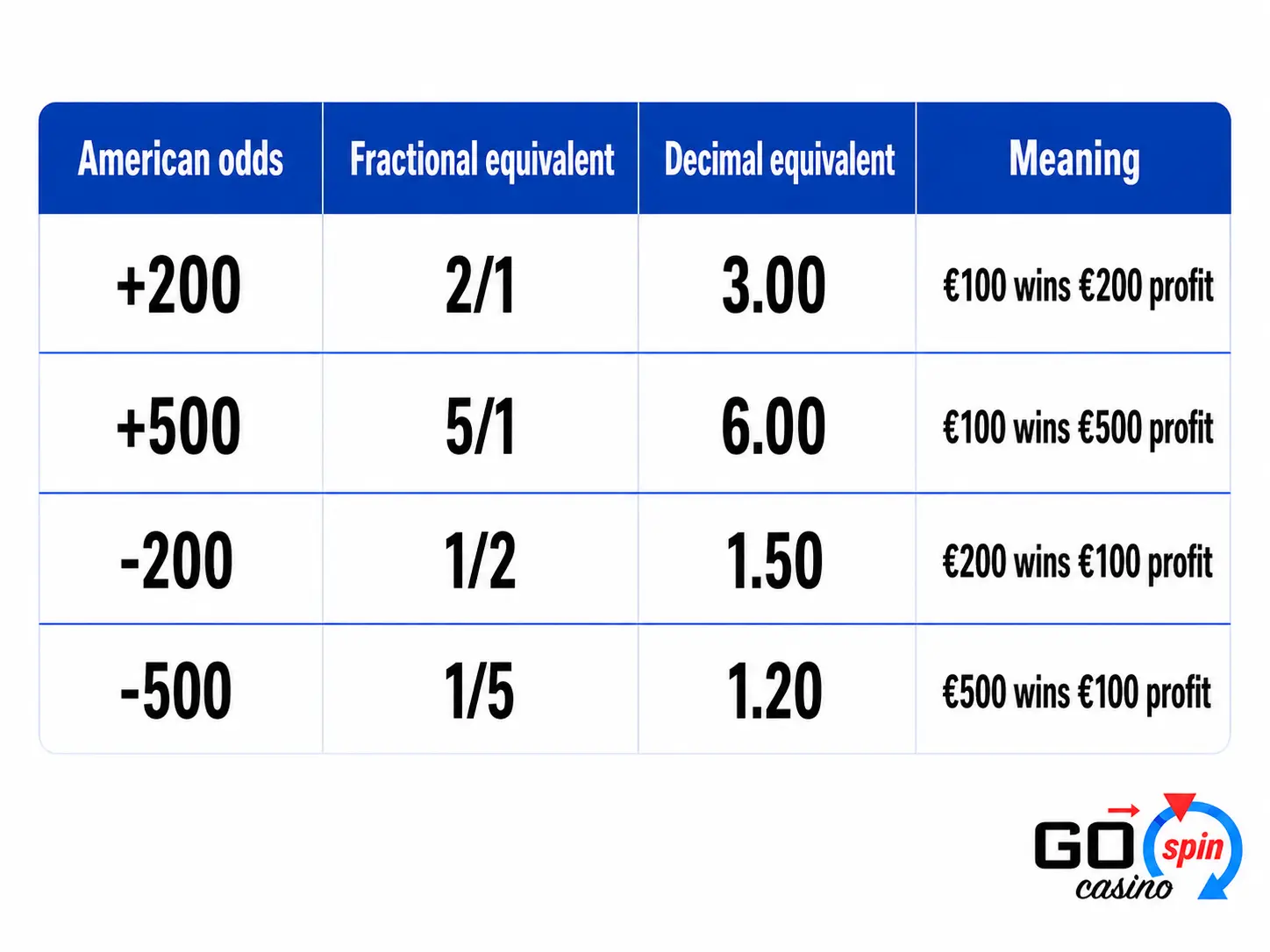
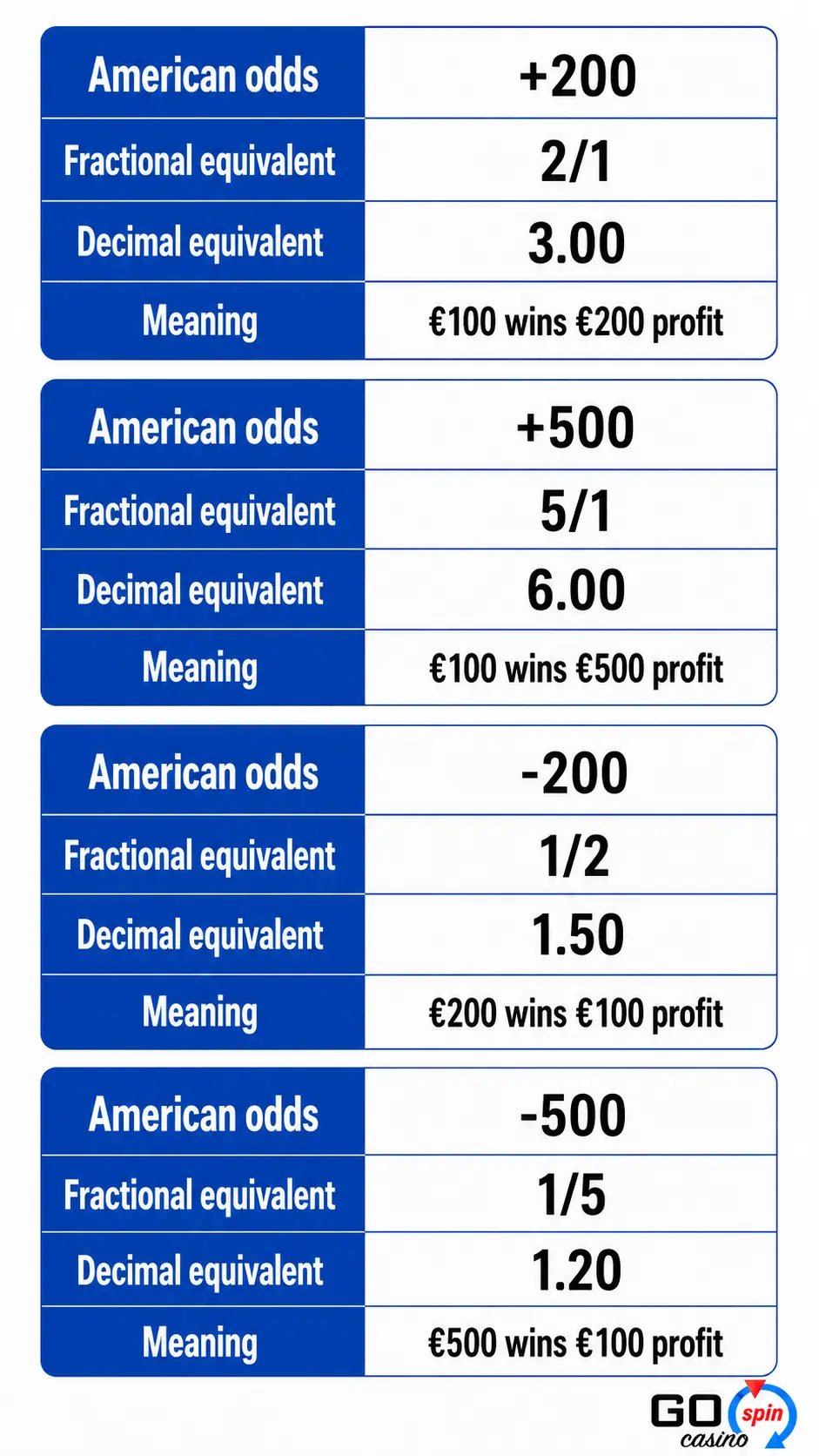
This is especially useful for football bettors who are used to fractional or decimal pricing but see American odds in international sports coverage, sportsbook promos or US-facing tournament markets. A price like +500 is the American way of showing a 5/1-style long shot, while -200 is an odds-on favorite.
1X2, Match Winner and Moneyline Explained
A 1X2 market is the most natural starting point for many international football bettors. It has three outcomes:
- 1: home team wins;
- X: draw;
- 2: away team wins.
Using Team A vs Team B, a 1X2 line might show Team A 2.10 / Draw 3.30 / Team B 3.60. In decimal odds, Team A 2.10 means a €10 winning bet returns €21 total, including the original stake. A draw bet wins only if the match finishes level under the market rules. A Team B bet wins only if Team B win under those same rules.
This is different from a two-way moneyline or “to qualify” market. In a knockout match, 1X2 may settle after 90 minutes plus stoppage time, while “to qualify” may include extra time and penalties. That small rule difference can completely change the bet.
Some international sportsbooks also display football prices in American odds. In that format, Team A -145 means Team A are priced as the favorite, and a bettor would risk $145 to win $100 profit. Team B +180 means a $100 winning bet would make $180 profit.
The core idea stays the same across formats: 1X2, match winner and moneyline markets are about the result, not the score margin.
Handicap Betting Explained
A handicap is about margin, not just winner. The sportsbook gives one side a virtual disadvantage and the other side a virtual advantage to balance the market. Football sportsbooks usually call this a handicap. In American sports content, the same concept is usually called a point spread.
Using the same Team A vs Team B example, Team A -1.5 means Team A need to win by 2 or more goals. A 1-0 win would not be enough. A 2-0 win, 3-1 win or 4-2 win would cover the handicap.
The underdog side works the other way. If Team B +1.5 is the line, Team B can win, draw or lose by 1 goal for the bet to win. That is why a handicap bet is not the same as simply picking the match winner.
A push happens when the final result lands exactly on the handicap, point spread or total number, and the stake is usually refunded. With Team A -1, Team A need to win by 2 or more. A win by exactly 1 is a push. Team A -1.5 removes that possibility, since a final score cannot land on a half goal.
Handicap betting is popular because it lets sportsbooks price stronger and weaker teams more evenly. It also gives bettors more ways to express an opinion than simply choosing home win, draw or away win.
Over/Under Goals Explained
An over/under, also called a total, is a bet on the combined score. It is not about which team wins.
In Team A vs Team B, Over 2.5 goals means the match needs at least 3 total goals. A 2-1, 3-0 or 2-2 result would win the over. A 1-0, 1-1 or 2-0 result would lose it. If the bettor takes Under 2.5 goals, the logic is reversed: the match needs 2 total goals or fewer.
Some sportsbooks also offer totals such as Over 1.5, Under 3.5 or team totals for one side only. Team totals focus only on one team’s goals, while match totals count both teams together.
Readers focused on football tournament markets can connect this idea with Go Spin Casino’s World Cup 2026 betting guide, where totals, futures, group markets and live betting all become part of the tournament betting picture.
Totals are useful because they allow a bettor to have an opinion about tempo, attacking style, defensive structure or match context without picking the winner.
Two-Way vs Three-Way Betting Lines
The 1X2 market already shows why this distinction matters. A three-way market has three possible outcomes: Team A win, draw or Team B win. The draw is not a technical side note. It is one of the main betting outcomes.
Two-way markets have two outcomes. A handicap, over/under or “to qualify” market gives one price for each side, and one side must win under the market rules unless the result creates a push.
This distinction matters because the same football match can be listed in several different ways. A 1X2 market may settle after 90 minutes. A “to qualify” market may include extra time and penalties. A handicap market may ignore the draw because the virtual goals create a different win condition.
It also explains why multiple selections can have positive odds or attractive decimal prices in the same match. If the probability is split across three outcomes, several prices can look like underdog-style payouts.
The practical rule is to check the market before reading the price. A two-way line, a three-way line and a qualification market can look similar on a screen, but the win condition is not the same.
Line Movement, Juice and Break-Even Price
Betting lines can move before an event starts. Team A might open at +120 and later move to -105, which means the market price has moved toward Team A. In decimal odds, the same kind of move could look like Team A shortening from 2.40 to 1.95. This can happen because of injuries, team news, weather, betting activity, starting lineups or sportsbook risk management. Line movement is useful information, but it is not a guarantee that the new side is the right bet.
Juice, also called vig, is the sportsbook’s margin built into the price. In American odds markets, this is why both sides of a handicap, point spread or total may appear at -110. At -110, the bettor risks $110 to win $100 profit. In decimal markets, the same idea is built into the combined prices offered across all outcomes.
This is also where break-even price matters. Odds imply how often a bet needs to win to break even before thinking about profit. A +200 bet implies roughly 33.3%. A -110 bet implies roughly 52.4%. That does not mean the bet will win at that rate. It only shows what the price is asking.
This is why a good pick can still be a bad bet if the price is poor. Reading a line correctly is not about predicting the future. It is about understanding the market, payout and risk before the bet is placed.
NFL and NBA Lines as a Quick Comparison
The same logic also appears in American sports, where a handicap is usually called a point spread. In the NFL or NBA, Team A -6.5 means Team A need to win by 7 or more points, while Team B +6.5 means Team B can win outright or lose by 6 or fewer. Totals work the same way: Over 218.5 in basketball needs 219+ combined points. The sport changes, but the reading order stays the same: market first, number second, odds third, rules last.
Common Mistakes When Reading Betting Lines
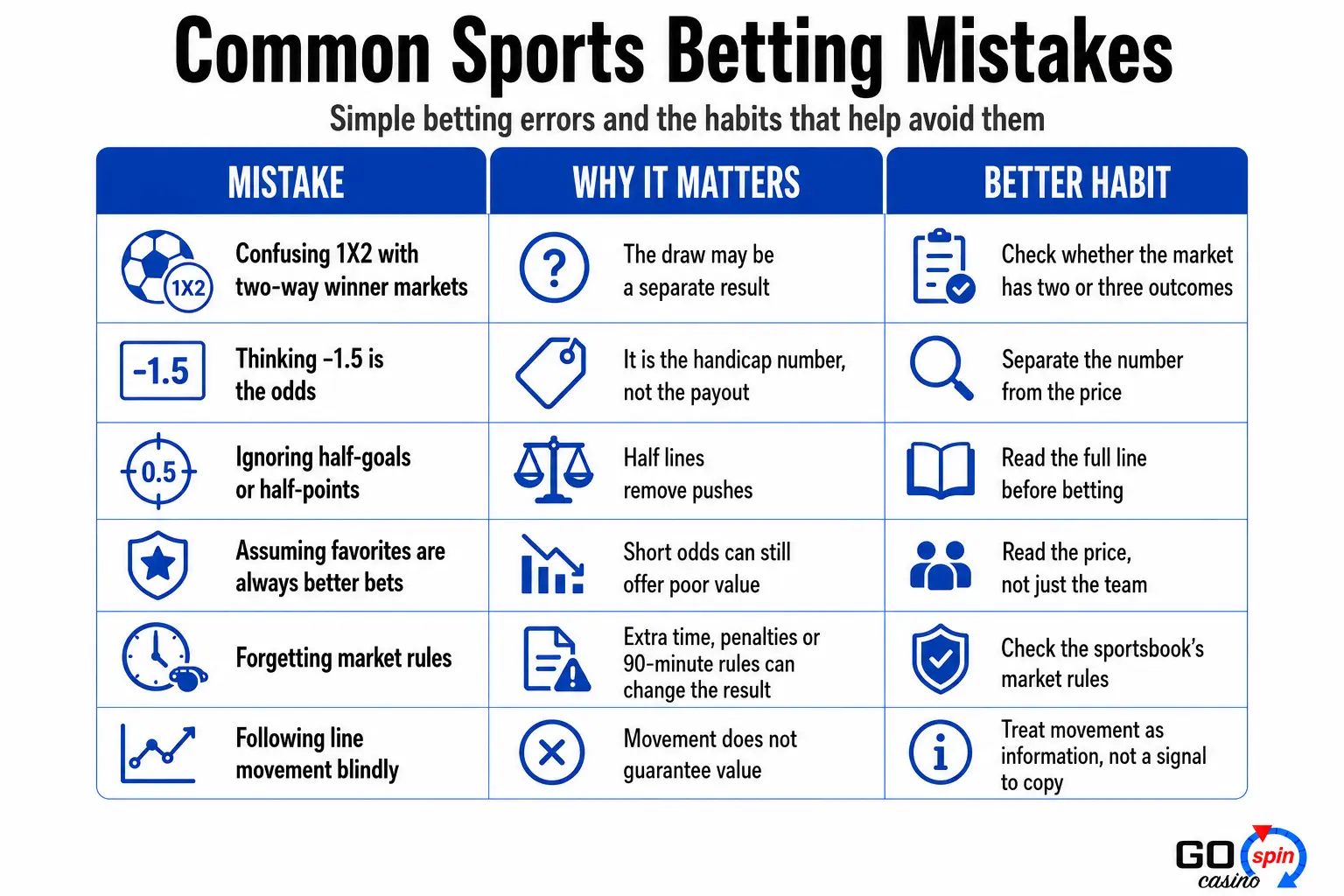
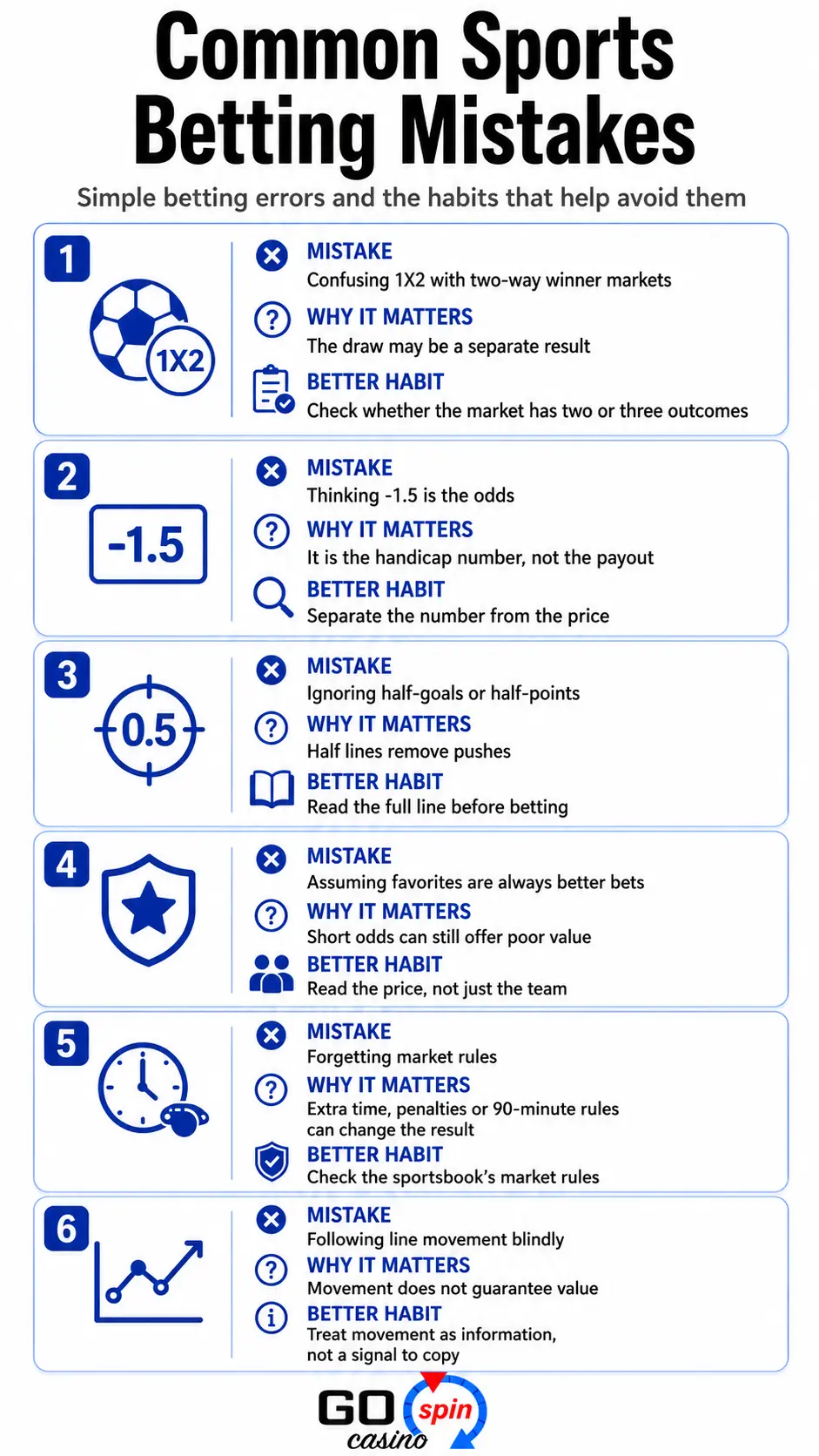
Most beginner mistakes come from reading one part of the line and ignoring the rest. The safer habit is to separate market, number, odds and rules every time.
Final Thoughts
Learning how to read a betting line does not guarantee better results, but it does prevent one of the worst beginner errors: betting on something without understanding the market. A sportsbook line is a price for a specific outcome, with specific rules and a specific payout.
The most important habit is to read the market before the number. In football, a 1X2 line, a handicap and an over/under can all sit on the same match, but each one asks a different question. The 1X2 market is about the result. The handicap is about margin. The over/under is about total goals. Odds formats then change how the price is displayed, whether that price appears as decimal odds, fractional odds or American plus and minus odds.
Before staking, check the win condition, the settlement rules and the price. A football 1X2 market may not behave like a “to qualify” market. A -1 handicap is not the same as -1.5. A shorter price does not automatically mean a smarter bet. Line movement, juice and break-even price can add useful context, but none of them remove the risk of the wager.
Before placing a bet, compare sportsbook platforms with the same discipline used to read the line: check the market depth, odds formats, payment options, usability, rules and safer gambling tools. A clear betting line helps players understand the wager. The right platform helps make the full betting experience easier to control.
FAQ
A betting line shows the sportsbook’s price and conditions for a bet, including the market, selection, number, odds and what must happen for the bet to win.
1X2 is a three-way football market. The 1 means home win, X means draw and 2 means away win.
Negative odds show how much needs to be risked to win $100 profit. Positive odds show how much profit a $100 winning bet would make.
Match winner is about who wins the match under the market rules. Handicap is about whether a team covers a goal or point margin set by the sportsbook. In American sports content, this is often called a point spread.
Over/under is a bet on whether the combined total score goes above or below the sportsbook’s listed number.