
A lock in sports betting is a pick someone believes is almost certain to win, but it isn’t a guaranteed bet or a formal sportsbook category. The lock betting term is betting slang for a high-confidence selection that looks “safe,” even though every wager still depends on probability, price, variance, and risk control.
That “safe” label is exactly what makes the term worth questioning. In betting communities, a lock can come from a serious handicapper, a casual bettor, a social media tipster, or a paid picks service trying to make a wager sound stronger than it really is. A team can be the obvious favorite, the line can look short, and the matchup can still break in the wrong direction. Before treating any pick as a lock, the better move is to look at the odds, the market context, and what could realistically go wrong.
Índice
- What Does the Lock Betting Term Mean?
- Why Bettors Call Some Picks a Lock
- Why True Betting Locks Don’t Exist
- Why “Guaranteed Pick” Language Is a Red Flag
- Lock Pick vs Locked Betting Market
- How to Treat Any Bet Someone Calls a Lock
- Better Terms Than “Lock” in Sports Betting
- Final Take: A Lock Is Confidence, Not Certainty
- FAQ About the Lock Betting Term
What Does the Lock Betting Term Mean?
The lock betting term refers to a wager someone believes has a very high chance of winning. It’s commonly used in the same way as “sure thing,” “guaranteed pick,” or “can’t miss bet.”
A bettor might say: “The home favorite moneyline is a lock tonight.” or “That’s the lock of the weekend.”
In reality, they’re expressing confidence. They’re not describing a special bet type. Sportsbooks don’t label wagers as locks because they’re safer than others. The term comes from betting slang, not bookmaker rules.
This matters because newer bettors can mistake confidence for protection. A lock may be based on good analysis, strong team news, or useful market movement. It may also be based on hype, public bias, or a tipster trying to sell a pick.
A lock can be a strong opinion, but it can’t remove risk.
That’s why the term belongs in sports betting terminology, but it should never be treated as proof that a bet is safe. It tells you how confident someone feels. It doesn’t tell you whether the odds are good, whether the market has already moved, or whether the stake fits the bankroll.
Why Bettors Call Some Picks a Lock
Bettors usually call a pick a lock when the outcome looks obvious before the event starts. That often happens with heavy favorites, big mismatches, injury news, strong recent form, or a public team facing weaker opposition.
A top football team at home against a struggling side might get called a lock. A basketball favorite facing an opponent missing two starters might get the same label. A tennis player with a dominant head-to-head record can quickly become someone’s “safe” pick.
The word also appears often around parlays.
A parlay banker is the leg a bettor sees as the safest part of a parlay, but it can still lose like any other selection. That distinction is crucial. Players often use a so-called banker to justify adding more legs, but one “safe” leg still has to win. If it loses, the whole ticket fails.
There’s also a marketing reason the word survives. Tipsters and betting influencers know that certainty sells. “Value at the current price” sounds analytical. “Strong lean” sounds measured. “Lock” sounds urgent and easy to believe.
That’s why it travels so quickly through betting groups and social feeds. It turns a complex betting decision into a simple message: trust this pick.
But sports betting shouldn’t work on trust alone. A proper decision needs price, probability, timing, and risk control. Confidence isn’t enough.
Why True Betting Locks Don’t Exist
There’s no such thing as a true lock in sports betting.
That doesn’t mean every high-confidence pick is bad. Some favorites are priced fairly. Some markets offer value. Some bettors do find edges by reading injuries, tactics, line movement, schedules, and matchup data better than the public.
But none of that creates a guaranteed outcome.
Sports are too unstable. A red card can wreck a football bet early. A basketball team can rest a star late in the day. A tennis player can retire injured. Weather can change totals. One referee decision, missed penalty, overtime period, or tactical switch can flip the bet.
Leicester City winning the 2015-16 Premier League after starting as a 5,000/1 outsider remains a useful reminder that sport doesn’t follow certainty. It’s an extreme case, but the lesson is simple: assumptions can break, markets can underestimate outcomes, and results don’t care how obvious something looked before kickoff.
There’s another layer serious bettors understand: a likely winner isn’t always a good bet.
If a team has a very high chance of winning, the odds usually reflect that. A -500 favorite might win most of the time, but the price can still be poor if the true risk is higher than the market suggests.
This is where betting myths become expensive. Bettors focus on who’s likely to win, but the sharper question is whether the odds are worth taking.
A strong team can be a bad price. A risky underdog can be good value. The word lock hides that difference.
Why “Guaranteed Pick” Language Is a Red Flag
The word lock becomes most dangerous when it appears in paid pick culture.
A strong betting case should explain the odds, price movement, matchup, risk, and reasoning behind the selection. It should also admit that the bet can lose.
A weak pitch usually skips that part.
Common red-flag language includes “guaranteed winner,” “free money,” “100 unit lock,” “fixed match,” “insider pick,” and “no chance this loses.” These phrases are built to create urgency and reduce hesitation. They push bettors away from analysis and toward impulse.
The more absolute the claim sounds, the more carefully the pick should be checked.
Tipster scams often rely on selective confidence. A seller may show winning screenshots without showing the full record. They may promote one successful pick while hiding losing runs. They may use vague stakes, edited slips, or private groups where losing posts disappear quickly.
The risk isn’t only paying for a bad pick. The bigger risk is copying bad staking behavior. When a bet is sold as a lock, some players increase their stake because they believe the downside is lower. If the bet loses, chasing becomes tempting.
One overconfident stake can lead to a worse next decision, especially when the original bet was treated as safer than it really was.
That’s why guaranteed language should never replace proof. Strong betting content should make the risk clearer, not pretend it doesn’t exist.
Go Spin Casino’s responsible gambling guide is a useful reminder that no betting opinion should override bankroll limits.
Lock Pick vs Locked Betting Market
A lock pick isn’t the same thing as a locked betting market.
A lock pick is slang. It means someone believes a wager is highly likely to win.
A locked betting market means the sportsbook has paused, suspended, or closed that market. This is where lock symbol betting comes in. When a sportsbook app shows a lock symbol, it usually means the selection is temporarily unavailable, the odds are being recalculated, or the market is no longer open.
That lock symbol doesn’t mean the sportsbook knows the bet will win. It also doesn’t mean the app is blocking a “good” pick because it’s too accurate.
Sportsbooks lock markets for practical reasons, especially during live betting. A market may lock because the game has started, live odds are updating, a goal or injury has just happened, team news has changed, or the market has reached its closing time.
This distinction matters for anyone learning sports betting terminology. “Lock” as a pick is a confidence label. “Locked” in an app is a market status.
How to Treat Any Bet Someone Calls a Lock
A bet being called a lock shouldn’t make the decision feel easier. It should trigger a more careful check.
The label itself has no betting value. What matters is whether the price, probability, and risk still make sense when the wager is placed.
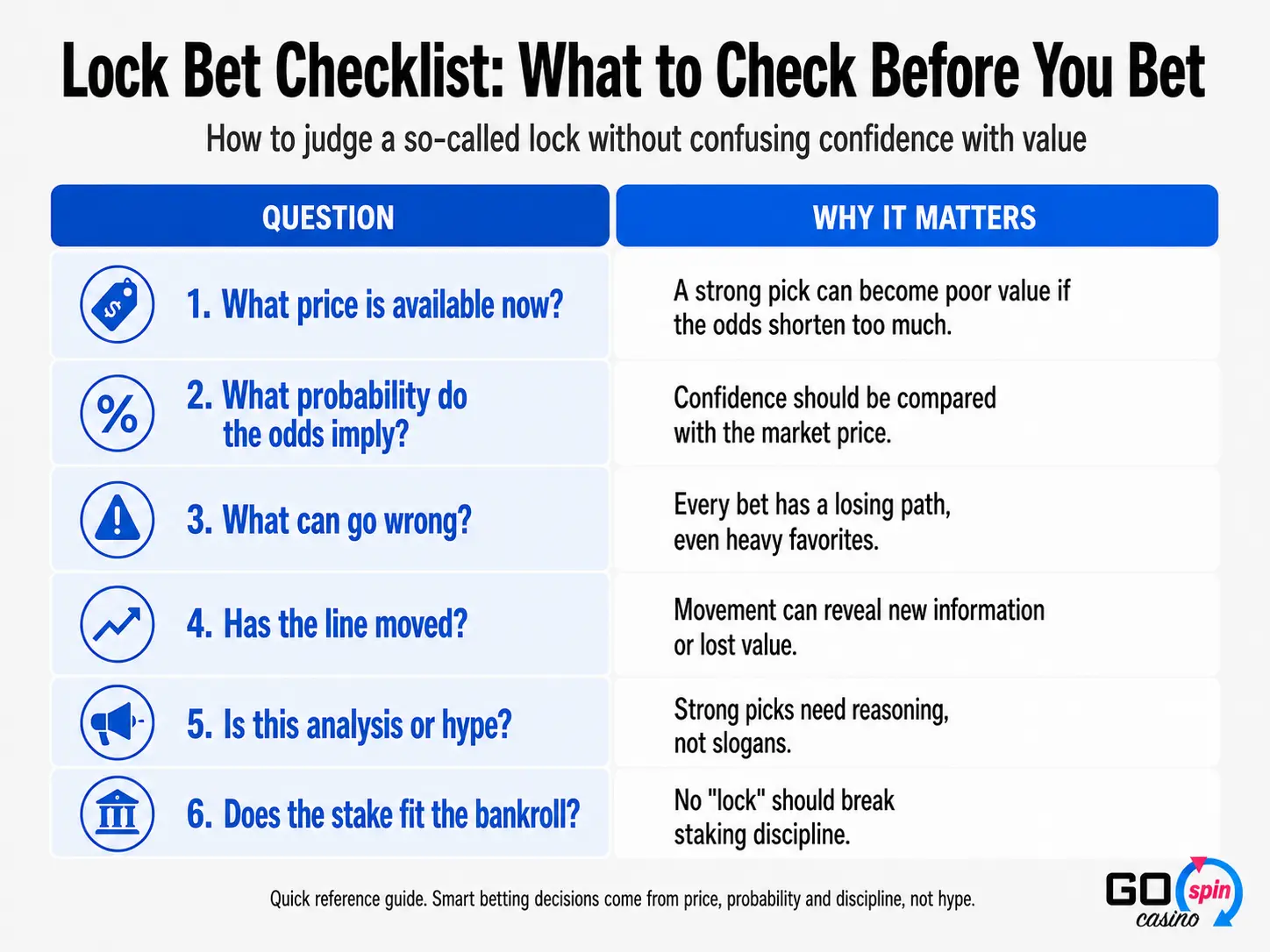
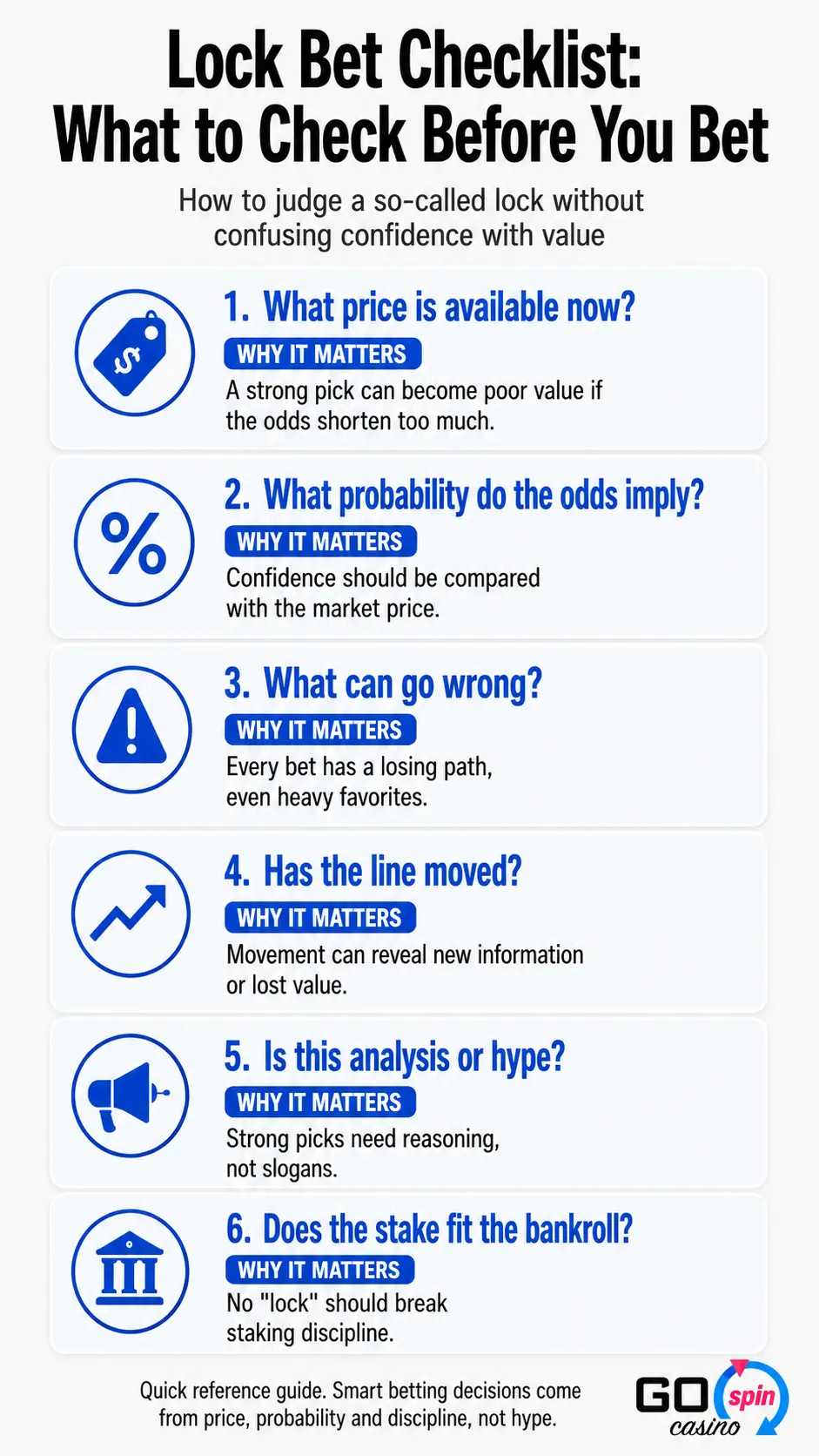
This checklist works because it moves the bettor away from emotion. The question isn’t “does this feel safe?” The question is whether the bet still deserves a place in the plan.
The wagering requirement forces €/$8,000 in total bets. If the player uses slots with a 96% RTP, the expected loss from that wagering is roughly €/$320. Then the max cashout is only €/$50.
Line value is especially important. A pick might be attractive at +120, weaker at -105, and poor value at -140. The team didn’t change, but the price did.
Bankroll discipline matters too. If a player normally stakes one unit, a so-called lock shouldn’t suddenly become a five-unit bet because someone used stronger language. The risk hasn’t disappeared. Only the confidence has changed.
For more practical betting education, Go Spin Casino’s betting strategy guides are better tools than following lock picks blindly.
Better Terms Than “Lock” in Sports Betting
The betting world would be cleaner if players used lock less often. It’s dramatic, but it isn’t precise.
Better terms keep risk in the conversation.
UM high-confidence pick tells readers the bettor likes the selection without pretending it can’t lose.
UM aposta de valor focuses on the relationship between odds and true probability. That’s more useful because a bet can be valuable even if it loses, and poor value even if it wins once.
UM strong lean signals preference without overstating certainty.
UM best bet can identify the top selection on a card, while still leaving room for variance.
UM plus-EV position points toward long-term expected value, not one isolated result.
UM banker can describe the leg a bettor trusts most in a parlay, but it should still be treated as a risk-bearing selection.
None of these terms guarantee profit. They’re better because they encourage sharper thinking. They keep the focus on probability, pricing, and repeatable decision-making.
“Lock” does the opposite. It turns uncertainty into a slogan.
Final Take: A Lock Is Confidence, Not Certainty
The lock betting term is popular because it makes uncertainty sound safe. That same framing can mislead bettors when confidence starts to feel like protection. A bet can be well researched, strongly priced, and backed by smart reasoning, but it still can’t be made immune to injuries, market movement, variance, or bad game flow.
The better habit is to treat every “lock” as a prompt to slow down. Check the odds. Question the price. Look for what could go wrong. Keep the stake inside the bankroll plan.
Before following the next “guaranteed” pick, build a stronger betting base with Go Spin Casino’s guides and compare trusted betting sites only when the risk, price, and bankroll fit your plan.
FAQ About the Lock Betting Term
A lock in betting is slang for a pick someone believes is almost certain to win. It isn’t a guaranteed outcome and should still be treated as a risky wager.
Some bettors use lock to imply certainty, but no sports bet is truly risk-free. Injuries, variance, line movement, and game events can break even the strongest-looking pick.
Tipsters selling “lock” picks should be treated carefully. Strong betting analysis should explain odds, probability, context, and risk. Guaranteed language is often a marketing tactic, not proof of an edge.
Better terms include high-confidence pick, value bet, strong lean, best bet, or plus-EV position. These terms allow for risk instead of pretending a bet is guaranteed.
Bettors sometimes call one selection the lock or banker of a parlay because they see it as the safest leg. That still doesn’t make the parlay safe, because one losing leg can break the full ticket.