

What does relegated mean in soccer? It means a team is demoted to a lower division after finishing near the bottom of the league standings. Unlike in American sports, where a bad season usually leads to a better draft pick or a rebuild, soccer teams can actually lose their place in the league. That threat is what makes relegation such a powerful part of the football league structure.
For American sports fans, relegation can sound brutal the first time they hear it. And honestly, that’s because it is.
In the NFL, NBA, MLB, NHL, or even MLS, a last-place finish might bring a better draft pick, a new coach, or another year of selling fans on “the process.” In soccer, a bad season can cost the club its place in the league.
This is one of the reasons European football feels so alive from top to bottom. The title race matters, of course. But the bottom of the table has its own electricity. A club in 17th place can be playing with the kind of fear and urgency you’d normally associate with a final.
That’s why relegation matters for fans, clubs, sportsbooks, and anyone watching the business side of the game. It affects revenue, player contracts, sponsorship value, fan pressure, and betting markets. Once a team gets pulled into a relegation battle, every fixture starts carrying more weight.
Soccer tiers don’t just reward winners. They punish failure. That pressure is exactly what makes the system so addictive to follow.
Table of contents
- Relegation in Simple Terms
- How Relegation Works in Soccer
- Promotion and Relegation Explained
- Soccer Tiers and the Football League Structure
- How Relegation Works Across Europe’s Top Leagues
- Why Relegation Feels So Different From American Sports
- What Is a Relegation Playoff in Football?
- Does MLS Have Relegation?
- Why Relegation Matters for Bettors and Sharp Fans
- Final Thoughts: Relegation Makes Every Match Matter
- FAQs About Relegation in Soccer
Relegation in Simple Terms
Relegation means a team has been moved down to a lower division because it performed badly enough over a full league season.
Simple on paper. Savage in practice.
If a club plays in the Premier League and gets relegated, it drops into the EFL Championship the following season. If a club is relegated from La Liga, it falls into Spain’s second tier. The rules change slightly from country to country, but the principle stays the same: league status has to be earned.
That’s the key difference for American readers. In the NFL or NBA, a terrible season can hurt pride, wreck momentum, and cost people their jobs. But the franchise keeps its league spot. In soccer, the punishment goes further. The club can lose the division it plays in.
And once you understand that, the whole table looks different.
How Relegation Works in Soccer
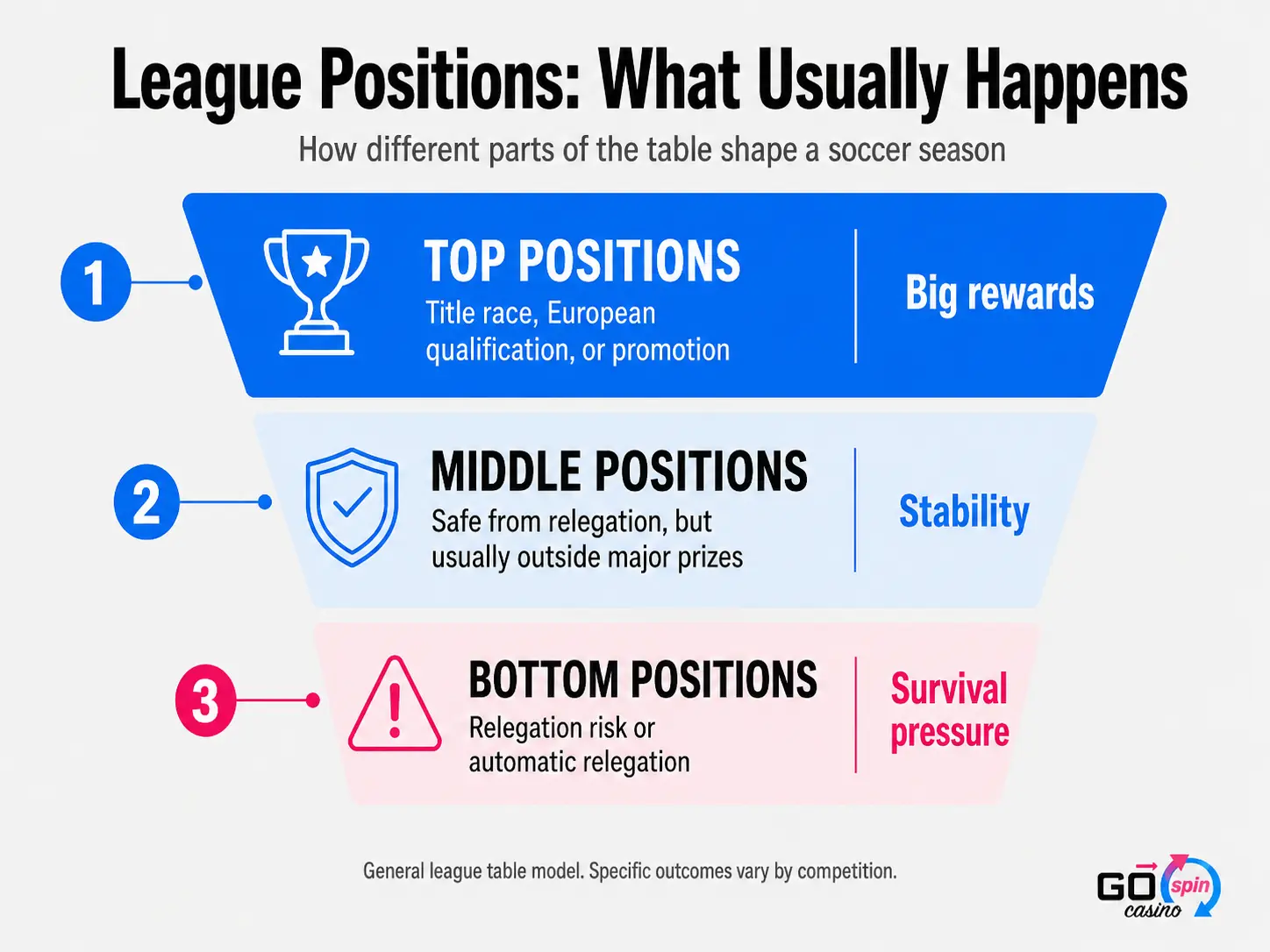
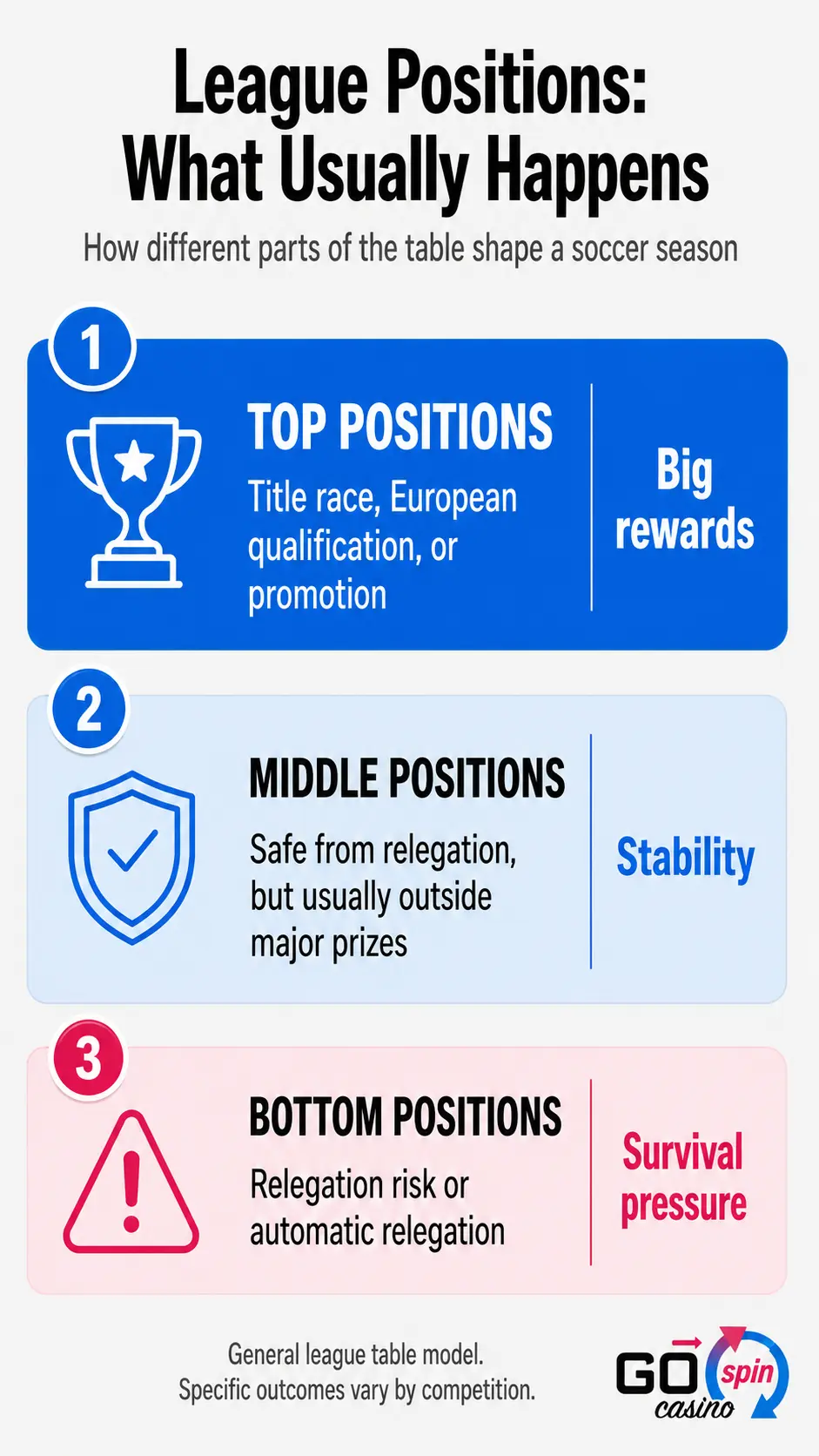
Relegation usually comes down to the final league table.
Teams earn 3 points for a win, 1 for a draw, and nothing for a loss. At the end of the season, the teams at the bottom of the table are relegated. In many leagues, that means the bottom 3 clubs go down. In others, it might be 2 automatic relegation places plus a playoff spot.
That’s where the drama lives. The gap between survival and relegation can be one late goal, one bad VAR decision, one injury crisis, or one ugly away defeat in April. From a betting perspective, those margins matter because the market can move fast when teams are separated by only a few points.
That bottom section is usually called the relegation zone. You’ll also hear people talk about the “relegation table,” which usually means the lower part of the standings where clubs are trying to avoid the drop.
Once a club falls into that zone late in the season, everything changes. The manager’s job gets hotter. Players tighten up. Fans start checking rival fixtures like they’re reading a trading screen. Odds shift quickly, especially in relegation markets and late-season match betting.
A mid-table match in April can be flat. A relegation six-pointer in April is a different animal. Search demand changes, betting intent sharpens, and sportsbook users start looking beyond the usual title and top-four markets.
Promotion and Relegation Explained
Relegation only really makes sense when you pair it with promotion.
Soccer tiers usually work like a ladder. The worst teams in one division move down, while the best teams from the division below move up. That movement is called promotion and relegation.
If 3 clubs are relegated from the top tier, 3 clubs usually replace them from the second tier. That keeps the league moving and gives lower-division clubs a real path upward.
That’s what makes the system so sharp. It punishes bad seasons, but it also keeps ambition alive below the top level. A small club can climb. A famous club can fall. The badge matters, but it doesn’t protect you forever.
A second-tier team can win promotion and suddenly land on bigger TV screens, bigger betting boards, and bigger commercial conversations. That’s part of what makes the football league structure so different from the closed-franchise model Americans are used to. Promotion is the dream. Relegation is the trapdoor.
Soccer Tiers and the Football League Structure
Most major soccer countries use a pyramid-style structure. At the top, you have the biggest league in the country. Below that, second division. Then third. Then fourth. Below the professional tiers, there are often semi-pro and regional leagues.
England is the easiest example for American fans because the pyramid is famous:
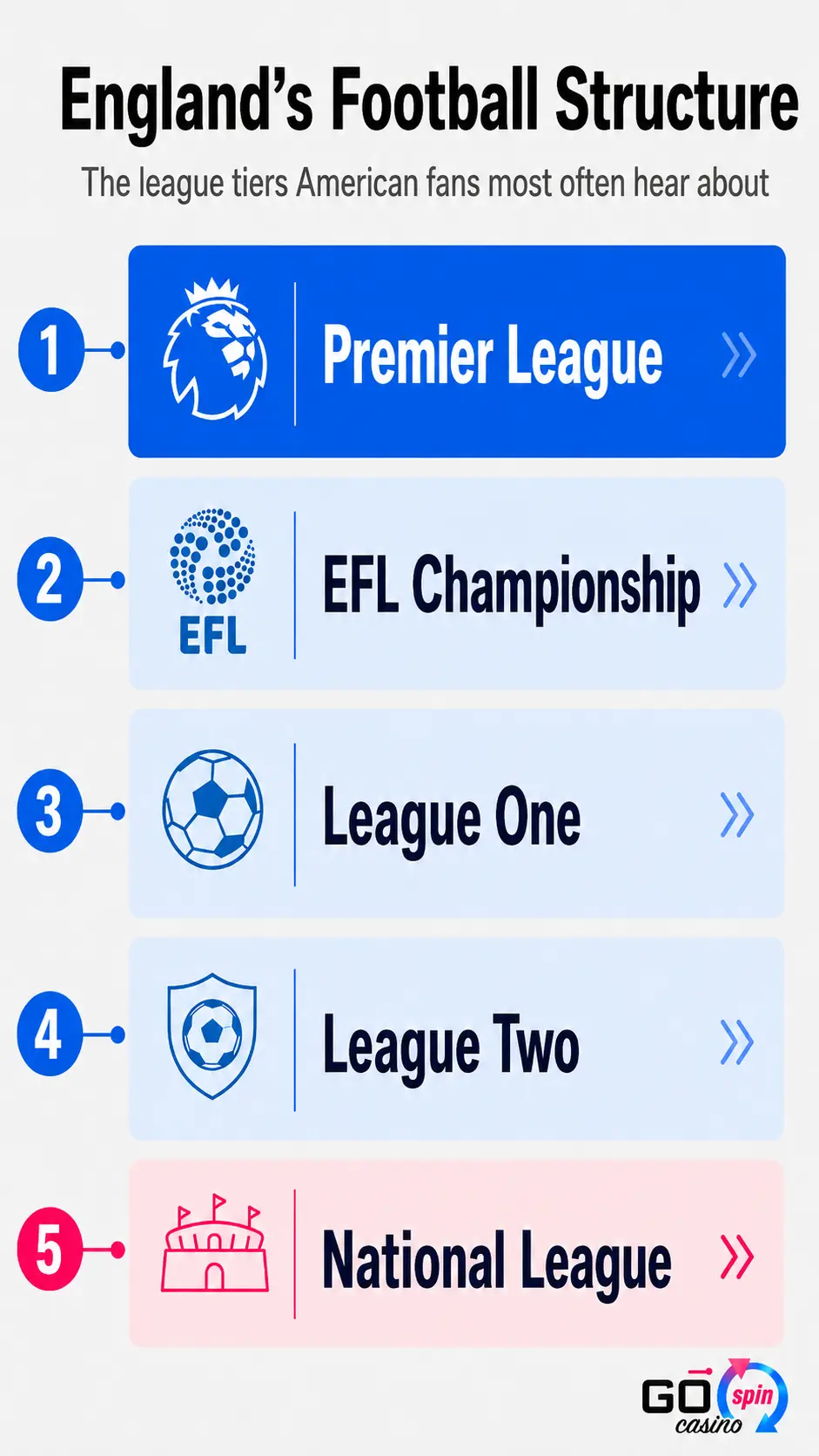
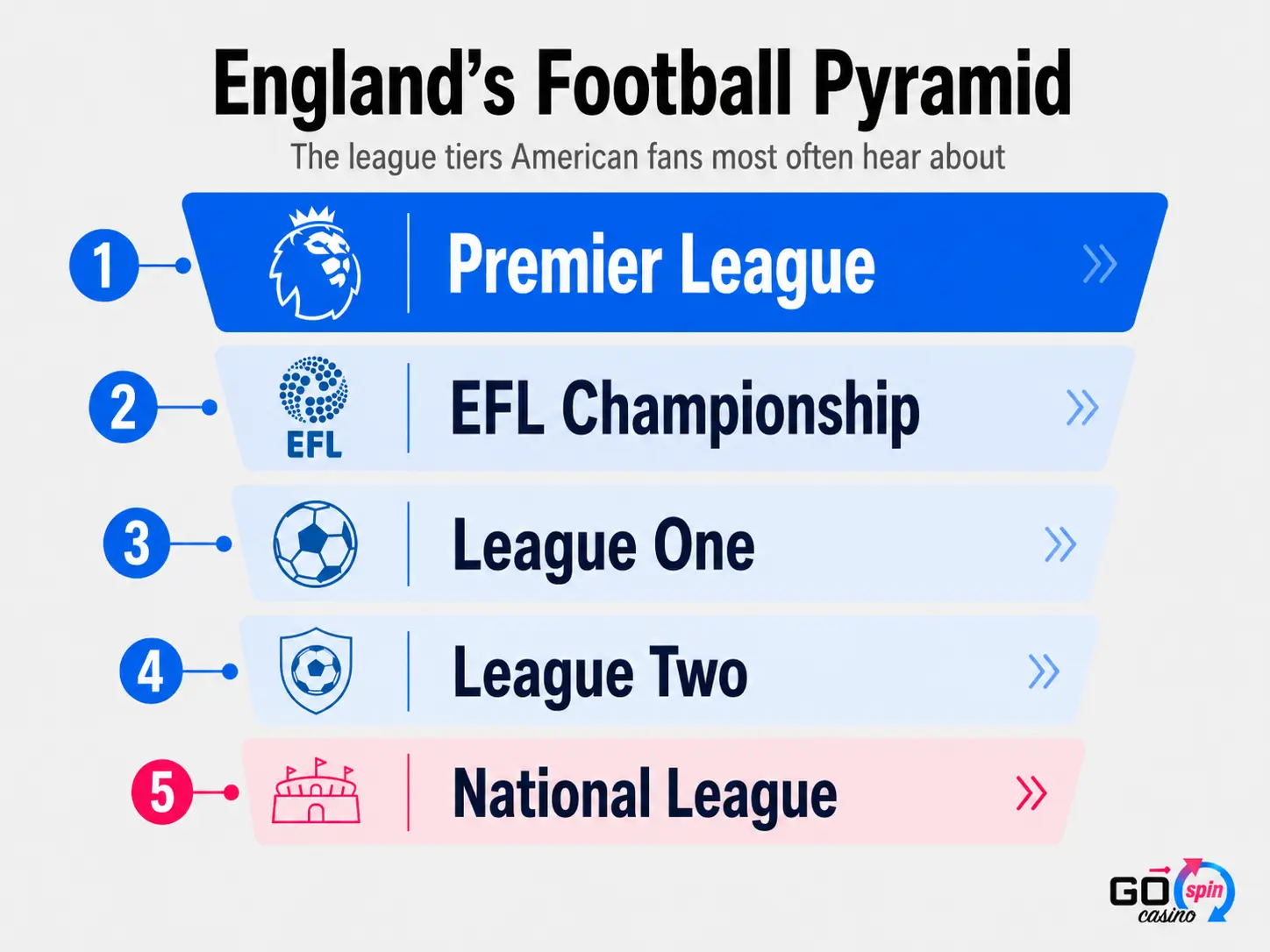
The Premier League gets the global spotlight, but the clubs below it aren’t filler. They’re fighting to climb.
The Championship, for example, has 24 clubs and usually plays a 46-match league season, which makes promotion races and relegation battles feel like a long, physical grind.
A promoted club moves into a 20-team Premier League season with 38 matches, 19 at home and 19 away. That jump is not just sporting. It’s commercial.
According to Deloitte’s 2025 Annual Review of Football Finance, Premier League clubs generated £6.3 billion, roughly €7.3 billion or $7.9 billion in revenue in the 2023/24 season. Championship clubs generated £958 million in aggregate revenue in the same season. That gap explains why promotion can change a club’s entire plan, and why relegation can wreck one fast.
That’s what makes soccer tiers so different from something like the NBA and G League. The G League supports NBA franchises. It doesn’t replace them in the standings. In soccer, a lower-tier team can actually take a higher-tier team’s place if it earns promotion.
Imagine if the worst MLB teams had to spend next season in Triple-A, while the best Triple-A teams took their place in Major League Baseball. It’s not a perfect comparison, but it gets the feeling across fast.
How Relegation Works in the Premier League
The Premier League is the example most American fans hear about first.
There are 20 clubs in the Premier League. Each team usually plays 38 league matches, 19 at home and 19 away. At the end of the season, the bottom 3 are relegated to the EFL Championship.
They’re replaced by 3 clubs from the Championship. Usually, that means the top 2 go up automatically, and 1 more club earns promotion through the Championship playoffs.
For relegated Premier League clubs, the drop can be savage. They go from playing Manchester City, Liverpool, Arsenal, Chelsea, Manchester United, and Tottenham to grinding through a longer, tougher Championship schedule.
It’s not just a step down in profile. It’s a completely different business environment.
That’s where parachute payments come in. These payments are designed to soften the financial crash after relegation. Without that mechanism, the gap between Premier League money and Championship money would be even more brutal. Even with it, relegated clubs often have to cut wages, sell players, or restructure quickly.
That’s why “staying up” is a phrase you’ll hear constantly near the end of the season. It means surviving relegation and keeping your place in the league.
How Relegation Works Across Europe’s Top Leagues
The Premier League is the easiest example for American fans, but it’s not the only model. Across Europe, relegation follows the same basic logic, with small format differences that matter late in the season.
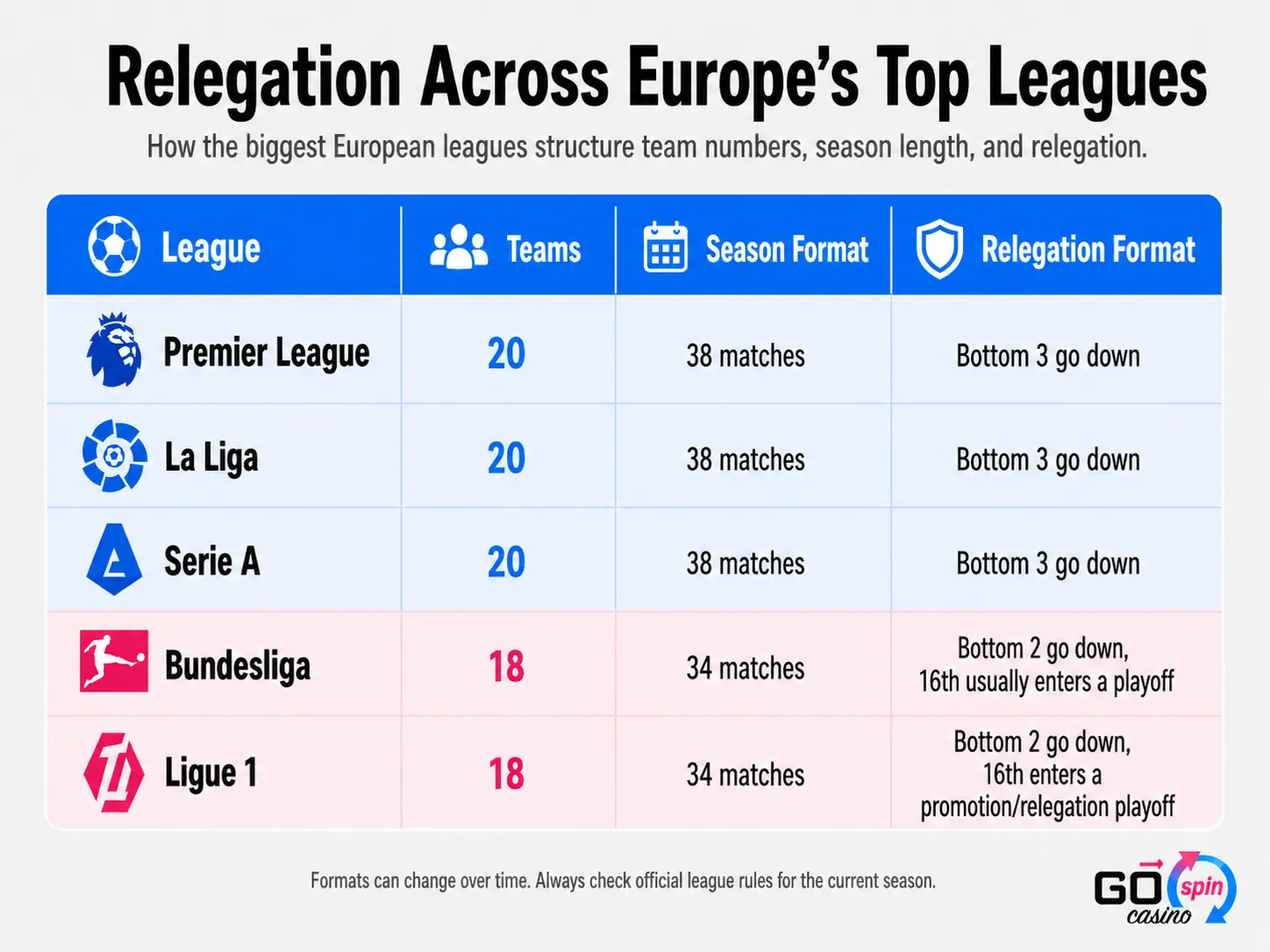
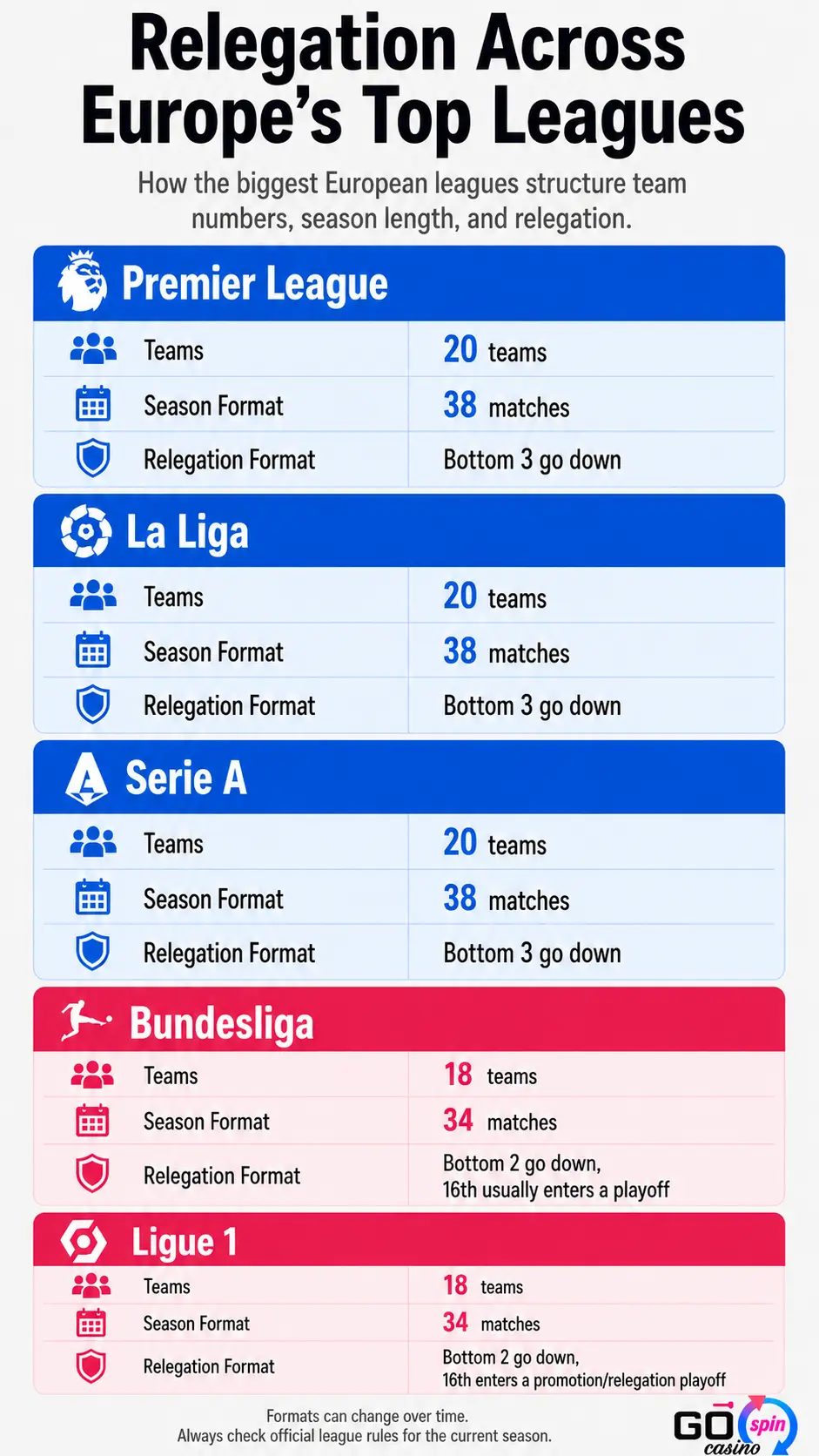
This is where casual explanations can get sloppy. England, Spain, and Italy are fairly similar at the top level, with 20 teams and 3 automatic relegation spots. Germany and France are different.
The Bundesliga has 18 teams, 34 matches, 2 automatic relegation places, and a playoff route involving the team that finishes 16th. Ligue 1 also uses an 18-team, 34-match format, with the 16th-placed side entering a promotion/relegation playoff rather than automatically dropping.
For fans, those small structural differences matter. A club in 16th place in the Premier League is usually safe if the bottom 3 are locked below them. A club in 16th in the Bundesliga or Ligue 1 may still have to survive a playoff.
For bettors, that difference matters too. A league with a playoff creates different incentives in the final weeks. A team might not be fighting only to escape automatic relegation. It might be fighting to avoid the playoff spot.
What Happens When a Soccer Team Gets Relegated?
When a soccer team gets relegated, it plays in a lower division the next season. That sounds simple, but the business impact is usually much bigger than the league table suggests.
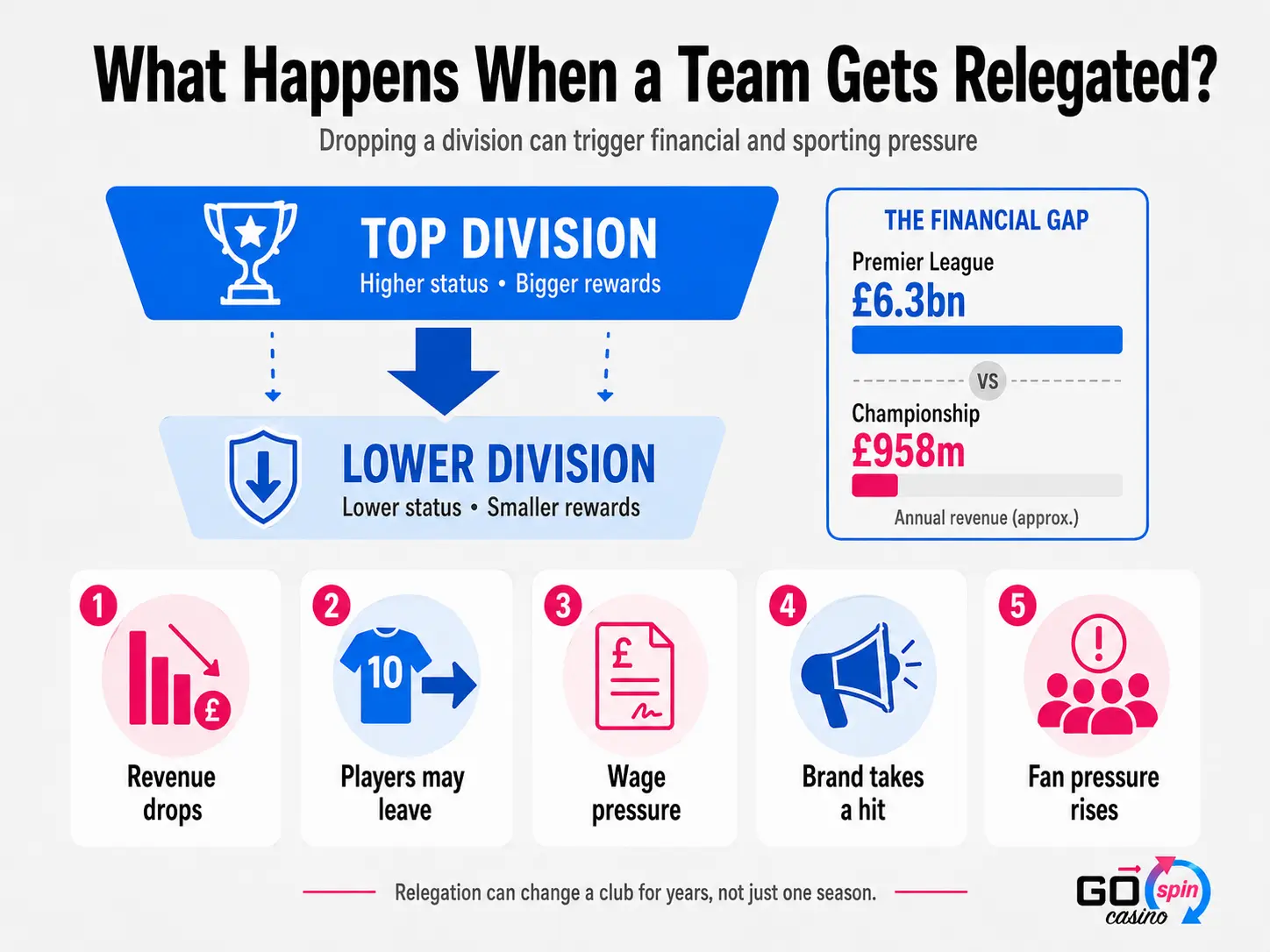
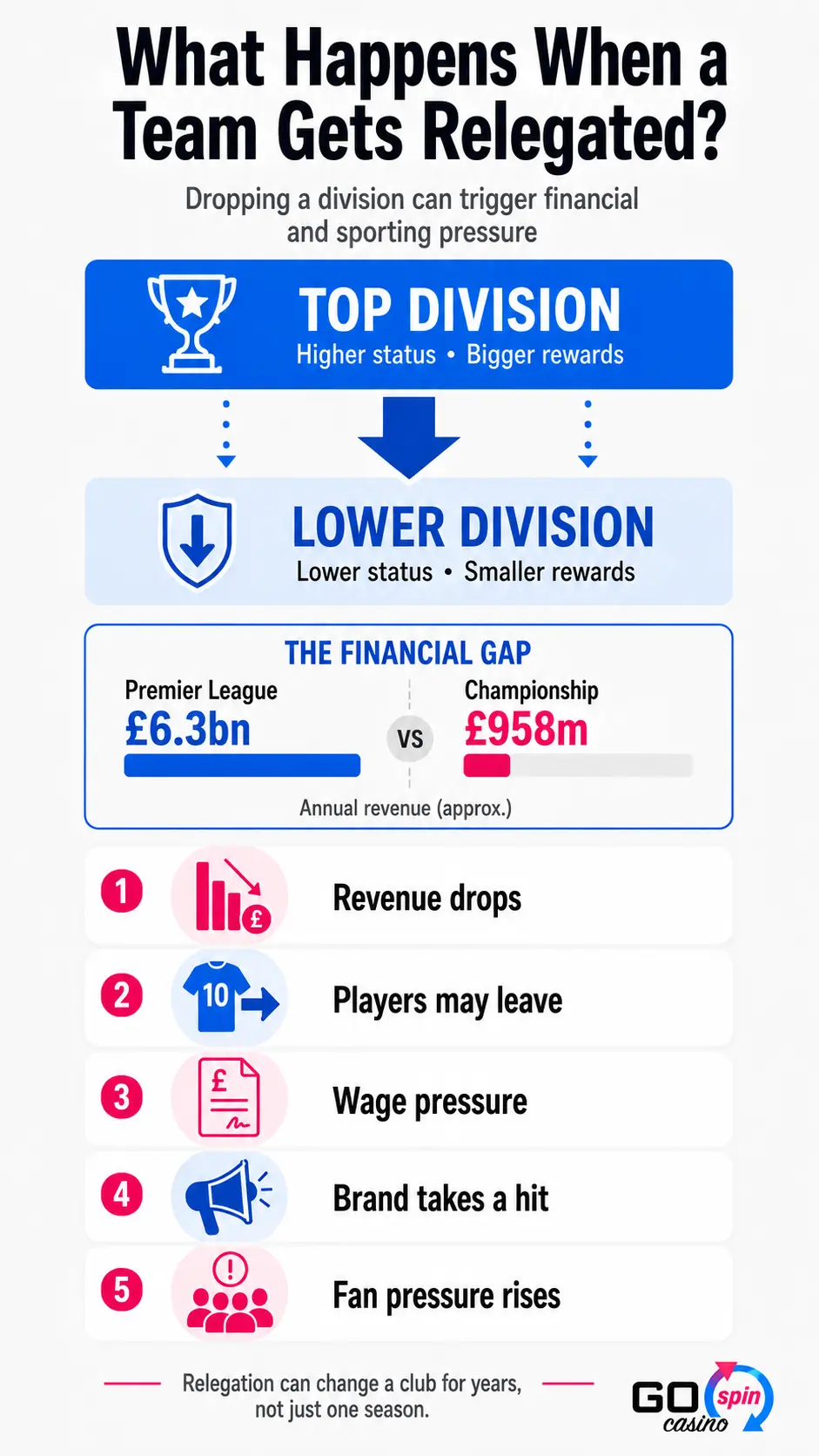
Revenue is normally the first hit. Deloitte reported £6.3 billion in Premier League club revenue for 2023/24, compared with £958 million in aggregate Championship revenue. That’s not just a smaller competition. It’s a different operating universe.
The financial drop can force fast decisions. Players may leave, wage bills become harder to manage, commercial visibility falls, and fan pressure rises quickly. Some contracts include relegation clauses, while other players may be sold simply to bring costs under control.
The club’s brand can shrink too. Sponsors, broadcasters, and casual fans usually pay more attention to top-flight clubs, so relegation can push even a famous team out of the main weekly conversation.
Some clubs handle the drop well and come straight back up. Others spiral. Relegation is not always a one-season problem. It can change a club’s direction for years.
From a betting perspective, relegated teams are tricky the following season. Don’t just look at the badge. Look at squad movement, wage pressure, manager stability, and whether the market has already priced in the bounce-back story.
Why Relegation Feels So Different From American Sports
This is where relegation really clicks for American fans.
Most major American sports leagues are closed systems. NFL teams don’t get sent to a lower league. NBA teams don’t drop into the G League. MLB teams don’t get replaced by Triple-A clubs. NHL teams don’t lose their league membership because they had a terrible season.
A bad American season can still hurt. Coaches get fired. Players get traded. Fans get angry. But the franchise stays in the league.
Soccer is different. In many countries, league status is earned every year.
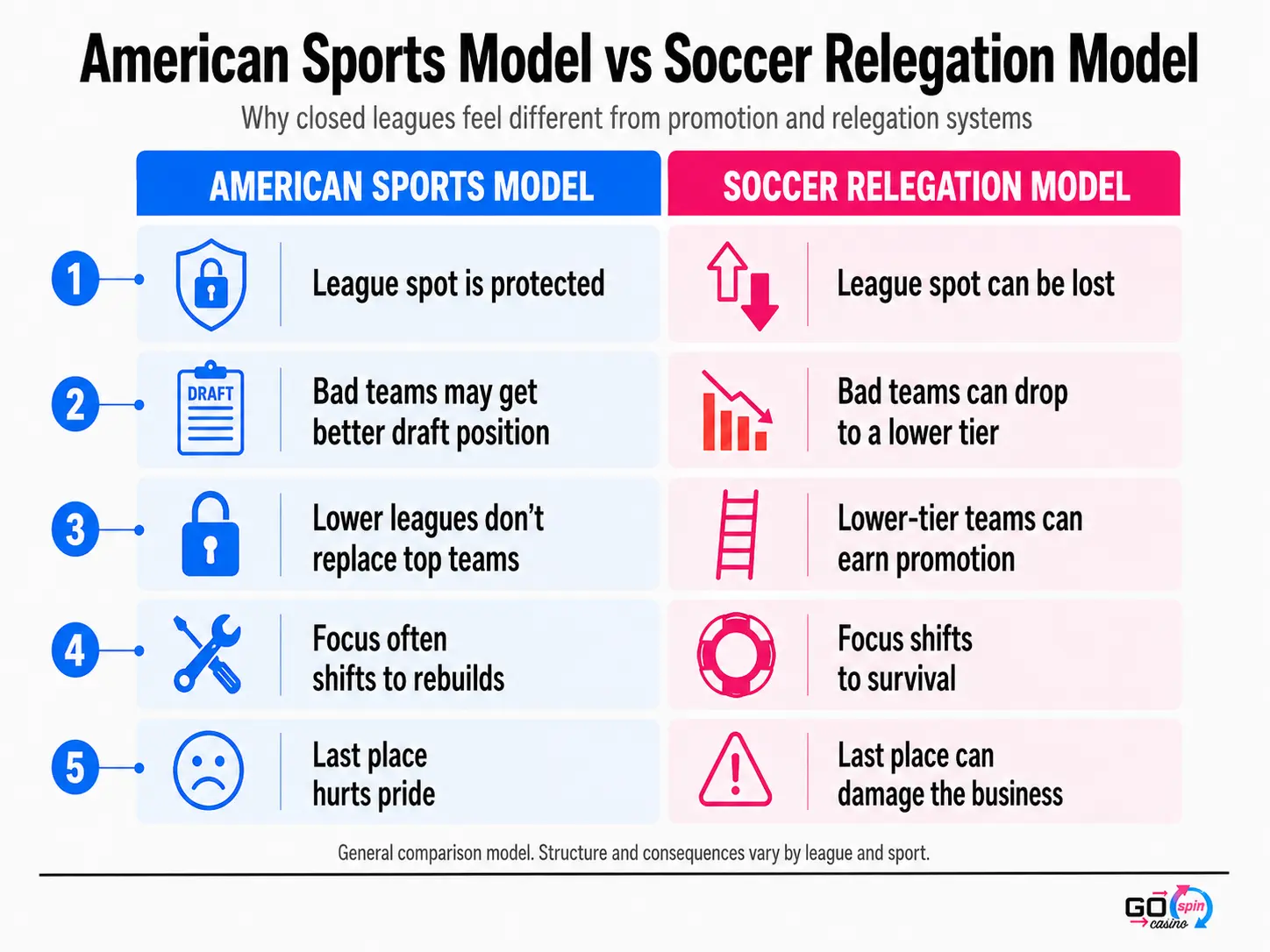

Relegation gives the bottom of the table teeth. It turns a bad season into an existential problem.
That’s why a 17th-place club can be playing the most important match of its season while the league leaders are already cruising. The glamour might be at the top, but the desperation is often at the bottom. And desperation makes great sport
What Is a Relegation Playoff in Football?
The Championship playoff final deserves its own mention because it sits right between promotion, relegation, and football finance.
The winner gets the final promotion place to the Premier League. The loser stays in the Championship.
That one match is often called the richest game in football because promotion can unlock Premier League broadcast revenue, sponsorship lift, higher ticket demand, and stronger commercial visibility.
Reuters described the 2026 Championship playoff final as a match valued at approximately £200 million in revenue. That kind of number explains why playoff final nerves feel different. It’s not just a trophy match. It can rewrite a club’s next 3 to 5 years.
These games are also interesting because they don’t behave like normal fixtures. Betting interest is broad, emotion is high, and casual bettors often pile into obvious narratives. That’s exactly when price discipline matters.
Does MLS Have Relegation?
No, MLS does not currently have promotion and relegation.
Major League Soccer works more like the major American sports leagues. Clubs are part of a closed league structure, and they don’t drop into a lower division because of poor performance.
That’s why relegation can feel strange for American fans who mostly follow MLS or traditional US sports. The model is different. MLS focuses on franchises, conferences, playoffs, expansion, roster rules, and long-term league growth. European football, and many other global soccer systems, use league pyramids where movement between tiers is part of the competitive structure.
There’s ongoing debate around whether promotion and relegation would ever work in the United States. Some fans love the idea because it adds stakes. Others point to the business structure of American sports, franchise fees, travel distances, stadium investments, and media deals.
MLS does not use relegation right now, but many major soccer leagues around the world do.
Why Relegation Matters for Bettors and Sharp Fans
When a team is fighting to stay up, motivation becomes easier to read but harder to price correctly. That’s where sharp fans and bettors should slow down rather than chase the obvious story.
Fixture difficulty matters. A club with 3 winnable home games left is in a different spot than a club still facing the top 4.
Goal difference matters too. Sometimes a team doesn’t need to win by 3. It needs a draw, or it needs to avoid a heavy defeat.
Manager changes can also move the market. Clubs near relegation often sack managers late, hoping for a short-term bounce across the final 6 to 10 matches.
Squad morale matters more than people admit. Some teams fight. Some crack. You can often see it in pressing intensity, defensive mistakes, and body language.
Market movement can be sharp. Odds for “to be relegated” can swing after 1 result, especially when teams are separated by only 1 or 2 points. In the final 5 to 8 rounds of a season, team news, a rival’s late goal, or a red card can shift prices fast.
That doesn’t mean you should blindly back desperate teams. Desperation isn’t value. Plenty of bettors overrate “must-win” spots and ignore quality, injuries, or tactical mismatch.
The smarter read is this: relegation pressure adds context. It doesn’t replace analysis.
If you’re betting on soccer, treat relegation battles like high-volatility spots. Check team news, table position, remaining schedule, recent performance data, and whether the market has already overreacted.
This is also where user intent gets sharper. Bettors aren’t just browsing generic match odds. They’re looking for relegation markets, live betting, cashout, competitive football pricing, and sometimes FTD-focused offers around major fixtures.
If you follow European football and want to bet on relegation battles, look for platforms that cover the full league table, not just title races and Champions League markets. Relegation odds, live betting, cashout options, and competitive football markets can all matter late in the season.
Final Thoughts: Relegation Makes Every Match Matter
Relegation is one of the best parts of global soccer because it makes failure real.
The top of the table has glory. The bottom has fear. A title contender may be chasing silverware, but a 17th-place team might be fighting to protect tens of millions in revenue, keep its best players, and avoid a full sporting reset.
These markets are emotional, messy, and full of context. They also punish lazy analysis. A “must-win” team is not automatically a smart bet, just like a huge welcome bonus is not automatically a good casino offer if the wagering terms are bad.
For American fans, the concept can feel strange at first. But once it clicks, it changes how you watch the sport. A match between 2 bottom-half teams isn’t filler. It might be a survival fight. A draw might feel like a win. A late goal might save a season.
Relegation turns the table into a pressure map.
18+ | Play Responsibly. If betting stops feeling like entertainment, step back and read our responsible gambling guide before placing another wager.
FAQs About Relegation in Soccer
Being relegated in football means a club drops from its current division to a lower division after finishing near the bottom of the league table.In American terms, imagine a team losing its place in the top league for next season because it performed badly enough over the full campaign. That’s relegation.
A relegated soccer team plays in the lower division the following season. It may also lose broadcast revenue, sponsorship value, players, and global visibility. The club then has to rebuild and try to win promotion back. Some teams return quickly. Others struggle for years.
A relegation playoff is a match or series used to decide whether a club stays in its current division or drops to a lower one. Some leagues use playoffs instead of, or alongside, automatic relegation. These games can be intense because 1 result can decide a club’s entire next season.
No. MLS does not currently use promotion and relegation. It operates as a closed league, similar to the NFL, NBA, MLB, and NHL. MLS teams do not drop into a lower division because they finish near the bottom of the standings.
In La Liga, the bottom 3 teams usually drop from Spain’s top division to the second tier after a 38-match season. The broader idea is the same as in England: top-division clubs must perform well enough to keep their place, while strong lower-division clubs can earn promotion.